RepublicTigerSports.com

During the early days of what we then called the “World Wide Web,” there was a mood of “digital entrepreneurism.” Anybody with a minimum of technical skills could create a website. Later, when blogs became a thing, it got even easier. You could start your own newspaper or magazine or — when the bandwidth got better and the tools easier — audio and video. Anyone could create their own “content” and do so for fun or profit. That was the dream and a few made it a reality.

One of those was my friend David Brazeal. David grew up in Republic, Missouri, a small town just outside of Springfield in the southwest corner of the state. He earned a degree in journalism from the University of Missouri and then reported news at a radio station in Jefferson City, MO.

That’s where I met him and then worked with him at Learfield Communications. David started in the newsroom but migrated to some of Learfield’s early, digital businesses. He was very good at what he did but eventually grew restless and longed to strike out on his own. His idea was to create a website that covered high school sports in his hometown.

With his wife’s blessing, he quit his very good job at a very good company and started RepublicTigerSports.com in 2009. David has defied the odds and made his “micro-site” a critical and financial success. I think it’s safe to say he covers high schools sports in Republic better than any traditional media outlook could or would. The town does not have a radio or TV station but does have a weekly newspaper.
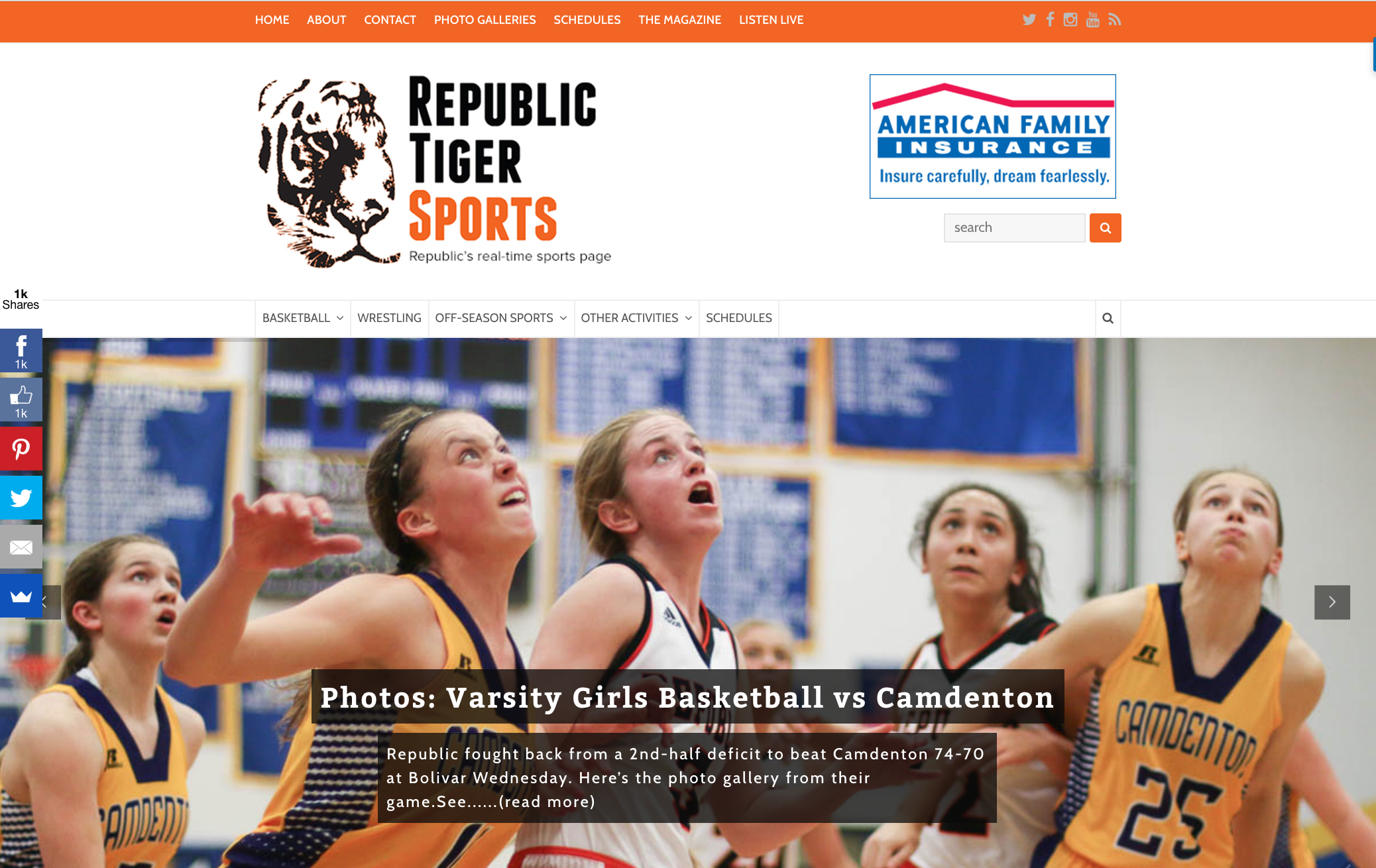
I don’t think I could begin to describe the breadth and depth of the content on his site. If you are even remotely interested in what he’s doing, spend 10 or 15 minutes on the website. If you’re still interested, you might enjoy listening to the interview below. Runs about 35 minutes.
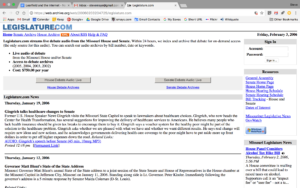
Legislature.com

In 1996 (maybe 1997) I was involved in the first effort to stream audio of floor debate from the Missouri legislature. It was early days for streaming and the audio sounded pretty shitty. We had very limited bandwidth and the first RealAudio encoders were primitive. But it was the first time anyone could listen to live debate without being in the Capitol building (where they had audio lines to each rep’s office).

That first year I think we only streamed live but the following year we started archiving the audio as well. That, however, was nearly useless if you were trying to find a particular piece of debate in audio files that could run five or ten hours.

Not sure I can explain this but what we did was insert links to specific points in the debate (not unlike how we now create YouTube links that jump you X minutes into the video). I spent hours doing this before I dumped it on an assistant. But it allowed someone that wanted to hear debate on House Bill 123 to click a link and get pretty close. Unbelievably tedious.

We provided this service at no charge for a year or two and then started charging $500 per session. Lots of takers, mostly lobbyists and lawyers. We bumped it to $750 the next session and lost a few subscribers. It wasn’t long after that that the House and Senate Information Offices took this service over and we were out of business. It wasn’t a good “business” business but it offered a hint of what would be coming down the road in terms of streaming.

If you’ve never listened to floor debate of a state legislature, it’s hard to describe how boring this shit was. As streaming tech got better, someone would suggest they stream video and they’d take a shot at that, usually on the final day of the session. On one such attempt they had to pull the plug quickly because the cameras were showing members dozing at their desks.

Once people saw that we could actually do this, we started hearing grumblings about the audio archives. It was explained to me this way: Since the dawn of time, the House and Senate journals were the official record of what happened in the respective chambers. But those records could be amended. So if one member called another member “a lying motherfucker,” that got stricken from the official journal. But but not from our audio archives. This made lots of folks very uncomfortable and — ultimately — led to the legislature taking over. I always assumed some poor schmuck got stuck with editing those monster audio files.

UPDATE: I failed to mention the important role Phil Atkinson and Charlie Peters (and the people that worked with them) played in this (and other) digital project. I’d ask, “Wouldn’t it be cool if we could…” and in a few days (or hours!) they found a way to do it.

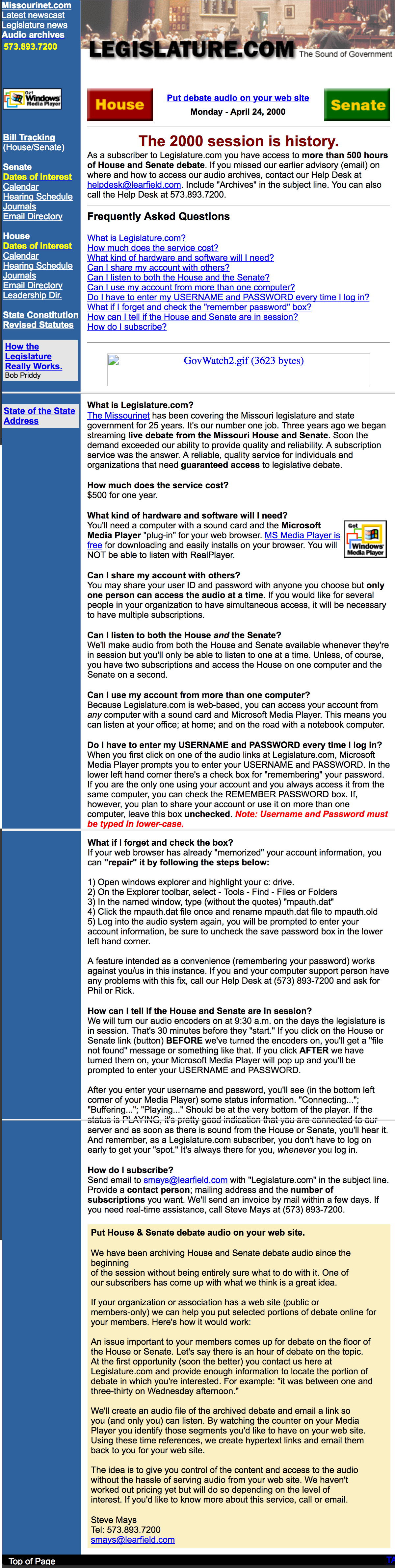
ANOTHER UPDATE: This was our first web page for this project. Really ugly, and really long.

The SMAYS Award

smays-award

The company I worked for holds an annual meeting of their sales reps that includes an awards ceremony. The awards are called the Clydes in honor of the company founder (Clyde Lear). Sort of like the Oscars but, well, the Clydes. One of the categories — Digital Sales — is named after me. I was pretty annoying in the late 90’s and early 00’s on the subject of the Internet. Lots of eye rolling back then, big part of the company’s revenue today. This is, I’m convinced, a short-lived vanity. It already seems odd to refer to something as digital when everything is, and has been, digital for a long time.

White Horse Pub, UK

Keith Povall has been an online pal for years. He lives in Walsall in the UK where he and his mate (that’s the way they talk) Wally the Welder frequent the White Horse pub, a traditional pub that Keith says is quickly dying out. So we decided to visit (via Google Hangout). I love all things British and could listen to these guys talk for hours. A few minute should be enough for most folks. I share my poorly produced video here for archival purposes.

When the net was young

A couple of nights ago I was browsing through some old Day-Timers (calendars) and came across a few memories from 1994:

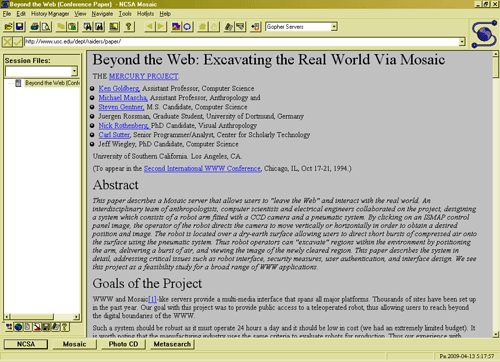
April 26 – A meeting with some folks at MOREnet and the University of Missouri J-School. My first look at a web browser (Mosaic). I was blown away. The Internet was a very different creature before the browser.

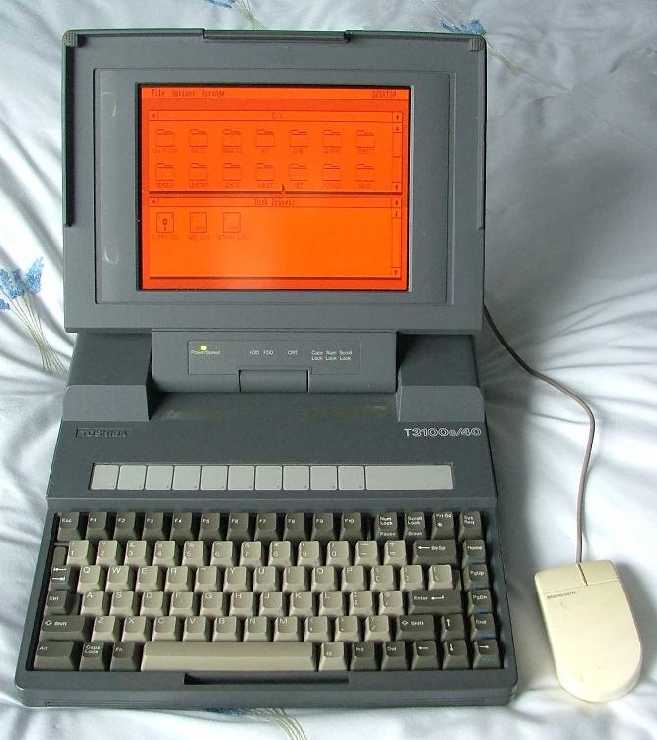
June 20 – Sent check to someone named Bill Bahr a check for $1,700 for a used Toshiba notebook computer. Base price was $1,400 plus $300 for a fax/modem PCMCIA card.

I think it was this one. It was a heavy mother but I was giddy at the idea of being able to take a computer with me on the road.

“Internet thing” catching on

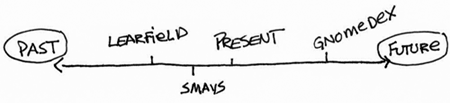
Five years ago I used this elaborate timeline to illustrate where I saw myself in relation to others in terms of technology awareness. A little out front (at the time) of most of our company… waaay behind the Smart Kids.

For much of the past 15 years I’ve been annoying people (mostly at work) with the latest gadget or –more recently– app. There were early adopters like me; others who would get on board once they clearly saw some proven value to their current job; and still others who jammed their fingers in their ears, chanting “la la la la la la I can’t HEAR you!”

This group always referred to “the Internet thing,” and to this day think Twitter is about what you had for lunch.

But something has changed. People are starting stop by my office or my table at the Coffee Zone and ask for a crash course in all this stuff I’ve been yapping about. It’s as though they woke up one morning and realized, “Shit! I’m way behind!”

Let me hasten to add, there is NOTHING I know that any reasonably intelligent person can’t pick up. But just as you can learn to speek Italian from a series of CD’s, you won’t really understand the language until you live in Genoa for a few years. It’s a cultural thing.

If I had to guess at what has brought this on –if, indeed, something has changed– I’d say it’s the iPhone and the iPad. The web has moved from your desktop (which you leave behind every night at 5 o’clock) to your pocket.

These latter day Luddites are hearing more and more expressions (from customers!) the meaning of which they have only the vaguest idea.

I’m doing my best to purge any “I told you so” from my thinking, but the simple truth is, a lot of these folks won’t catch up. They’re trapped on the wrong side of the digital divide. By the time they scramble up and over… everyone will have moved on.

Ehi, aspetta per me voi ragazzi!

The music of the 2050’s

My earliest memories of music are from the 50’s. If I described a song as having “a 50’s sound,” you’d probably understand what I meant.

I divide the next decade into Early 60s and Late 60s. The 70’s connote Disco for me. For some reason I don’t have any recollection of the music of the 80’s and 90’s.

So here’s my question for your musicologists out there:

How is that each musical era can sound not only different from the previous era, but from ALL previous eras? Will we have a period that repeats some earlier period?

If not, does this mean that it will get more and more difficult to create a completely fresh sound? How different will music sound to these disturbingly large ears in 30 years?

Covering election returns

Election night was a big night for radio station news departments. Or, they were back in the 70’s in the little town where I worked.

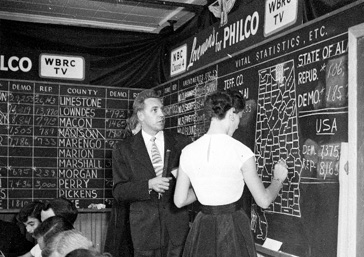
The candidates would crowd into the county clerk’s office and watch as the votes were written on a big chalk board. The radio station news guy would setup a small transmitter and send back updates that were broadcast live. You were either there… listened to us… or heard the results the next morning at the local coffee shop.

When I started working with The Missourinet (a statewide radio network) in the mid-80’s, it wasn’t that different. One of our reporters would set up at the Secretary of State’s office with a dedicated land-line (before cell phones). Maybe they used one of the state’s phones, I don’t recall. But the reporter would phone in regular updates to the network newsroom where they’d go out to affiliate stations around the state.

Sometime in the 90’s technology improved to the point where we could Telnet into the the state computers (via very slow modem’s) and access the numbers directly. And then report them over the network.

Fast forward to the Web. No more Telnet but those early websites were very glitchy. And slow. But they got better every election. It was a wonderful thing. Anyone with internet access could see the returns as they were tabulated. But it was still easier for radio stations (and their listeners) to take our reports than produce their own.

Last week one of our news directors stopped by my office to talk about what we would do online for the upcoming election. Missouri’s Senate race is the Main Event and we’ll have reporters at both candidates venue. They’ll do interviews and feed those back to the network where reporters will be working the Secretary of State’s website.

One the other end of the information pipe, people will still be listening to the radio and watching TV but I expect Twitter and Facbook to be where many get their first information. (Does the Secretary of State have a Twitter feed?). And most of it will be mobile.

Eventually we’ll all vote electronically, without standing in line. And we’ll see the results in near real time.

Will this elections more susceptible to fraud? Girl, please! Is the TSA making flying safer?