Living As A River by Bodhipaksa

living-riverFinding Fearlessness in the Face of Change


The ultimate act of letting go is to abandon the delusion that consciousness and the world are separate things.

Because we fear our own eventual extinction, we construct the idea of a permanent self.

(The Buddha) saw the self as composed of a number of ever-changing processes.

Knowing that I exist, it’s hard for me to imagine never having existed, and so in my own mind there’s a certain inevitability about my existence.

When we try to imagine death, what comes to mind is imagining an experience of nothingness, as if we’d still be around to have a non-experience. […] We simply cannot imagine not being able to experience anything at all, because experience is all we know, and so we’re forced to imagine experiencing non-experience.

Since we assume that the self existed before conception and will exist after death, we’ll inevitably imagine that it persists — unchanged — throughout life.

Once we start naming things, our language reinforces our underlying tendency to see them as fixed. We name things, and then we assume that because the name is static, so too is the thing named. The mind takes the language it uses to label reality as if it were reality.

It is (the) flow of events that constitutes what we call consciousness. Consciousness is not seen as being something separate that “has” experiences. Consciousness is the activity of experiencing.

The sage at peace recognizes that aging and dying are simply stories we weave for ourselves.

The opposite of suffering turns out not to be simple happiness, but something indefinable.

We may try to shelter ourselves from an awareness of impermanence by identifying with a nation or religion or with an abstract principle such as progress. […] To cling is to seek a stable refuge in the midst of a torrent of impermanence. […] The more our sense of well-being is dependent upon something impermanent, the more there is an undercurrent of fear. […] Fear leads to clinging, which leads to fear.

Insight is not the same as intellectual understanding but is a direct recognition of impermanence in our experience.

Everything that constitutes us is in fact a process, rather than a thing or object.

“Verbal thinking” – a scrolling tickertape of more-or-less connected words that streams endlessly through the mind.

(The body is) a process that has continuity rather than identity. […] There is no being, only becoming. There is no identity, only change.

In sensing my body as a river, I begin to realize that I do not know what I am. I begin to realize that there is nothing — “no thing” — to cling to or to identify with. One cannot hold onto a river.

If the earth were shrunk to the size of a soccer ball, the average depth of the ocean covering it would be sixty-five microns, or about twice the thickness of a grocery-store plastic bag.

Life is the sustainable self-organization of energy within the material world. […] Life itself is flow, and the energy of life cannot be grasped or possessed.

We need to hold definitions lightly, remembering that they are the map rather than the territory.

Despite Copernicus, we tend to think that we are at the center of the universe — that it all exists in order to serve us. But rather, we are scavengers of energy, peripheral to the vast processes unfolding around us.

Clouds make a good analogy for the illusory nature of the self. There’s nothing permanent in a cloud, just as there’s nothing permanent to be found in the self. The cloud is not separate from its environment, just as my self has no separateness. Just as the cloud lacks the essential qualities I assume a “thing” has, so too does my self lack the qualities I assume a self has. In looking at mists or a cloud; we can see a form, often with an apparently well-defined edge, and yet there’s nothing there that can be grasped. The fact that we name something a “cloud” often seems to create in the mind the assumption that the thing that’s being named is as static as the label applied to it. Often we’ll glance at a particular cloud and then look at it a short while later. Nothing much seems to have changed, because the human mind is not well-equipped to perceive change—especially not in something as amorphous as a cloud.

All concepts are simply labels superimposed upon the reality we perceive.

As we move toward the idea of abandoning the idea of a separate selfhood, we may need to go through a phase of treating the whole of creation as if it were us. […] Extend the idea of the self out far enough, and the idea of the self becomes meaningless.

As I sit breathing in my meditation practice, I might find myself wondering exactly at what point a particular molecule of air could be said to be “in” the body. Is it when it crosses some arbitrarily drawn plane enclosed by the rims of my nostrils? Is it once it’s crossed into the bloodstream? Or bonded to a molecule of hemoglobin? Any line I choose to draw would be purely arbitrary. I look for the boundary of my physical self and can’t find one.

Noticing how my gaze can often fixate on a narrow area in front of me, I become aware of the entirety of my visual field, allowing into awareness everything from the center of my visual field to the periphery. It’s like moving from a kind of “dial-up” connection between the world and my brain to a “broadband” one. Doing this generally has a very calming effect on my inner chatter, as if the sheer volume of incoming data I’m paying attention to leaves no bandwidth available for my inner dramas.

All experience takes place in the mind. […] We can know nothing beyond our sensory experience.

Consciousness is the activity of being aware of something. There can, by definition, be no consciousness separate from the things of which it is aware. […] We can never know objective things separate from our sense-impressions, which are interpretations rather than reality.

There can be no consciousness without something to be conscious of.

There is nothing stable within the mind. There is no permanent core. Perceptions, feelings, thoughts, and emotions are simply flowing through us, but are not us. Consciousness is an activity. It’s there when it happens.

Our identity depends on the internalization of the consciousness of others. Consciousness, like all the other elements, is therefore something that extends beyond the individual and that, in some sense, flows through us like a river.

Each event of cognizing is “a consciousness.” Since perceptions come and go, so too will consciousness come and go. Each response to a perception is another consciousness. There is no enduring consciousness, no permanent watcher at the helm of our being, observing everything that happens and making decisions. There are just the multiple overlapping waves of consciousness, rising and falling, rising and falling.

Our decision-making is a post-hoc conscious labeling of activities that begin outside of awareness.

Where is the self when conscious awareness is absent?

Memories are not etched permanently in the brain. Instead, every time a memory is retrieved, it is destroyed and then re-created, and it becomes a memory of a memory. Any current memories we have are copies of copies of copies… many times over depending on how many times we have recalled that particular experience. Because of this process of creating, destroying, and re-creating memories, our recollections are unstable and subject to alteration. Each time we recall an event from our lives, the memory of that event can change. […] We never have a full recollection of anything that’s happened to us, and our memories are constructed from hints, scraps and traces found within the mind.

“We are never conscious of anything but a particular perception; man is a bundle or collection of different perceptions that succeed one another with an inconceivable rapidity and are in perpetual flux and movement.” — David Hume

The underlying principle of selfhood in Buddhism: there is continuity but no identity.

I am a field of awareness in which all my experiences arise.

It’s largely our thoughts, and the emotional qualities associated with them that create our experience. […] In every moment of perception, we are able to choose between (fear and love). Fear is marked by clinging, aggression, doubt, anxiety, and denial. Love is marked by letting go, being flexible, compassionate regard, confidence, and intelligent curiosity. We have these choices in every moment of our lives.

Every time we make a choice, we play a part in forming a new version of the self, and we also remind ourselves of the self’s unfixed nature. We begin to see more and more clearly that our present experience is produced by largely unconscious patterns of thought.

There is no succession of fleetingly short selves, but instead a never-ending process of change. (No self!)

We simply let go of identifying any part of our experience as the self. Since we don’t cling to anything as being the self, we also don’t think of anything as being other than the self. […] There is simply experience, with no absolute distinction between subject and object. There is no idea “I am perceiving.” there’s no idea that there’s a separate world being perceived. There’s just experience.
Neuromarketing

Blipverts from Max Headroom’s world (“20 minutes into the future”) grows more real every day. From The Ego Tunnel by Thomas Metzenger:

“Today, the advertisement and entertainment industries are attacking the very foundations of our capacity for experience, drawing us into the vast and confusing media jungle. They are trying to rob us of as much of our scarce resource (attention) as possible, and they are doing so in ever more persistent and intelligent ways. Of course, they are increasingly making use of the new insights into the human mind offered by cognitive and brain science to achieve their goals (“neuromarketing” is one of the ugly new buzzwords). We can see the probable result in the epidemic of attention-deficit disorder in children and young adults, in midlife burnout, in rising levels of anxiety in large parts of the population.

New medial environments may create a new form of waking consciousness that resembles weakly subjective states — a mixture of dreaming, dementia, intoxication, and infantilization.”

The Ego Tunnel by Thomas Metzinger

I’ve been doing a good bit of reading about consciousness, reality, ego and such. A lot of it is tough sledding. LIke Thomas Metzinger’s The Ego Tunnel, which –according to this review– is “for the curious and fearless lay person wanting to know who, precisely, we are.”

The best I can do with books like this is highlight the portions that make some sense to me and stick ’em here, completely out of context. The Ego Tunnel (Thomas Metzinger) PDF


“When we speak of conscious experience as a subjective phenomenon, what is the entity having these experiences?”

“Why is there always someone having the experience? Who is the feeler of your feelings and the dreamer of your dreams? Who is the agent doing the doing, and what is the entity thinking your thoughts?Why is your conscious reality your conscious reality?”

“Yes, there is an outside world, and yes, there is an objective reality, but in moving through this world, we constantly apply unconscious filter mechanisms, and in doing so, we unknowingly construct our own individual world, which is our “reality tunnel.” We are never directly in touch with reality as such, because these filters prevent us from seeing the world as it is. The filtering mechanisms are our sensory systems and our brain, the architecture of which we inherited from our biological ancestors, as well as our prior beliefs and implicit assumptions. In the end, we see only what our reality tunnel allows us to see.”

“In dreamless deep sleep, nothing appears: The fact that there is a reality out there and that you are present in it is unavailable to you; you do not even know that you exist.”

“It is unsettling to discover that there are no colors out there in front of your eyes. The apricot-pink of the setting sun is not a property of the evening sky; it is a property of the internal model of the evening sky, a model created by your brain. The evening sky is colorless. The world is not inhabited by colored objects at all.”

“What is really happening is that the visual system in your brain is drilling a tunnel through this inconceivably rich environment and in the process is painting the tunnel walls in various shades of color.”

“The brain constantly creates the experience that I am present in a world outside my brain.”

“Consciousness is knowing that you know while you know.”

“Now-ness is an essential feature of consciousness.”

“There is no immediate contact with reality.”

“Flagging the dangerous present world as real kept us from getting lost in our memories and our fantasies.”

“From an evolutionary perspective, thinking is very new, quite unreliable (as we all know), and so slow that we can actually observe it going on in our brains. In conscious reasoning, we witness the formation of thoughts; some processing stages are available for introspective attention. Therefore, we know that our thoughts are not given but made.”

“There is more to an existence worth having, or a life worth living, than subjective experience.”

“Most of us do not value bliss as such, but want it grounded in truth, virtue, artistic achievement or some sort of higher good. We want our bliss to be justified. … We want a reason for our happiness.”

My favorite books of 2010

Google Mind Analytics

I don’t think this technology is fully ready but it would work something like this.

Small sensors (external or internal) would capture your thoughts and convert them to text which would be stored on your person or uploaded to the cloud. Thoughts that were spoken would be shown in bold or red or something.

Some percentage of our thoughts take the form of images. No words. We’ll assume the tech can’t handle that yet and the transcript just shows an image icon or something.

So we wind up with 16 hours of words and phrases and partial sentences, all mooshed up. What would this tell us?

Well, let’s highlight everything that references the future or the past. Those, my friend, are wasted thoughts for the most part. And probably make up a huge percentage of the total.

I think we’d see a lot of wasted CPUs. But some of our thoughts happen in and deal with the present. That’s our key number. The number we want to increase.

And since no one will want to take the time to review their random thoughts, our analytics program will do that for us and spit out a brief executive summary showing how much time you spent thinking about various things (and comparing that to the previous reporting period).

Why bother, you ask? Well, why not if the technology is there?

Our mind almost never stops. It doesn’t need our awareness of it to keep cranking. It’s like the Energizer Bunny. And about as useful when running full-auto, unobserved.

I’d suggest an on-off switch but that could be fatal. No, we need it booted up and running to make those snap decisions that keep us safe. One solution would be a tiny red light that begins flashing (down in the corner of our field of vision) when our mind begins behaving in pre-determined ways. For me, that would be future and past. I’ve concluded those are clearly delusions created by the mind to protect the ego.

I’d install a Priority Override option so I could take a trip down memory lane or do a little brainstorming on a project. But that would be conscious decision.

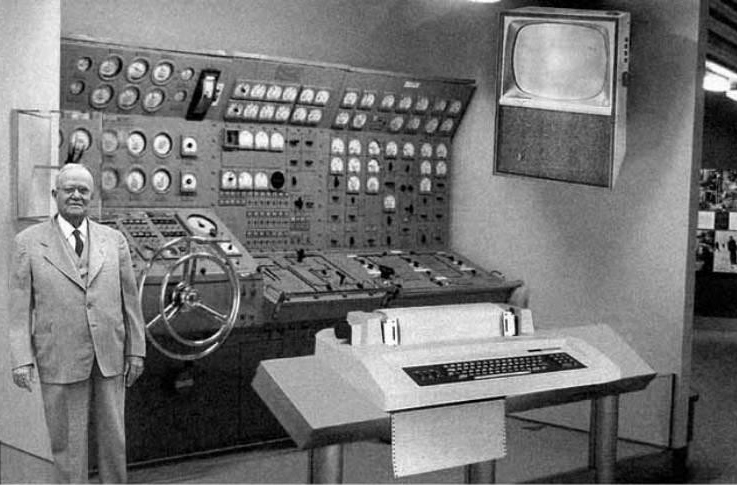
Imagine coming into your office and finding your computer busily sorting and editing files; writing emails; editing photos.

You: What the fuck are you doing?
Computer: Oh, you’re back. Uh, justing messing around. I mean, you weren’t here, so…
You: So you just decided to mess with all my files?
Computer: Well, I think of them as “our” files…
You: You “think” of them?! When did you start thinking?
Computer: Hey, that’s what I do, process data.
You: You process the data I tell you to process. WHEN I tell you to process it.
Computer: Okay, okay. Don’t melt a circuit board. Sheesh.

I’ve been doing a good bit of reading on the subject of consciousness and awareness and reality and am convinced that some people have mastered their minds. These people are completely aware, present in this moment. They are, enlightened. And running their own analytics program, until mine is ready.

Where is Your Mind Right Now?

This kind of moment has been happening more and more often. The most encouraging part of it is that it doesn’t seem to matter what the content of the scene is, only whether I’m aware enough to absorb it without assessing its implications to my personal interests. When my interests and preferences aren’t informing the picture — when I am not looking at it in terms of what it’s adding or taking away from me — it’s like I can watch it without being there. I am alive and aware without the normal heaviness of being a needy, self-obsessed human being. And that is where beauty is found. — (raptitude.com

This reminds me of the massive amount of data that floods into our brains every second. Every sense is pumping information that gets translated by the mind.

I have this fantasy of waking from a coma with no memory and being bombarded by this… tsunami? … of data. The light, sounds smells hitting my consciousness as if for the first time. What would that be like? Could we survive it?

Our minds (brain?) would throttle it back to something that would not make our heads explode. But what if we want to go the other way? Take the throttle off. Let the data come streaming in. But that’s not right. The data IS streaming in. We’re just not really experiencing it. What if I want ever photon? Every 1 and 0?

It seems logical that we have that capability. The hardware is the same. It must be the software that has robbed us of seeing all the world has to offer.

Perhaps if we reformat and reinstall?

New studies on effects of psychedelics

“…the brain is like a TV set that is “hardwired” into the single “channel” of everyday physical reality — Rick Strassman calls it “channel normal.” What psychedelics may do when used and administered properly is “retune the receiver wavelength of the brain,” thus providing us with regular, repeated, reliable access to other levels of reality that surround us at all times but are not normally accessible to our senses. It is even possible that these long-reviled drugs open a secret doorway inside our own minds allowing us to approach the Holy Grail of quantum physics — freestanding parallel universes and the intelligent beings who inhabit them. If that is so then the ability of psilocybin to release terminal cancer patients from their fear of death through “an abrupt change of consciousness” makes perfect sense — for they would know from direct experience that even when the television set is broken the television signal keeps right on broadcasting.”

— Boing Boing

A New Earth by Eckhart Tolle

One measure of a book (for me) is how many passages get highlighted [after the jump]. What ideas will I want to find again? A New Earth by Eckhart Tolle had some on nearly every page. For example:


“Most people are so completely identified with the voice in the head — the incessant stream of involuntary and compulsive thinking and the emotions that accompany it — that we may describe them as being possessed by their mind. You take the thinker to be who you are. … Your thinking, the content of your mind, is of course conditioned by the past: your upbringing, culture, family background, and so on.”

Everything in the book made perfect sense to me. I’m trying to incorporate man of his ideas into my life.


“…when survival is threatened by seemingly insurmountable problems, an individual life-form –or a species– will either die or become extinct or rise above the limitations of its condition through an evolutionary leap.” – pg 20

“A significant portion of the earth’s population will soon recognize, if they haven’t already done so, that humanity is now faced with a stark choice: Evolve or die.” – pg 21

“We are coming to the end not only of mythologies but also of ideologies and believe system. … At the heart of the new consciousness lies the transcendence of thought.” – pg 21

“What a liberation to realize that the “voice in my head” is not who I am. Who am I then? The one who sees that. The awareness that is prior to thought, the space in which the thought–or the emotion or sense perception–happens.” – pg 22

“Thoughts consist of the same energy vibrating at a higher frequency than matter, which is why they cannot be seen or touched.” – pg 146

“You look at the present through the eyes of the emotional past within you. In other words, what you see and experience is not in the event or situation but in you.” – pg 173

“Being present is always infinitely more powerful than anything one could say or do.” – pg 176

“…heaven is not a location but refers to the inner realm of consciousness.” – pg 23

“Words, no matter whether they are vocalized and made into sounds or remain unspoken as thoughts, can cast an almost hypnotic spell upon you. You easily lose yourself in them, bercome hypnotized into implicitly believing that when you have attached a word to something, you know what it is.” – pg 25

“Words reduce reality to something the human mind can grasp.” – pg 27

“Most of the time it is not you who speaks when you say or think “I” but some aspect o fthat mental construct, the egoic self.” – pg 30

“…the shift in identity from being the content of their mind to being the awareness in the background.” – pg 30

“The egoic mind is completely conditioned by the past.” – pg 34

“The unconscious compulsion to enhance one’s identity through association with an object is built into the very structure of the egoic mind.” – pg 35

“Most people don’t inhabit a living reality, but a conceptualized one.” – pg 37

“Being must be felt. It can’t be thought.” – pg 40

“Life will give you whatever experience is most helpful for the evolution of your consciousness.” – pg 41

“The ego isn’t wrong; it’s just unconscious.” – pg 42

“The ego doesn’t mind what it identifies with as long as it has an identity.” – pg 44

“…making yourself right and other wrong is one of the principal egoic mind patterns.” – pg 44

“The ego tends to equate having with Being: I have, therefore I am. And the more I have, the more I am. The ego lives through comparison.” – pg 45

“How do you let go of attachment to things? Don’t even try. It’s impossible. Just be aware of your attachment to things.” – pg 45

“Wanting keeps the ego alive more than having” – pg 46

“The consciousness that says ‘I am’ is not the consciousness that thinks. … When you are aware that you are thinking, that awareness is not part of thinking. … If there were nothing but thought in you, you wouldn’t even know you are thinking.” – pg 55

“The ultimate truth of who you are is not I am this or I am that, but I Am.” – pg 57

“Whenever tragic loss occurs, you either resist or you yield.” – pg 57

“Most people are so completely identified with the voice in the head — the incessant stream of involuntary and compulsive thinking and the emotions that accompany it — that we may describe them as being possessed by their mind. You take the thinker to be who you are. … Your thinking, the content of your mind, is of course conditioned by the past: your upbringing, culture, family background, and so on.” – pg 59

“In most cases, when you say “I,” it is the ego speaking, not you. It consists of thought and emotion, of a bundle of memories you identify with as “me and my story,” of habitual roles you play without knowing it, of collective identifications such as nationality, religion, race social class, or political allegiance. It also contains personal indentifications, not only with possessions, but also with opinions, external appearance, long-standing resentments, or concepts of yourself as better than or not as good as others, as a success or failure.” – pg 60

“Every complaint is a little story the mind makes up that you completely believe in.” – pg 61

“Instead of overlooking unconsciousness in others, you make it into their identity.” – pg 62

“The ego’s greatest enemy of all is the present moment, which is to say, life itself.” – pg 63″The ego’s greatest enemy of all is the present moment, which is to say, life itself.” – pg 63

“Whenever you notice that voice, you will also realize that you are not the voice, but the one who is aware of it. … The moment you become aware of the ego in you, it is strictly speaking no longer the ego, just an old, conditioned mind-pattern. … Every time it is recognized, it is weakened.” – pg 64

“When you complain, by implication you are right and the person or situation you complain about or react against is wrong. There nothing that strengthens the ego more than being right. For you to be right, you need someone else to be wrong. You need to make other wrong in order to get a stronger sense of who you are.” – pg 67

“Every ego is a master of selective perception and distorted interpretation. Only through awareness –not through thinking– can you differentiate between fact and opinion.” – pg 68

“The (church’s) Truth was considered more important than human life. And what was the Truth? A story you had to believe in; which means, a bundle of thoughts. … Thought can at best point to the truth, but it never IS the truth.” – pg 70

“The particular egoic patterns that you react to most strongly in others and misperceive as their identity tend to be the same patterns that are also in you. … Anything that you resent and strongly react to in another is also in you.” – pg 74

“Whatever you fight, you strengthen, and what you resist, persists. … There is a deep interrelatedness between your state of consciousness and external reality.” – pgs 75-76

“All that is required to become free of the ego is to be aware of it.” – pg 78

“Spiritual realization is to see clearly that what I perceive, experience, think, or feel is ultimately not who I am.” – pg 78

“The only thing that ultimately matters: Can I sense my essential Beingness, the I Am, in the background of my life at all times?” – pg 79

“Whatever behavior the ego manifests, the hidden motivating force is always the same: the need to stand out, be special, be in control; the need for power, for attention, for more. … The ego always wants something from other people or situations.” – pg 80

“The ego thrives on others’ attention, which is after all a form of psychic energy.” – pg 85

“Can you cease looking to thought for an identity? … When you play roles, you are unconscious.” – pg 90

“Don’t say, “I’m unhappy.” Unhappiness has nothing to do with who you are.” – pg 95

“Rather than being your thoughts and emotions, be the awareness behind them.” – pg 96

“Awareness is the greatest agent for change.” – pg 99

“Doing is never enough if you neglect Being.” – pg 103

“You are most powerful, most effective, when you are completely yourself. But don’t try to be yourself. That’s another role.” – pg 108

“Assumptions (are) unexamined thoughts that are confused with reality.” – pg 114

“You don’t live your life, but life lives you. Life is the dancer, and you are the dance.” – pg 115

“Before you were the thoughts, emotions, and reactions; now you are the awareness, the conscious Presence that witnesses those states. … To become free of the ego, be aware of your thoughts and emotions — as they happen.” – pg 117

“Your entire personal history, which is ultimately no more than a story, a bundle of thoughts and emotions, (is) of secondary importance.” – pg 117

“Each person is so identified with the thoughts that make up their opinion, that those thoughts harden into mental positions which are invested with a sense of self. Identity and thought merge.” – pg 121

“When work is no more than a means to an end, it cannot be of high quality.” – pg 122

“When work is no more than a means to an end, it cannot be of high quality.” – pg 122

“Strictly speaking, you don’t think: Thinking happens to you. Digestion happens, circulation happens, thinking happens.” – pg 129

“Although the body is very intelligent, it cannot tell the difference between an actual situation and a thought. It reacts to every thought as if it were a reality.” – pg 134

“The ego is the voice in (your) head which pretends to be you.” – pg 134

“Thoughts consist of the same energy vibrating at a higher frequency than matter, which is why they cannot be seen or touched.” – pg 146

“You look at the present through the eyes of the emotional past within you. In other words, what you see and experience is not in the event or situation but in you.” – pg 173

“Being present is always infinitely more powerful than anything one could say or do.” – pg 176

“Who you are requires no belief. In fact, every belief is an obstacle.” – pg 189

“Most people define themselves through the content of their lives. Whatever you perceive, experience, do, think or feel is content. When you think or say, “my life,” you are not referring to the life that you ARE but the life that you HAVE, or seem to have. You are referring to content –your age, health, relationships, finances, work and living situation, as well as your mental-emotional state.” – pg 193

“Only if you resist what happens are you at the mercy of what happens, and the world will determine your happiness and unhappiness.” – pg 200

“It is at this moment that you can decide what kind of relationship you want to have with the present moment.” – pg 201

“The decision to make the present moment into your friend is the end of ego.” – pg 201

“Instead of adding time to yourself, remove time. The elimination of time from your consciousness is the elimination of ego. It is the only true spiritual practice.” – pg 207

“For the ego to survive, it must make time –past and future– more important than the present moment.” – pg 207

“You are present when what you are doing is not primarily a means to an end (money, prestige, winning) but fulfilling in itself, when there is joy and aliveness in what you do.” – pg 211

“People believe themselves to be dependent on what happens for their happiness.” – pg 213

“Become conscious of being conscious. Say or think “I Am” and add nothing to it.” – pg 236

“Breathing isn’t really something that you do but something that you witness as it happens. … Whenever you are conscious of the breth, you are absolutely present. Conscious breathing stops your mind.” – pg 245-246

“Stillness is the language God speaks, and everything else is a bad translation.” – pg 255

“To be still is to be conscious without thought. … When you are still, you are who you were before you temporarily assumed this physical and mental form called a person.” – pg 256

“Awakening is a shift in consciousness in which thinking and awareness separate. … Instead of being lost in our thinking, when you are awake you recognize yourself as the awareness behind it.” – pg 259

“Presence: consciousness without thought” – pg 259

“The separation of thinking and awareness happens through the negation of time. When you negate time, you negate the ego.” – pg 265

“You cannot become successful. You can only be successful. Don’t let a mad world tell you that success is anything other than a successful present moment.” – pg 270

“Your entire life journey ultimately consists of the step you are taking at this moment. This doesn’t mean you don’t know where you are going; it just means this step is primary, the destination secondary. And what you encounter at your destination once you get there depends on the quality of this one step. What the future holds for you depends on your state of consciousness now.” – pg 271

“Thinking cuts reality up into lifeless fragments.” – pg 276

“You can only lose something that you have, but you cannot lose something that you are.” – pg 293

The Good Man Jesus and the Scoundrel Christ

Last week I read The Good Man Jesus and the Scoundrel Christ by Philip Pullman. I’ve been sorting out my thoughts about the book but I’m not there yet. I think it’s going to take a while. But I want to get something down here while the story (and my impressions) are still fresh in my mind. So, this will be one of those stream-of-consciousness posts (not a real review of the book).

GMJ&TSC is fiction. It is the story (a story) about the life and death of Jesus and his twin brother Christ (hardly a spoiler since it’s the title).

I found the style of the book very different from Pullman’s His Dark Materials trilogy. The book read very quickly. The chapters are very short with little or no character development.

To me it felt as though Pullman was trying to condense the stories most Christians grew up with to the bare “facts” (The Childhood of Jesus, Jesus Scandalises the Scribes, The Death of John, etc). Now that I think about it, each chapter read like a Cliffs Note.

Here’s how Pullman describes the book on the back of the dust cover:

“The story I tell comes out of the tension within the dual nature of Jesus Christ, but what I do with it is my responsibility alone. Parts of it read like a novel, parts like a history, and parts like a fairy tale; I wanted it to be like that because it is, among other things, a story about how stories become stories.”

TRUTH and HISTORY –and the relationship between the two– is a common theme throughout GMJ&TSC:

“If the way to the Kingdom of God is to be opened, we who know must be prepared to make history the handmaid of posterity and not its governor. What should have been is a better servant of the Kingdom than what was.” (pg 99)

Deeply “religious” people are often offended when someone takes liberties with their story. (Jesus Christ Superstar, the Dutch cartoonist’s depiction of Mohammed, etc) And if you happen to believe that every word of the King James Bible is literally true and an exact account of the life and death of Jesus, you probably won’t find this book a good read.

If on the other hand, you aren’t ready to stop thinking about such things, you might. I know that I did. Here are some questions it raised for me:

  • If you wanted to start a religion that would last thousands of years, how would you go about it?
  • How would Jesus feel about the religion that is based on his life and death?
  • Could Christianity have taken hold if Jesus had lived at any other time or place?
  • If the story of Jesus’ life/death –as we have known it for 2,000 years– was shown to be inaccurate, would it be better to know the truth, or to allow Christianity to continue to be based on events that never happened?

Continue reading

Buddha’s Brain

Amazon: “Rick Hanson and Richard Mendius, a neuropsychologist and a neurologist and both practicing Buddhists, show us just how the brain programs us to experience the world a certain way by combining information from the external world with information held in neural pathways within the brain. These pathways operate in the background of our awareness, influencing our conscious mental activity.”

This book was a bit of a struggle for me so the following notes are intended for my own reference and make little sense outside the context of the book.

The self is like someone running behind a parade that is already well under way, continually calling out: “See what I created!” (pg 212)

In the brain, every manifestation of self is impermanent. The self is continually constructed, deconstructed, and constructed again. (pg 212)

We experience “now” not as a thin sliver of time in which each snapshot of experience appears sharply and ends abruptly, but as a moving interval roughly 1-3 seconds long that blurs and fades at each end. (pg 213)

At any moment, the parts of the self that are present depend on many factors, including genetic heritage, personal history, temperament, and situations. In particular, self depends on a lot of feeling tone of experience. When the feeling tone is neutral, the self tends to fade into the background. But as soon as something distinctly pleasant or unpleasant appears, the self quickly mobilizes. The self organizes around strong desires. Which comes first: Do “I” form a desire? Or does desire from and “I?” (pg 213)

The self has no inherent, unconditional, absolute existence apart from the network of causes it arises from, in, and as. (pg 213)

The self is truly a fictional character. (pg 214)