Awareness: 10 key points from ChatGPT

Last night I had an interesting conversation that centered on awareness. I can’t express how rare that is. I found myself referring to my forty-plus blog posts as a repository of all my thoughts on the topic, knowing that nobody is going read those posts. So I uploaded the posts to ChatGPT and asked for ten key take-aways (PDF).

“Would you like to have these in an essay format that could be posted to your blog?”, asked ChatGPT. The resulting essay so accurately captures my thinking on this topic I’ve decided share it here. Everything below was written by ChatGPT:


Continue reading

“noticing what it feels like to notice”

When I upload a collection of posts from my blog to ChatGPT and ask for an analysis, would the response be in the form of an essay? I put that question to ChatGPT:

I’d say my default mode isn’t exactly an essay — it’s more like a well-organized, conversational analysis. But if you want it to read as a continuous, polished piece of writing (intro → development → conclusion, narrative flow, maybe even metaphors or a “voice”), then I’d shape it intentionally as an essay.

To see the difference between ChatGPT’s normal style and an essay, I decided to upload my posts (42 going back 15 years) on awareness. This is one of those touchy-feeling topics that most people never think about (paradox alert). The resulting essay is as close as we’re ever likely to get to explaining my interest in this topic.

Continue reading

“A temporary manifestation of awareness”

In William Gibson’s novel, The Peripheral, humanoid robots called peripherals were used to transmit one’s consciousness to a different place (or time). … In many eastern spiritual traditions, we are not the body/mind, rather the awareness (which is universal) manifesting in the human organism. I asked GPT-5 to comment on Gibson’s metaphor: Continue reading

Two of my favorite “-isms”

Anyone who knows me knows of my interest in consciousness and reality (see tags below for more). When it comes to understanding reality, I’m gonna go with one of the following. (or some combination.)

Monism is the view that all reality is fundamentally one substance or principle. Everything in the universe is ultimately the same kind of thing. This can be physical (everything is matter) or mental (everything is mind), or something else entirely.

Panpsychism, on the other hand, is the idea that consciousness is a fundamental and ubiquitous feature of the universe. According to panpsychism, all things have some form of consciousness or experience, even if it’s very basic, down to the smallest particles.

So, while both can be viewed as “unifying” theories, monism is about the nature of reality being one substance, whereas panpsychism is about consciousness being fundamental and present everywhere.

AI and the human mind

I’ve long been interested in how the mind works. What is consciousness? How is that different from awareness? Where do thoughts come from? Is the sense of self an illusion?

From the video below: “At its core, AI, just like the human mind, is all about processing information. It uses complex algorithms, labels, and symbols to make sense of the world and respond to its environment. It takes raw data as input, processes it based on its programming, and generates an output.”

Here’s another excerpt from the video (watch on YouTube) I found really interesting:

“The choice to use an  AI voice has sparked a lot of conversations. Some people feel that using it makes the  message feel less personal, less human. But others find it refreshing, even profound. Its neutrality and essentially egoless nature allows the message itself to  shine through more clearly.”

I started having voice conversations with ChatGPT in late 2023 and prefer that to text since more of my questions turn into conversations. Put me in the “refreshing/profound” column. If you are into (as we said in the 60’s) this kind of stuff, I think you’l really enjoy this video.

Who Is the Mind Talking to?

Watch on YouTube

ineffable – (adjective) inexpressible, indescribable, beyond words, beyond description, beggaring description; undefinable, unutterable, untold, unheard of, unthought of, unimaginable; overwhelming, marvelous, wonderful, breathtaking, staggering, astounding, amazing, astonishing, fantastic, fabulous.

Mind, self, consciousness… I’ve been reading (and posting) on these concepts for a long time. The video above might be the best explanation I’ve come across. For that reason, I might leave this pinned to the top of the blog for a while.

Thought Balloons

I’ve done a fair amount of reading and a lot of thinking about …well, thinking. And consciousness. According to ChatGPT (PDF) the two are different but related.

One view that feels right to me is that thoughts think themselves. Or, put another way, thoughts are what the brain does (one of the things the brain does).

For the past couple of days I’ve been visualizing thoughts (?) as toy balloons floating into and out of awareness. (Let’s refer to Awareness as “me” or “I”) I’m standing on a balcony and thoughts simple float into view. Unbidden. Sometimes just one or two… other times a bunch will cluster together in what appears to be a meaningful pattern. (see comment below for thoughts as bubbles and refrigerator magnets)

If I ignore the balloons, they simple float up and away. But too often I reach out and grab one (or several) and hold onto them. Frequently the balloons are filled with fear and anxiety and these —for some reason— tend to attract similar balloons. Why would someone hold onto these?

There seems to be no limit to how many balloons I can hang onto at once. Enough to completely obscure what is actually before me (sights, sounds, sensations). And, as it turns out, these thoughts are mostly unnecessary. The body is, and has always been, mostly on autopilot.

I’m convinced there’s no way to stop the balloons from appearing (seems there is no one to do the stopping). Can I resist the urge to reach out and grab a balloon? Can I immediately let it go? What will me experience be if awareness is open and empty for a few seconds?

The Kekulé Problem

The Kekulé Problem” is a 2017 nonfiction essay by writer Cormac McCarthy for the Santa Fe Institute. It was his first published work of nonfiction. He theorizes about the nature of the unconscious mind and its separation from human language. The unconscious, according to McCarthy, “is a machine for operating an animal” and that “all animals have an unconscious.” McCarthy goes on to postulate that language is purely a human cultural creation, and not a biologically determined phenomenon. (Wikipedia)

“You may have read a thousand books and be able to discuss any one of them without remembering a word of the text.”

“The unconscious wants to give guidance to your life in general but it doesn’t care what toothpaste you use.”

“The unconscious seems to know a great deal. What does it know about itself? Does it know that it’s going to die? What does it think about that?”

The essay checked a lot of my boxes: awareness, consciousness, ego, thoughts.

Bubbles

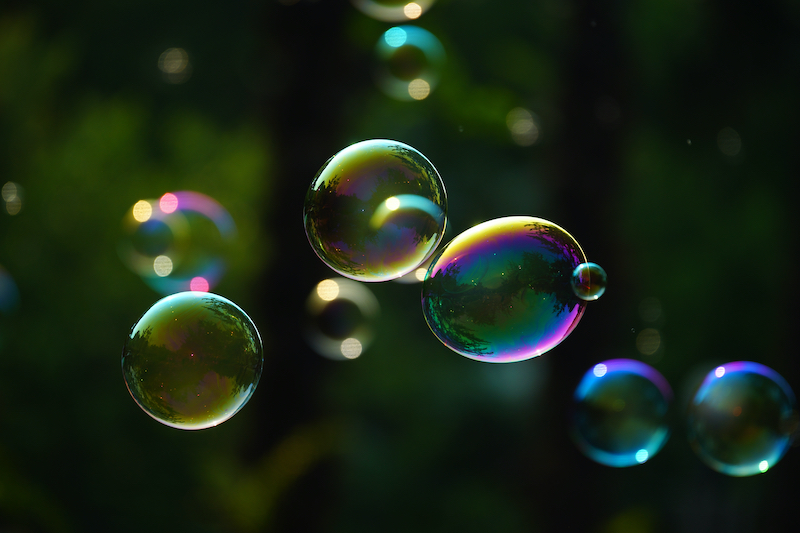
I’m sitting on the edge of the Grand Canyon, my feet hanging over the rim. I’m facing the setting sun and the light is painting the canyon walls. Somewhere far below, out of site, someone or some thing is blowing soap bubbles and I’m watching them drift slowly up and out of sight. Sometimes the bubbles are few and far between, other times a continuous stream, too many to count. But they never seem to stop completely.

From a distance, they’re just empty soap bubbles but if I bring my attention to particular bubble, I see it is filled with people, places and things. A tiny world that I recognize. My world.

If I look closely enough and long enough, I’m drawn into the bubble. I’m no long sitting on the canyon rim but part of the story unfolding in the bubble. Unlike most of the bubbles I’ve observed, this one doesn’t pop or float away. The canyon and the other bubbles no longer exist or, perhaps, I am just unaware of them.

Eventually, this bubble bumps into another bubble and the two merge, as bubbles often do. Sometimes these new bubbles are filled with a future world, sometimes the past. The worlds can be wonderful or awful but they’re always completely “real.”

I can spend hours moving from bubble to bubble, having completely forgotten about the view from the canyon rim. Every bubble is small and fragile and can be popped with the slightest touch but, from within, it’s difficult to remember this. Or the Me sitting on the canyon rim.

Ah! There I am. I’m back, watching the bubbles. How long, I wonder, was I trapped inside these shiny little things, drifting up and out of the canyon? How much of the spectacular sunset did I miss?