
Apple Music Update

I’ve been a fan of Apple Music since its launch in 2015 and have posted here praising the curation process. I asked Gemini for an update:


(Gemini) Apple Music leans heavily on human curation as a point of pride, positioning itself as a “cultural curator” rather than just a data utility. While Spotify is known for its “Algotorial” approach, Apple’s editorial team is the backbone of their most prominent playlists. Here is a breakdown of the people behind the lists:

The Global Editorial Team

Apple employs over 1,000 curators globally. These aren’t just tech employees; they are largely recruited from the worlds of professional DJing, music journalism, and radio programming.

  • The Specialists: They are organized by genre and region. For example, the person curating a “K-Pop” playlist likely lives in or has deep cultural ties to Seoul, rather than a generalist working out of Cupertino.
  • The Task: Their job is to listen to thousands of tracks weekly. Unlike algorithms, they are looking for “narrative flow”—ensuring the transition from a high-energy track to a mellow one feels intentional and human.
  • The Philosophy: Apple’s internal mandate often focuses on “human emotion and cultural wisdom.” They prioritize songs that might not have the best “data” (skips/saves) but are culturally significant or represent a “vibe” the algorithm might miss.

High-Profile Tastemakers

You’ll often see names attached to specific radio shows or “Guest Curator” lists. These individuals influence the editorial direction of the broader playlists:

  • Zane Lowe & the Radio Team: As the Global Creative Director, Lowe (formerly of BBC Radio 1) oversees much of the “tone.” His team includes veteran broadcasters like Ebro Darden (Hip-Hop/R&B) and Matt Wilkinson.
  • External Partners: Apple also allows “Brand Curators” to maintain profiles. These include publications like The Independent, Pitchfork, or Rolling Stone, and labels like Numero Group or XL Recordings.

How They Work With “The Machine”

The process is a feedback loop. While the human editors pick the “Flagship” tracks for playlists like Today’s Hits or Rap Life, they use data to see if their “gut feeling” was right.

  • If an editor places a song at #1 and users skip it 80% of the time, the data tells the editor to move it.
  • Conversely, the human editors provide the “high-authority signals” that the algorithm then uses to populate your personal Discovery Station or New Music Mix.

You won’t usually find an individual’s name on a standard Apple-branded playlist (e.g., Pure Throwback). However, if you look at the bottom of a playlist description, Apple often credits the curator if it’s an external partner. For internal lists, the “voice” is kept anonymous to maintain the Apple brand identity.
Apple Music “All Time”

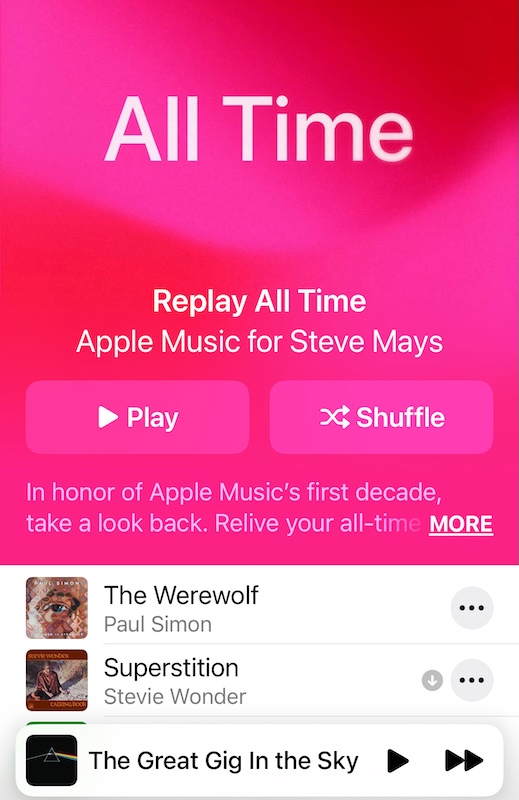
When I fired up the Apple Music app this morning I was greeted with a new playlist. “In honor of Apple Music’s first decade, take a look back. Relive your all-time favorite tracks, all in one playlist.” 100 songs that will take 7 hours and 10 minutes to listen to. And a great playlist it is. (If you’re an Apple Music subscriber that link will take you there)

Apple Music launched on June 30, 2015 and I did my first blog post on July 2. I was immediately taken with Apple Music and have happily paid $109 a year for the service. While I did not have a massive collection of albums and CD’s, I gave them away shortly after subscribing to Apple Music and have never regretted the decision. In the ensuing ten years Apple Music has “learned” my musical preferences and created better playlists than I could have.

“AirPods!”

During the early days of the pandemic, as more and more people began showing up on TV via Zoom et al, I would shout out to Barb, “AIRPODS!” That quickly became annoying so I would whisper, “AirPods.” Now I just mouth the words.
I have mine in so frequently I’ve stopped noticing them (they fit my ears perfectly). Arguments about audio quality aside, they have changed my perception of music. It seems to be coming from inside my head, rather than through my ears.

Apple Music playlists (piano solos and cello solos) have become the the background for my awareness, making me noticeably more relaxed and peaceful.

The people who make the streaming playlists

Good piece from last year on the people who curate playlists for streaming music services:

“As streaming has gone mainstream, these curators, many of whom began their professional lives as bloggers and DJs, have amassed unusual influence. Their work, as a rule, is uncredited — the better for services designed to feel like magic — but their reach is increasingly unavoidable. Spotify says 50% of its more than 100 million users globally are listening to its human-curated playlists (not counting those in the popular, algorithmically personalized “Discover Weekly”), which cumulatively generate more than a billion plays per week. According to an industry estimate, 1 out of every 5 plays across all streaming services today happens inside of a playlist. And that number, fueled by prolific experts, is growing steadily.”

“All the signs point to playlists being the dominant mode of discovery in the near future,” says Jay Frank, senior vice president of global streaming marketing for Universal Music Group, the largest of the major label conglomerates. “When it comes to trying to find something exciting and new, more people are going to want to go to trusted playlists.”

I hope these folks always have a job and I sort of think they will. Not convinced an algorithm can do the voodoo they do.

Hair

I just purchased ($10) the 1968 cast recording of the Broadway musical Hair. I couldn’t find the album in Apple Music so I had to purchase from the iTunes store. The album charted No. 1 on the Billboard 200, the last Broadway musical cast album to do so (as of 2016, which finally saw The Hamilton Mixtape chart No. 1, although that is not a cast album). So says Wikipedia. Hair’s cast album stayed at No. 1 for 13 weeks in 1969. You had to be there.

Apple Music changing the way I think about music

Not sure I can explain this but let’s give it a shot. Raise your hand if you’re old enough to remember “collecting websites.” This was back in the early days of the web and long before Google made it easy to find your way back to a favorite site. Bookmarks were an important part of your web browser. It wasn’t uncommon to have dozens (hundreds?) of bookmarks. So many you needed a folder structure to keep them all organized. I don’t know many who still maintain such lists. Modern browsers do a pretty good job of keeping up with your favorites sites based on your surfing habits.

I’m seeing a similar evolution in my music listening habits. I still have some playlists I created in iTunes. These are lists of songs I purchased and downloaded. Or, more recently, just downloaded from Apple Music. But I’m finding it increasingly cumbersome to navigate these lists when compared to the way Apple Music connects me to music. Where my playlists are static (the same songs), Apple Music playlists are updated with fresh songs. I don’t know if this is true of all playlists or just some. But the result is a fresher, more dynamic experience. In some ways this feels like listening to a good radio station where the music rotation is the best blend of favorites and new stuff like the favorites. I told you… difficult to explain.

There are some classics I’ll always want to keep close (Mad Dogs and Englishmen, Harvest, Tapestry, etc) but I’m feeling less need to organize and manage “my” (i.e. downloaded) songs. If I’m in the mood for some funk or a Janis Joplin song Apple Music will deliver the good far better than my collection. My downloaded library is finite where Apple Music is infinite but increasingly aware of what I like (or might like).

Curated music playlists

I’m a big fan of curated playlists (Apple Music for me) and have been curious about how and by whom these lists are created. This longish article is the best look at this I’ve read to date.

“Spotify says 50% of its more than 100 million users globally are listening to its human-curated playlists (not counting those in the popular, algorithmically personalized “Discover Weekly”), which cumulatively generate more than a billion plays per week. According to an industry estimate, 1 out of every 5 plays across all streaming services today happens inside of a playlist.”

“Music fans […] can smell the difference between a service where much of the product is dictated by algorithms or charts and one that is guided by more knowledgeable but equally passionate versions of themselves.”

Secretive as always, “Apple declined to share how many of those users are going to its playlists and how often.”

This is why I love Apple Music

You know I love my Apple Music playlists. And have wondered aloud who puts these together. Steven Levy wondered the same thing:

“Who are those editors putting the playlists together? It turns out they are music nerds who might have otherwise been displaced by technology. People from radio; people who used to work at publications; people who used to work at record companies — hard core passionate music people. They check in to work at offices in Cupertino or LA (though a few work remotely) and perform curation tasks that include making those playlists, which they draft and discuss in meetings that must be more fun than the ones at your job. The important thing is that they are human beings. Apple believes that only flesh-and-blood music lovers can properly select and format these lists, artfully making the segues from one tune to the next.”

“They are very much like those cosmic deejays in the early days or FM, or today’s superstar spinners at Las Vegas casinos and high end clubs everywhere. But without a direct channel to communicate with the audience — no microphone to explain yourself between blocks of song — it’s a weird kind of communication they have with their audience. […] After listening to a lot of these playlists, I feel I almost know whoever it is at Apple who specializes in Americana, Blues, and 60s rock.”

Apple Music has a Connect feature where fans can ‘connect’ with their favorite artists. I have zero interest in doing that but would love to connect with the people who create the playlists.

Radio dial just too small

podcastsBeen thinking some more about broadcasters lobbying for mobile carriers to turn on the FM receiver chip in phones. Never gonna work. Radio dial just too small. A little back-story:

Since getting my first iPhone several years ago, I’ve always listened to music with earbuds when in the car. The 4Runner didn’t have a good way to interface and I just never bothered when I got the MINI. Apple Music has me listening more these days so I purchased an aux cable to play iPhone music through the MINI speakers.

Lo and behold! The MINI has really good speakers. Way better experience than the earbuds. (Yes, everybody told me that) Anyway, back to the radio dial…

With the unlimited data plan (ATT) on my phone, I can listen to (almost) all the music there is. And the playlists. And the customized “stations”… as well as the half-dozen podcasts I follow.

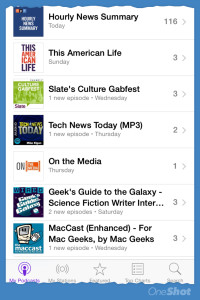
“Hey, Siri. Podcast. Tech News Today.” Voila!

No radio station can match this. ALL the radio stations can’t match this.

Apple Music’s “For You” feature

The idea is to recommend music based on my existing iTunes library along with the genres and artists I ID’d when setting up Apple Music. (I never found Pandora’s algorithm very good at this. The other services might be better.) It’s only been a few days but I’m impressed, especially with the playlists. Seeing my favorite artists/music as well as deep tracks I didn’t know existed. With stuff by artists I’ve never heard of. This experience will only get richer (I hope) as I continue to provide feedback by listening an liking playlists and individual tracks. This browse runs 9 minutes but you can bail after a couple and still get the idea.