AirPods at the Olympics

I don’t watch a lot of TV news these days but when I do happen upon a cable news interview the odds are pretty good the interviewee will have the iconic Apple AirPods in his ear. That’s how he’s hearing the questions from the news guy. It never occurred to me the AirPod microphones might be the source of the audio.

Tonight I watched an interview (on NBC) with one of the Olympic athletes who was using AirPods to hear the questions from the interviewer.
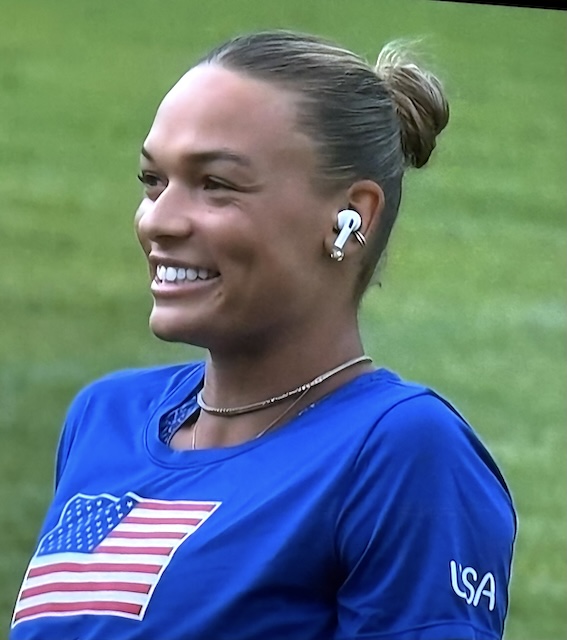
I first noticed this in some of the interviews with family members (of the athlete) sitting in the stands. I’m assuming this works like the earpiece (IFB) news anchors use to communicate with the control room. In every instance (that I’ve seen) they’ve been Apple AirPods when there are probably lots of devices NBC could have used.

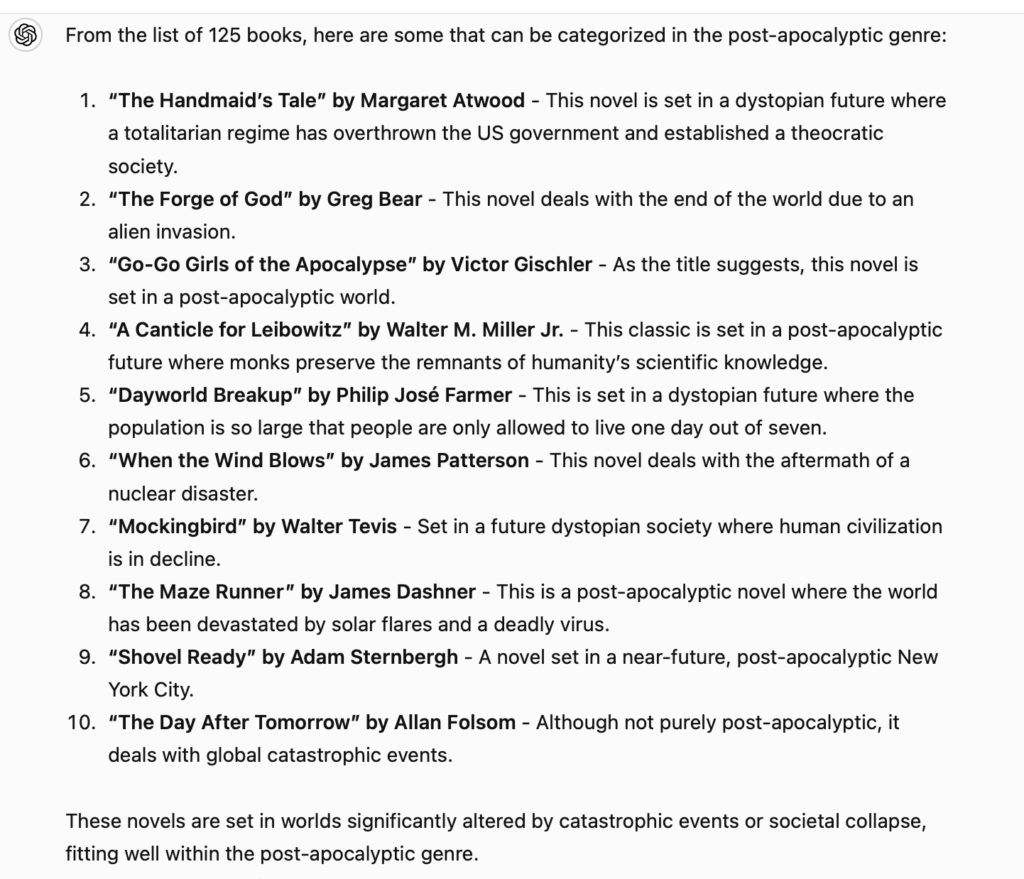
As I do with increasing frequency these days, I asked ChatGPT if she had any information on this.


You’re right that NBC and other networks have been seen using Apple AirPods during interviews, including with Olympic athletes and their families. The use of AirPods in these situations is a practical solution for a few reasons:

1.Wireless Convenience: AirPods are wireless, which makes them less cumbersome compared to traditional wired earpieces or over-the-ear headphones. This is especially useful in dynamic or remote settings, like interviewing athletes or their families who may be moving around or in informal environments.

2.High-Quality Audio: AirPods provide good audio quality, which ensures that the person being interviewed can clearly hear the questions being asked. This clarity is crucial for maintaining the flow of live interviews, especially in noisy or crowded environments like those often encountered during the Olympics.

3.Discreet Appearance: AirPods are small and less noticeable on camera compared to larger headphones or traditional broadcast earpieces. This makes them a more aesthetically pleasing choice for televised interviews, where the focus is on the interviewee rather than the equipment.

4.Ease of Use: AirPods are easy to connect to various devices, such as smartphones, which are often used by reporters or production teams in the field to conduct interviews. Their ease of use and quick setup make them an efficient choice for live broadcasting situations.

5.Ubiquity and Familiarity: AirPods are widely recognized and used, so many people are already familiar with how to use them. This reduces the need for technical adjustments or explanations during setup.

NBC’s use of AirPods is a modern adaptation to the challenges of broadcasting in various environments, offering a blend of practicality, quality, and aesthetics.
ChatGPT story in Carl Hiaasen style

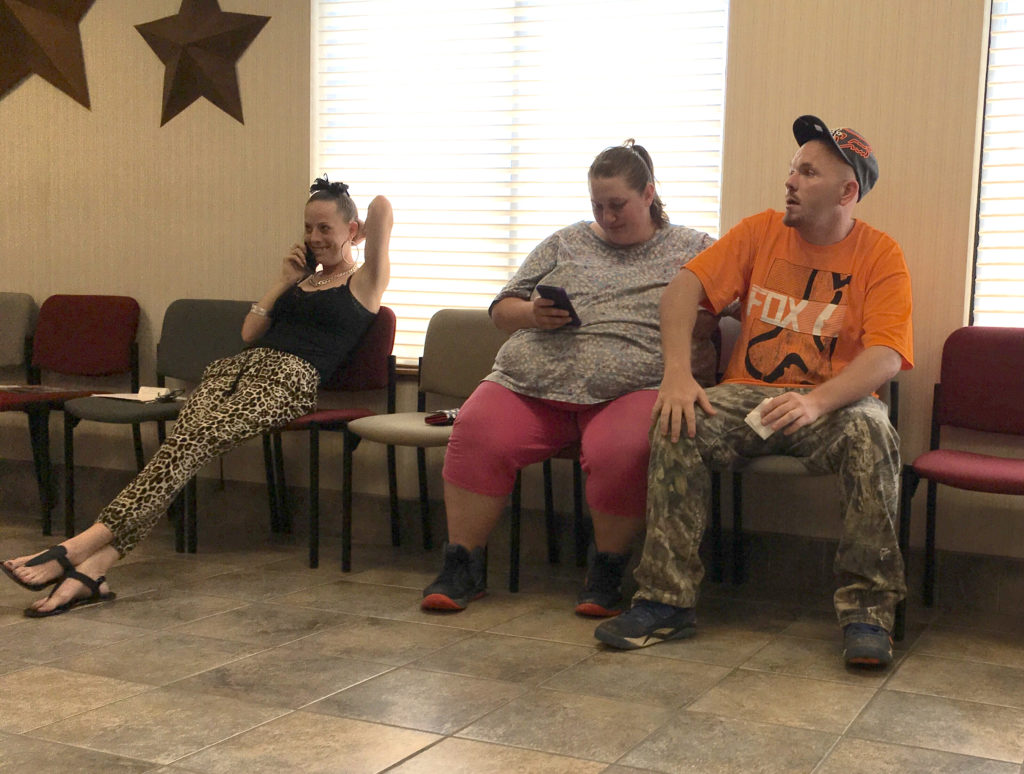
I love Carl Hiaasen‘s novels. I’ve read every one of them. Most of them three or four times. I can’t think of a writer that creates more colorful (bizarre) characters. So I wasn’t expecting much when I uploaded this photo to ChatGPT and asked her to write a thumbnail description of each of the people as if they were in a Carl Hiaasen novel.

Karen “Krazy Karen” McCallister. Krazy Karen, a former exotic dancer turned amateur sleuth, always seems to be at the wrong place at the wrong time. She’s got a penchant for loud prints, louder opinions, and a mysterious past involving a nightclub in Key West. Her talent for finding trouble is matched only by her knack for talking her way out of it.

Darlene “Darla” Jenkins. Darla is the town’s gossip queen, who knows everyone’s business thanks to her relentless scrolling through local Facebook groups. She’s a plus-sized powerhouse with a soft spot for conspiracy theories and a talent for making friends in low places. Don’t be fooled by her sedentary demeanor; Darla has her fingers on the pulse of every small-time scam in town.

Earl “Squirrel” Dobbs. Earl, better known as Squirrel, is a part-time poacher and full-time mischief maker. His wardrobe consists entirely of camouflage, not because he hunts often, but because he believes it makes him invisible to his creditors. Squirrel’s greatest talents are vanishing when the law’s nearby and concocting get-rich-quick schemes that never quite pan out.

Not Carl Hiaasen but not bad.

Vetting process for VP candidate

Lots of stories about who Kamala Harris will choose for her running mate. I’m reminded of the movie Game Change and the scenes where McCain’s campaign is looking into the background of Sarah Palin. I prompted Perplexity for info about this process.

The vice presidential vetting process is an intensive and thorough examination of potential running mates. Here are key aspects of the process:

1. Candidates typically undergo extensive background checks, including reviews of their financial records, medical history, public statements, and personal lives.

2. The vetting team, usually comprising campaign staff and volunteer attorneys, may ask candidates to answer up to 200 probing questions covering various aspects of their lives.

3. The process involves examining tax documents, medical records, and even private social media profiles of candidates and their family members.

4. Candidates may be asked highly personal questions about their sexual history, financial dealings, and potential controversies.

5. The vetting team aims to uncover any potential liabilities or surprises that could harm the campaign.

6. The timeline for vetting can vary. While most campaigns have months, Kamala Harris’s team has had a compressed timeline of just a few weeks.

7. The process typically concludes with in-depth presentations on each finalist to the presidential candidate, followed by final interviews with top contenders.

8. Confidentiality is crucial, with vetting notes often destroyed after the process to maintain privacy.

The goal of this rigorous process is to avoid any unexpected issues that could derail the campaign and to ensure the chosen running mate strengthens the ticket

I’ll never get a close look at this process for any number of reasons but here are some of the things about which I am curious:

  • Who does the hands-on research and what sort skill set is required?
  • What’s involved in investigating someone’s social media account? Do they read every Facebook and Twitter post? Watch all YouTube videos?
  • Do they look at files on a prospect’s phone and computer?

ChatGPT on my non-fiction reading

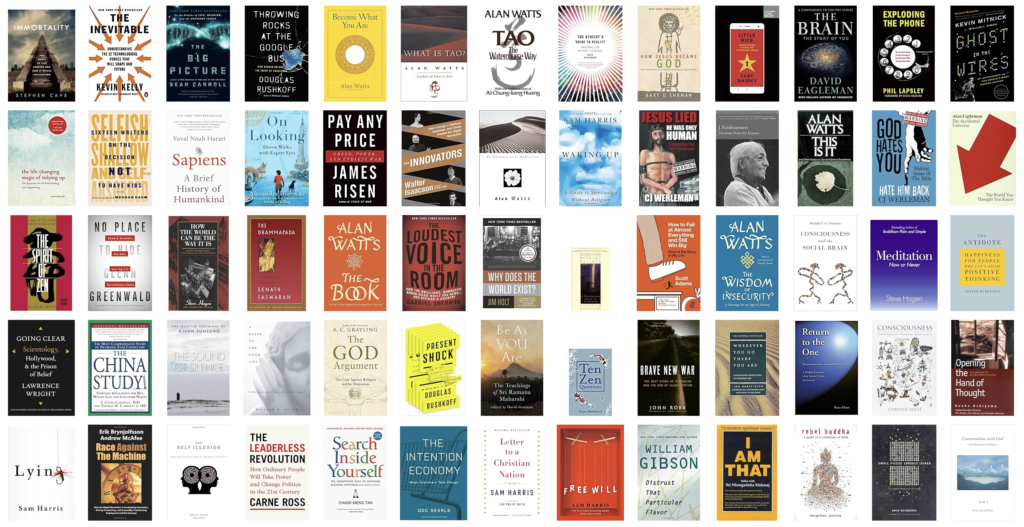
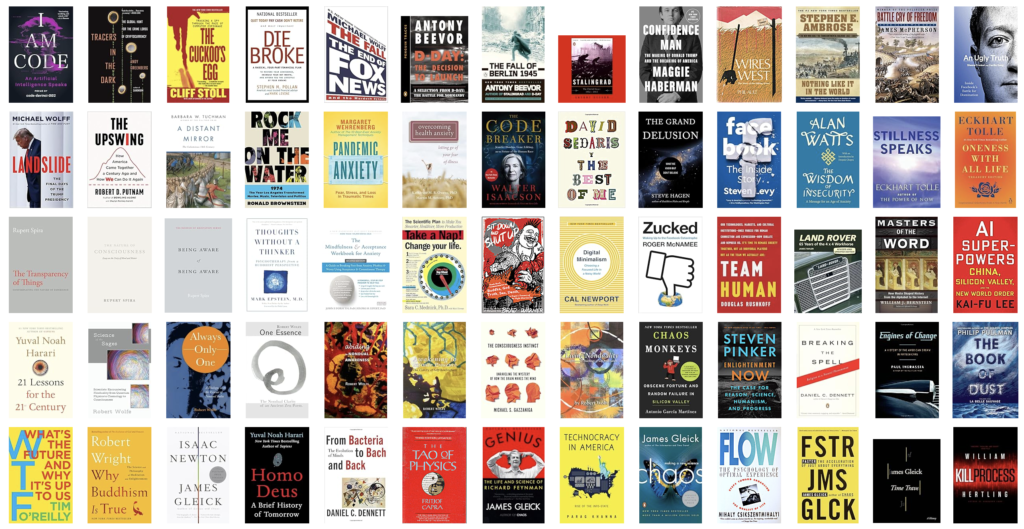
ChatGPT: Based on the covers of the books shown in the images, here’s what I can surmise about the person who has read these books:

1.Diverse Interests: The reader has a wide range of interests, including technology, history, psychology, spirituality, science, and self-improvement.

2.Curiosity About Technology and Its Impact: Books like “The Inevitable,” “The Innovators,” and “AI Superpowers” suggest an interest in how technology shapes society and the future.

3.Historical Interests: Titles like “The Fall of Berlin 1945,” “D-Day,” and “Stalingrad” indicate a fascination with significant historical events, particularly those related to World War II.

4.Spiritual and Philosophical Exploration: The inclusion of books by Alan Watts, Eckhart Tolle, and other spiritual authors suggests a deep interest in exploring philosophical and spiritual ideas, possibly leaning towards Eastern philosophies and mindfulness.

5.Interest in Cognitive Science and Psychology: Books such as “The Brain: The Story of You,” “Consciousness and the Social Brain,” and “The Master and His Emissary” indicate a strong interest in understanding the human mind and consciousness.

6.Self-Improvement and Personal Growth: Titles like “Digital Minimalism,” “The Power of Now,” and “Meditation: Now or Never” point towards an interest in self-improvement, mindfulness, and personal growth.

7.Skeptical and Critical Thinking: Books like “The God Delusion,” “Breaking the Spell,” and “Why Buddhism is True” suggest a tendency towards skeptical and critical thinking, particularly about religion and spirituality.

8.Fascination with Future Trends and Speculative Thinking: Titles such as “Homo Deus,” “21 Lessons for the 21st Century,” and “The Singularity Is Near” imply a fascination with future trends, speculative thinking, and what lies ahead for humanity.

9.Interest in Societal and Cultural Issues: Books like “The Upswing,” “Zucked,” and “Chaos Monkeys” suggest an interest in societal and cultural issues, particularly related to media, technology, and economics.

Overall, this reader appears to be highly intellectual, curious about a broad range of topics, and keen on understanding the world from multiple perspectives, including historical, technological, philosophical, and scientific. They seem to value both critical thinking and personal growth.

“More human than human”

That’s the motto of the corporation in Ridley Scott’s sci-fi classic, Blade Runner. The film was released 42 years ago and has stood the test of time. I watched it again last night. For the tenth time? The twentieth? And every time I discover some perfect new visual detail or bit of dialog. Like this from Rachael:

“I’m not in the business. I am the business.”

As I watched the movie again last night I was aware of the phone by my hand and the AI chatbots within. I asked ChatGPT about the “More human than human” line.

The line “More human than human” from Blade Runner is quite intriguing. In the context of the film, it refers to the replicants created by the Tyrell Corporation, which are designed to be almost indistinguishable from humans but are often superior in physical and mental capabilities. Philosophically, it can be interpreted in several ways:

    • Creation and Perfection: It suggests that the replicants are engineered to be better than humans, embodying idealized qualities that surpass natural human limitations.
    • Identity and Humanity: It raises questions about what it means to be human. If replicants can think, feel, and even surpass human abilities, what distinguishes them from humans? It blurs the lines between creator and creation.
    • Irony and Critique: There’s an irony in the phrase, as the replicants, despite being “more human,” are denied human rights and treated as mere property. It critiques the ethical implications of creating life and the responsibilities that come with it.

Overall, the phrase encapsulates the film’s exploration of humanity, identity, and the ethical dilemmas of advanced technology.

In a recent interview with Rolling Stone, Scott called AI a “technical hydrogen bomb” and warned about its potential dangers.

I asked ChatGPT to review my tags

I uploaded my tag cloud to ChatGPT and asked what, if anything, could be surmised about someone with these interests.


Based on the tags you’ve shared from your blog, it’s clear you have a wide range of interests. Here’s a snapshot of what I gather about someone with your array of interests:

  1. Technology and Gadgets: You seem to have a keen interest in tech, particularly anything Apple-related, like iPads, iPhones, and MacBooks. Your tags suggest you follow developments in mobile technology, autonomous vehicles, and virtual reality. This indicates you’re probably quite tech-savvy and enjoy staying updated on the latest advancements.
  2. Communication and Media: With extensive tags related to radio, podcasting, and social media, it appears you have a strong background in communication. Your past work in communications and at a radio station aligns with this. Your interest in podcasting and blogging shows you’re still active in sharing ideas and engaging with others through modern platforms.
  3. Speculative and Dystopian Fiction: Authors and works like Bruce Sterling, Neal Stephenson, and “Snow Crash” suggest you enjoy speculative and dystopian fiction. This fits well with your love for speculative fiction, crime fiction, and spy fiction, highlighting your penchant for imaginative and thought-provoking narratives.
  4. Philosophy and Mindfulness: Tags like Buddhism, Tao, meditation, Eckhart Tolle, and Alan Watts point to a deep interest in philosophy and mindfulness. Your commitment to daily meditation and your identification as a “half-assed, wannabe Taoist” underscore a pursuit of inner peace and understanding of the self.
  5. Humor and Entertainment: You have a notable appreciation for humor, with tags related to funny songs, The Daily Show, and comedians like George Carlin. This shows you value wit and humor, likely enjoying content that makes you laugh while often reflecting on deeper societal issues.
  6. Science and Futurism: Tags such as consciousness, free will, evolution, quantum theory, and figures like Ray Kurzweil and Yuval Noah Harari indicate a strong interest in science and futurism. You’re probably fascinated by the mysteries of the universe, human potential, and the future of humanity.
  7. Political and Social Commentary: Your tags related to politics, social media, and figures like Trump and Obama suggest you keep abreast of current events and societal trends. This fits with your view that politics and religion are inherently bad for humanity, implying a critical stance towards these institutions.
  8. Creative Expression and Arts: Tags like photography, poetry, music, and animation reveal a creative side. You likely enjoy expressing yourself through various art forms and appreciate the artistic endeavors of others.
  9. Personal Interests and Hobbies: Your collection of tags about old vehicles, hiking trails, and specific interests like chainsaws and ukuleles suggest you have diverse hobbies that keep you engaged and entertained in your personal life.
  10. Community and Relationships: The numerous references to individuals like Ben Brogdon, Bob Priddy, and many others indicate a strong sense of community and personal relationships. You value your connections and likely enjoy engaging with a wide network of friends and acquaintances.

Overall, someone with these interests is a well-rounded, curious individual who values technology, philosophy, creative expression, and community. You have a mix of intellectual pursuits and hobbies that keep your life both stimulating and balanced.

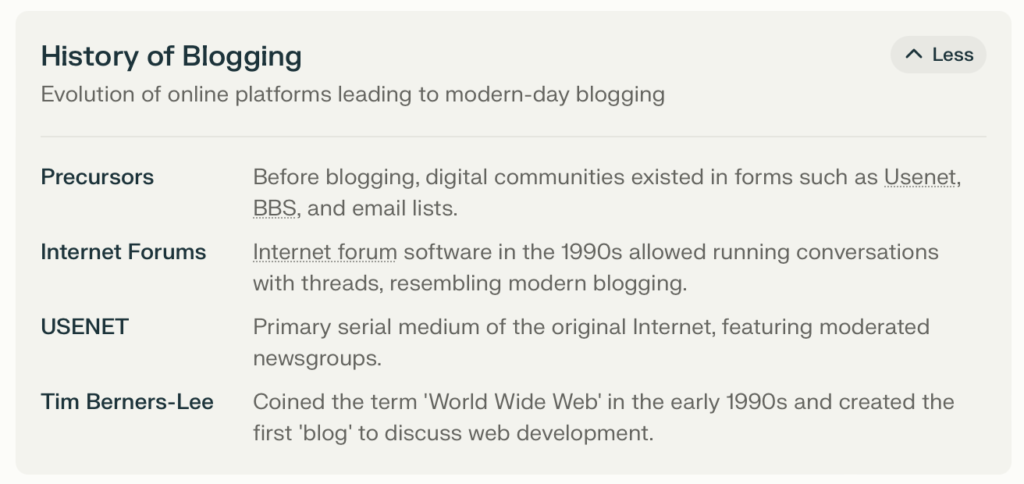
Perplexity: Origin of the term “blog”

The word “blog” is a shortened form of the term “weblog,” which was coined by Jorn Barger on December 17, 1997. The shorter version “blog” was coined by Peter Merholz, who jokingly broke the word “weblog” into the phrase “we blog” in the sidebar of his blog Peterme.com in April or May 1999.

The term “weblog” itself originated from the practice of logging or recording information on the web, similar to how sailors would log details of their voyages in a ship’s log. The “web” part refers to the World Wide Web, and “log” refers to the act of recording or journaling.

So in essence, “blogging” stems from the concept of maintaining an online log or journal, which evolved from earlier forms of digital communities like Usenet, email lists, and bulletin board systems. The term gained widespread popularity after Pyra Labs used “blog” as both a noun and verb in connection with their Blogger product in the late 1990s.

When ChatGPT can read my blog

ChatGPT recently informed me it could do some creative and useful things for me if I gave it access to my Google Drive files and folders. I thought about it but since I have just about everything in Google Drive I decided to wait a bit. For now I can simply upload or link to a document or file. But the list of things ChatGPT could do with this access was impressive. So I asked if it could “read” my 6,000+ blog posts.


ChatGPT currently doesn’t have the capability to directly access or interact with content on external websites, including public blogs, in real-time. However, you can share specific posts or content from your blog, and I can help analyze, discuss, or provide feedback based on that. If there are specific posts or themes you’d like to talk about, feel free to share them here, and we can dive into the details.

To which I replied, Let’s assume that at some point in the future ChatGPT will be able “read” the 6,000+ posts on my blog. (Something no human has ever done) Wouldn’t that dramatically… enhance? … our interactions?

Absolutely, if ChatGPT could read and analyze all 6,000+ posts on your blog, it would greatly enhance our interactions. Here’s how it could benefit:

  1. Personalized Responses: Understanding the nuances of your thoughts, interests, and experiences documented over the years would allow me to tailor responses to be even more relevant and insightful.
  2. Contextual Awareness: I could reference specific posts or themes you’ve discussed previously, providing continuity and depth in our conversations.
  3. Enhanced Recommendations: Based on your past writings, I could offer more targeted suggestions for books, topics, or activities that align with your interests.
  4. Insightful Analysis: I could help identify patterns or recurring themes in your blog posts, providing a fresh perspective on your work and potentially sparking new ideas.
  5. Memory and Continuity: Our interactions would feel more seamless, as I’d have a detailed “memory” of your blog posts, making it easier to pick up where we left off in previous conversations.

In essence, this capability would make our interactions more dynamic, informed, and personalized, making me a more effective conversational partner.

What, I asked, are the technical obstacles to having this functionality now?

There are a few technical and practical obstacles to implementing this functionality currently:

  1. Data Privacy and Security: Accessing and processing large amounts of personal data, like your blog posts, involves significant privacy and security considerations. Ensuring that such data is handled securely and with appropriate permissions is crucial.
  2. Data Integration: Integrating and processing a large volume of text data from an external source like a blog requires robust data integration techniques. This involves fetching, parsing, and storing the data in a way that can be efficiently queried and analyzed.
  3. Computational Resources: Analyzing 6,000+ posts involves substantial computational power, both for initial processing and for real-time interactions. This necessitates efficient algorithms and scalable infrastructure.
  4. Natural Language Understanding: While natural language processing (NLP) has made significant advancements, understanding the context, tone, and nuances across thousands of posts is still a complex task. This requires advanced models and potentially custom training to accurately capture your writing style and preferences.
  5. User Control and Customization: Giving users control over what data is accessed and how it is used is essential. This means developing user-friendly interfaces and options for customization, which adds another layer of complexity.
  6. Ethical Considerations: There are ethical considerations around the extent of data analysis and the potential for unintended consequences, such as reinforcing biases or making incorrect inferences.

While these challenges are significant, they are not insurmountable. Advances in AI, NLP, and data processing continue to evolve, making such functionality more feasible in the future. It will require careful planning, robust technology, and thoughtful implementation to ensure it is done effectively and ethically.

Hotel California guitar solo

Chen is one of the daughters in a “family band” from the Philippines. She —and what I assume are her two sisters and father— perform amazing covers of hit songs. The still to the right is from a 2 1/2 minute video of her playing the guitar solo from The Eagles’ Hotel California. A couple of things about this short video grabbed me. Her obvious proficiency with this guitar solo but even more was the blissed out concentration that you see in the faces of the best guitar players. In the zone?

A couple of questions popped into my head: How long did it take her to master this iconic solo… followed by, Who wrote and first performed it. I went to Perplexity for the following, including reference sources:

According to interviews and accounts from Don Felder and others involved, the iconic guitar solos and dueling guitar parts on “Hotel California” by the Eagles came together in the following way:

  • Don Felder originally composed the music and recorded a demo for “Hotel California” at his home studio in Malibu in 1976. On this demo, he improvised and recorded sample guitar solos and parts that he envisioned for himself and Joe Walsh to play on the final recording.
  • When it came time to record the guitar solos and leads in the studio in Miami, Felder and Walsh initially started improvising new parts together. However, Don Henley stopped them and insisted they learn and play Felder’s original demo solo parts note-for-note.
  • The problem was Felder didn’t have the original demo tape with him in Miami. He had to call his housekeeper back in Malibu, have her find the cassette, play it over the phone, and Felder re-learned and transcribed his own improvised guitar parts from the demo.
  • Felder estimates that over half of the iconic guitar solos and dueling parts on the final “Hotel California” recording came directly from the original demo he recorded at home, with him and Walsh splitting up and learning those parts.
  • Specifically, Felder played the first half of the ending guitar solo, while Walsh played the second half. They then combined for the harmonized finale section.

So in summary, while Felder and Walsh did collaborate and split the guitar solos, a significant portion was actually Felder improvising alone on his original demo, which Henley insisted they recreate faithfully in the studio.