Direct Mail Spam (2011)

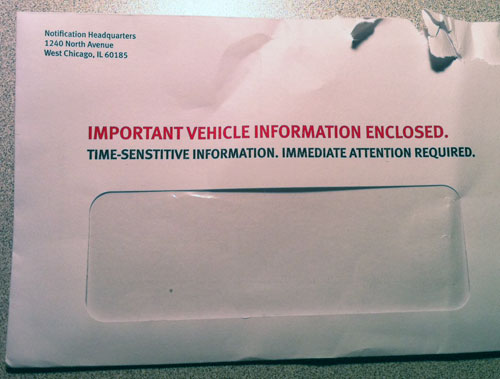
It bothers me –more than it should– that I can filter out most email spam but not the spam that hits my USPS mail box.

The envelope above contained a not-very-interesting offer from a local car dealer (Capitol Chrysler Jeep Dodge). I’m guessing the dealer knew it wasn’t very interesting because he designed the envelope to look like something official from the state DMV. He knew that if the recipient knew is was fr0m a car dealer, she would just toss it.

So, if the dealer is this dishonest in his marketing, why should I expect him to be any more trust-worthy in selling me a car?


“How to make trillions of dollars”

David Cain is (Raptitude) helping me (and many others) “get better at being human.” In this post he explains how television has been used by “very-high-level marketers” to create a nation of people who typically:

  • work almost all the time
  • absorb several hours of advertising every night, in their own homes
  • are tired and unhealthy and vaguely dissatisfied with their lives
  • respond to boredom, dissatisfaction, or anxiety only by buying and consuming things
  • have disposable income but can’t find a more fulfilling line of work without losing their health insurance
  • create health problems for themselves, which can be treated with drugs they can “ask their doctor about”
  • own far more items than they use, and believe they don’t have enough
  • are easily distracted from the unhealthy state of their lives and their culture by breaking news and celebrity gossip
  • perpetually convince themselves it is not the right time to make major lifestyle changes
  • happily buy stuff that breaks within a year, and which nobody knows how to fix
  • have learned, through the media’s culture of blame-mongering, that the key to solving public and private issues is to find the right people to hate

Wow. Sound like anyone you know?

I’m trying to stop watching the evening network news. A tough habit to break. It’s been part of my life since… well, since the beginning of network news. Thanks to DVR technology I can skip all the adds to which Mr. Cain refers.

My friend (and one of the 5 smartest guys I know) Henry has eliminated “news” completely. Or so he says. I’m not sure how one does that. But if anyone can, it’s Henry. He makes a compelling case that knowing the news adds nothing to his life. He’s very well (selectively?) informed, so…

The excerpts above don’t tell you much about “how to make trillions of dollars” so I encourage you to read the full post if that’s something you’d like to do.

    Neuromarketing

    Blipverts from Max Headroom’s world (“20 minutes into the future”) grows more real every day. From The Ego Tunnel by Thomas Metzenger:

    “Today, the advertisement and entertainment industries are attacking the very foundations of our capacity for experience, drawing us into the vast and confusing media jungle. They are trying to rob us of as much of our scarce resource (attention) as possible, and they are doing so in ever more persistent and intelligent ways. Of course, they are increasingly making use of the new insights into the human mind offered by cognitive and brain science to achieve their goals (“neuromarketing” is one of the ugly new buzzwords). We can see the probable result in the epidemic of attention-deficit disorder in children and young adults, in midlife burnout, in rising levels of anxiety in large parts of the population.

    New medial environments may create a new form of waking consciousness that resembles weakly subjective states — a mixture of dreaming, dementia, intoxication, and infantilization.”

    If this page had ads, you’d ignore them

    Robin Wauters takes a look at the results of a new Adweek Media/Harris Interactive survey of about 2,100 U.S. adults. Topic: ads
    “over six in ten respondents say they tend to ignore or disregard Internet ads. Among those who ignore online ads, two in five say they ignore banner ads (43 percent) the most, and one in five say they ignore search engine ads (20 percent) the most.”
    Ms. Wauters notes Internet ad revenues in the U.S. are at an all-time high. What about other media?
    “people who said they ignore ads on other media: television ads (14 percent), radio ads (7 percent) and newspaper ads (6 percent).”
    If only 7% ignore radio ads, I’ll put that in the win column. Younger folks are more likely to ignore radio ads, compared to older people.
    11% in the 18-34 demo say they ignore radio ads, compared to 6% 55+.
    Ms. Wauters concludes her post by concluding all ads have to be better. Much better