
Good look at the Google Ad Creation Marketplace

Can Google Audio Ads be as easy and effesctive as Google AdWords? That was the question Donna Bogatin (Digital Markets) put to André Bergeron, owner/operator of Babble-On Recording Studios. She wanted “a radio production talent insider take” on how the Google Ad Creation Marketplace will impact the radio advertising industry. Bergeron seems to know what he’s talking about.

“Dollar-A-Holler Radio ads have been around forever. The local Hi-Fi Store owner could always go into the local station and bark off a series of sale prices in shrill tones that would annoy anyone within earshot. This would be no different, really. There is so much more to effective messaging, to branding, to understanding how people listen to the radio than simply writing down “for all your underwear needs” and handing it off to Johnny promo voice to record.

Part of why people can’t stand listening to the radio is the quality of the ads, they’re, by most estimations, shouted, boring, and insultingly simplistic, and, if there are a lot of them, it just magnifies the mind-numbing nature of them.”

I think that sentence really sums it up. That reality will ultimately prove to be The Big Problem for radio going forward. Shitty commercials in an era when we no longer have to listen to them in order to hear the news and music we want.

Andre Bergeron emails an additional thought:

Throughout a programming day, the station dresses itself with a carefully crafted image using music, personalities, promotions, etc – to create “a brand”, if you will. Then a stopset comes on and it’s like the advertisers are allowed to dress the station in clown’s clothes, leisure suites or horizontal stripes.”
When advertisements become recommendations

“As we move to an age where the only true advertisements are recommendations, what is the role of the traditional advertisement going forward? Recommendations I understand. They can come in many shapes and forms. People you know and trust telling you about products and services they like … A matching engine that takes your “buying” intentions and connects them with someone else’s “selling” intentions.”

[JP Rangaswami via gaping void]

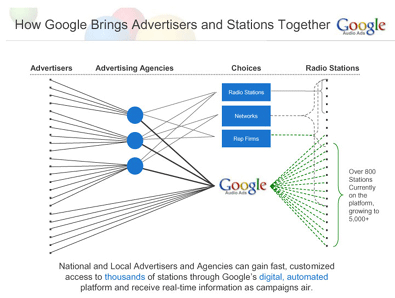
How Google Audio Ads work (PowerPoint slides)

The folks at ZDNet’s Digital Markets have some PowerPoint slides that illustrates how Google Audio Ads work. And this from Voices.com:

“Google has positioned the Audio Ads system to serve both top-level advertisers, as well as the advertising agencies themselves. The graphic also shows 75% of the transactions coming from the agencies, and only 25% from independent advertisers. This is likely because advertising agencies already have media planning and media buying personnel, not to mention existing relationships with local and regional radio stations.”

The lables in the little blue rectangles are: Radio Stations, Networks and Rep Firms. Which suggests that advertisers will simply have another option for placing their ads on radio stations. And if Google can make it easier or cheaper or more effective (i.e. feedback, reports, etc)… they’ve added value to the process.

Update: Google Audio Ads

From Inside AdWords blog: “Over the last year, we’ve been working hard to integrate the dMarc advertising platform into Google AdWords. We’re happy to announce that the integration is now complete and we’ve recently begun a U.S. beta test of Google Audio Ads with a small group of AdWords advertisers.”

If you haven’t been keeping up, here’s how Google describes their Audio Ads:

“Google Audio Ads brings efficiency, accountability, and enhanced ROI to radio advertising by providing advertisers with an online interface for creating and launching radio campaigns. You’ll be able to target your customers by location, station type, day of the week, and time of day. After the radio ads are run, you will be able to view online reports that tell you exactly when your ad played.”

A couple of days ago, Mark Ramsey (Hear 2.0) pointed us to an application page on the Google website.

Ad Specialist Application — Thank you for your interest in joining the Google Ad Creation Marketplace. We’re looking for some of the top audio ad specialists to join our Ad Creation Marketplace – a searchable directory of talent to help AdWords advertisers to create radio advertisements. For advertisers new to the radio space, or who are starting a new campaign, the Marketplace provides an invaluable starting point for finding the talent they need.

So, I decide to buy some Google Audio Ads. I search the Google Ad Creation Marketplace database for someone to write and produce my spot. We agree on a price. I send some copy. They email back an MP3 file. I’m off to the races. Maybe. Mr. Ramsey is skeptical and I confess I am too. But if it works… it could have a profound change on how advertiser buy and place ads.

Update: According to News.com, the radio ads are running in more than 260 metropolitan markets, covering about 87 percent of the country

George Carlin on mindless marketing blather

AdRants points us to a wonderful 4 min bit of a George Carlin performance:

“More than half of what comes out of your mouth in that client presentation is mindless, pointless, idiotic sounding, space-filling blather. Don’t you want meetings to be shorter? Aren’t you sick of fake words that mean nothing? Wouldn’t you rather be actually creating something rather than killing it with the boatload of words you throw at it before you ever show it to the client? Of course you would. So stop talking like an idiot.”

I’ve been working hard in recent years to do more listening than talking in meetings with clients. I’m not there. I still talk too much. But I’m making progress.

The experiment I’m dying to try is to record (audio) one of the client presentations. And then transcribe it. That is when we will see just how mindless and pointless most of our blather is. The simple truth is, we can’t hear how dumb we sound while we’re talking.

Apple ditches “Mac Guy” in new ads

Apple’s “I’m a Mac” campaign is almost perfect: It’s funny, memorable, and efficiently lays out the advantages of Macs over PCs. Its only defect: Virtually everyone who watches it comes away liking the “PC guy” while wanting to push the “Mac guy” under a bus.

Justin Long (the “Mac guy”) is out. The campaign’s other principals, director Phil Morrison and journo-humorist John Hodgman, are both returning for another round of spots.

According to Seth Stevenson, ad critic for Slate, Long is “just the sort of unshaven, hoodie-wearing, hands-in-pockets hipster we’ve always imagined when picturing a Mac enthusiast…. It’s like Apple is parodying its own image while also cementing it.” Of the polymathic Hodgman, Stevenson writes, “Even as he plays the chump in these Apple spots, his humor and likability are evident.” — Radar Online

I didn’t find the Mac guy ‘a smug little twit.’ Hmmm. I shudder to think what that says about moi.

Google (still) moving into radio

“Web search leader Google Inc. is hiring scores of radio sales people and is spending heavily in a bid to expand its position in the $20 billion radio industry. Google spokesman Michael Mayzel said this week that the company will begin a public test of Google Audio Ads by the end of the year. Advertisers will be able to go online and sign up for targeted radio ads using the same AdWords system they use to buy Web search ads.” — Reuters

Should Google buy Clear Channel?

Article in AdAge briefly explores that question. The phrase that jumped out of the story at me was, “automated sale of remnant ads.”

“Right now, through Google’s year-ago acquisition of dMarc, a radio systems company, it has been able to create an automated way to sell what is mostly remnant radio inventory, which remains unsold until the last minute. But, noted Mr. Bank, Google Audio is making several high-profile hires in the radio sales field in major radio markets. Now why, if Google Audio’s selling of remnant ad time is so automated, would there need to be so many high-priced radio ad sales folks.”

I’m pretty sure a big chunk of my salary for the past 20 years has come from acquiring and selling “remnant radio inventory.” Should companies that trade services for commercials on radio stations (we call it barter) be concerned about this? My guess is most station managers would rather have cash for his unsold commercials.

The Google-Clear Channel idea is an interesting one. CC has lot of stations and Google has figured some things out about advertising.