
The Girl with the Dragon Tattoo (movie)
 You’re reading a novel with a particularly good character and you think, “They’ll never find an actor who can bring this fictional person to life.” That happens to me frequently and I’m usually right.
But the Swedish producers of The Girl with the Dragon Tattoo did a wonderful job of casting Noomi Rapace in the role of Lisbeth Salander.
This is one of the better movies I’ve seen in a long time and watching with sub-titles didn’t detract in the least. After the first few minutes I forgot I was reading the actors words at the bottom of the screen. (I should mention, however, that Barb and I had read Stieg Larsson’s novel, so that probably made it easier to keep up.)
We’re fortunate to have a theater nearby that shows foreign language films. I supose it’s possible the U.S. remake of this film could be a winner but I encourage you to see the original.
Clay Shirky: The Collapse of Complex Business Models
I won’t attempt to summarize this post by Clay Shirky. The best I can do is pull a couple of quotes. If you’re in the media business, you’ll want to skip this one.
“…most TV is made by for-profit companies, and there are two ways to generate a profit: raise revenues above expenses, or cut expenses below revenues. The other is that, for many media business, that second option is unreachable.”
“When the value of complexity turns negative, a society plagued by an inability to react remains as complex as ever, right up to the moment where it becomes suddenly and dramatically simpler, which is to say right up to the moment of collapse. Collapse is simply the last remaining method of simplification.”
Nothing on my mind
I’ve been reading about and practicing meditation for a couple of years with the goal of a quiet mind, free from thoughts, for half an hour.
(If you’re an experienced practitioner of meditation, please don’t write to tell me what I’m doing wrong. I will stipulate that.)
I don’t know at what age we have our first thoughts. But once they start, they don’t stop, except when we’re asleep. (Do we think when we’re asleep? Are dreams thoughts?)
Most of us believe we “choose” our thoughts. I can think about a banana… and then switch to a porcupine. If that’s true, it would seem to follow we can choose NOT to think. I have no idea if that is, in fact, possible. But maybe we can reduce the number and “volume” of our thoughts. Sort of like the relative quiet that comes after turning off a blaring television.
Why bother, one might ask. Well, it is restful and pleasant and might have health benefits (But let’s not go there.) I’m also curious about what I might “hear” if I can tune out all of the static.
Back in my radio days, one of the “sign-on” procedures involved warming up the station transmitter. Once it was ready, you punched a button that turned on the carrier (wave). Then I’d walk back into the control room, open the mic, and read the sign-on announcment.
If a listener had their radio tuned to our frequency (830), they would hear a low hum for those few seconds before I began talking.
That’s the “almost silence” I’m shooting for. Who know what signal might be hidden by the noise of our daily thoughts?
Kindel Book Reader for the iPad
I plut the Kindel book reader on the iPad because I couldn’t find the title I wanted for the iBook. But it works fine and while re-reading William Gibson’s Spook Country, I discovered an interesting feature.
I highlight or underline passages in paper books and the the ebook readers make this nice and easy. In the example below, I highlighted a line in yellow. Curious about the dashed line under the next paragraph I clicked and got the little explanation bubble.
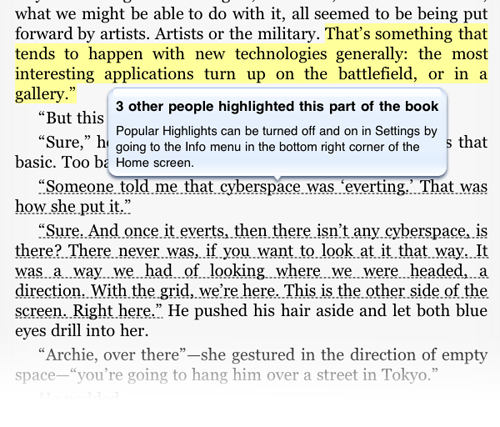
This feature can be turned off but I think I’ll leave it on for now. Obviously I have at least one thing in common with those other readers: this book. Interesting to see what passages they find noteworthy.