“The enemy has a name now”

From a scary post by John Pilger:

“Like the European revolutions of 1848 and the uprising against Stalinism in 1989, the Arab revolt has rejected fear. An insurrection of suppressed ideas, hope and solidarity has begun. In the United States, where 45 per cent of young African-Americans have no jobs and the top hedge fund managers are paid, on average, a billion dollars a year, mass protests against cuts in services and jobs have spread to heartland states like Wisconsin. In Britain, the fastest-growing modern protest movement, UK Uncut, is about to take direct action against tax avoiders and rapacious banks. Something has changed that cannot be unchanged. The enemy has a name now.

If you really believe the problems facing our country can or will be solved with the next election (or a Democrat or a Republican), raise your hand.
“The Future of Work”

Chris Brogan thinks work will be more and more modular, mobile, cause-balanced, smaller/bigger, and goal-aligned.

“Many of us will start using “project” as the unit of measurement of work. Meaning, a job won’t be a job any more, but a collection of projects, sometimes with the same employer and sometimes not. We will all work a bit more like Hollywood’s film industry, gathering the right team for the right project, and having more than one “picture” in the works at all time. This will require a lot more self-organizing and a lot more self-discipline, but people who define work around the unit of “project” instead of the unit of “job” will definitely have a better chance of succeeding.”

Brogan notes that “management styles are still based around “butt in chair” metrics.” While you might just be hoping to have a job in the future, this short –but insightful post– is worth a read if you want a peek at what things will be like in the future.

Memory is fiction

A recurring theme in some of my recent reading has been the nature of subjective time. Among other insights, that the past and the future are delusions, created by the mind. This is a little easier to grasp for the future. Any ideas we have about what is going to happen is clearly fiction. But the past feels more “real.” It happened. I remember it. But that’s fiction as well.

“A memory is only as real as the last time you remembered it. The more you remember something, the less accurate the memory becomes. The larger moral of the experiment is that memory is a ceaseless process, not a repository of inert information. It shows us that every time we remember anything, the neuronal structure of the memory is delicately transformed, or reconsolidated.” — The Frontal Cortex

This reminds me of the scene in Blade Runner when Rachel discovers her memories are implanted. A disturbing thought because (for most of us) we ARE our memories.

But if that’s not really so, if our memories are fiction, who are we? Probably not who we think.

The goodness of GoodReader

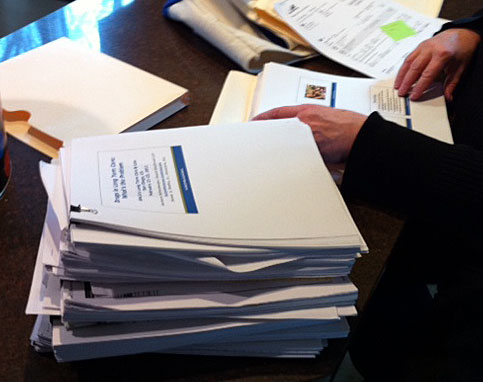
Barb is attending (and speaking at) a legal conference in San Diego this week. The photo shows some of the documents she insists she might need access to.

In the bad old days she might have shipped these to her hotel (and back). For this trip they are all neatly organized as PDFs in GoodReader on her iPad.

Super-thin displays are here

via singularityhub.com

Perhaps one day the Super Bowl could be televised uninterrupted by commercial breaks – the camera could simply zoom in on the quarterback’s AMOLED covered helmet during a time out. Or even better for advertisers, their commercials could play throughout the game, turning each helmet into a video display>