
“Blogging’s ability to impact mainstream discourse has never been greater. When I worked as a reporter a decade ago, I knew that when my editor decided to put something on the web — but not in the actual paper — it was a brushoff. Fewer people would see the web content, and (pre-Google) it would evaporate into the ether; it wasn’t solid like an actual paper on someone’s doorstep. Now the hierarchy has been reversed; an article lives forever on the web and will be seen around the world. Nick Bilton’s blog on the New York Times website has just as much credibility as what’s in the print edition; and Mashable, in the tech world, has as much or more credibility than the Times. Nowadays, we’re measured by the quality of information — not its brand name. If you create high-quality content, you legitimately may become a source as powerful and trusted as the “legacy media.”
My offices
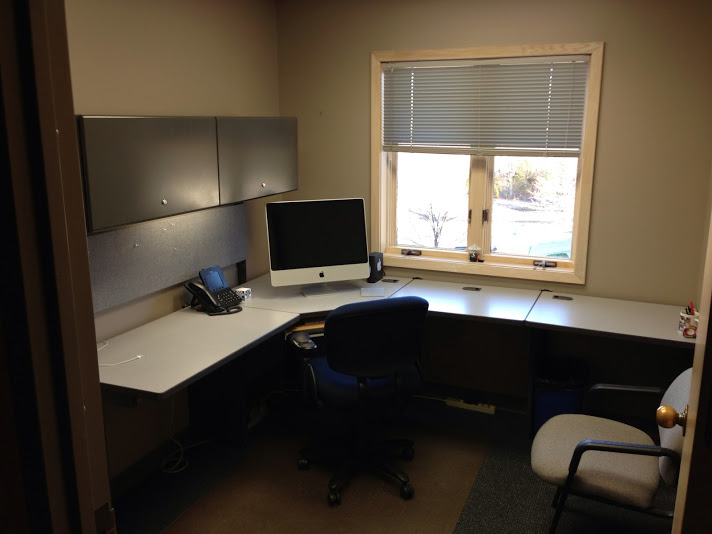
While cleaning out my office yesterday, I reflected on the spaces in which I’ve worked over the past 40 years. During my radio days I spent most of my hours in a studio (on-air or production). When I came to Learfield they didn’t have a real office but provided a tiny desk on a tiny sun porch attached to the old house.
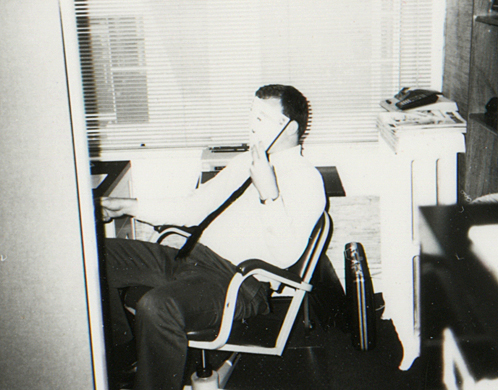
I don’t have a photo of my desk but it looked just like this one (in which Roger Gardner is hiding his face for some reason). I got a nicer space when Jim Lipsey and I each had a corner of a big old room in that same house.
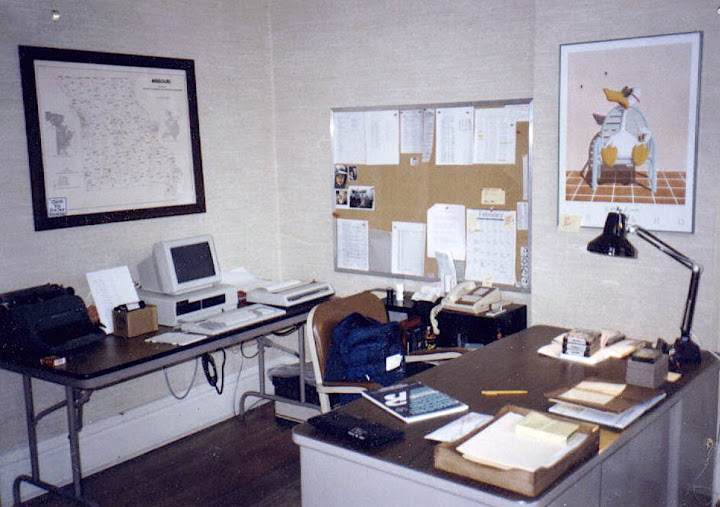
We eventually built the nice building we’re in now and I had a nice office just a couple of down from our CEO. That proximity mattered in those days (perhaps it still does). The carpet was a different color in these offices to visually make the point we were special.
I suppose we once needed offices to put things like filing cabinets and typewriters and chairs for visitors. And we needed a private space to talk about things that others weren’t authorized to hear. My little office started feeling like a small prison cell (albeit with a big window).
In an era of smart phones and MacBooks, a building filled with little square rooms lining hallways seems… quaint. Hardly the best use of space. But then, where would I keep my stapler.
No rest of life
“There is no rest of life. Life is one. Without beginning, without middle, without ending. The concept: beginning middle and meaning comes from a sense of self which separates itself from what it considers to be the rest of life. But this attitude is untenable unless one insists on stopping life and bringing it to an end. That thought is in itself an attempt to stop life, for life goes on, indifferent to the deaths that are part of its no beginning, no middle, no meaning. How much better to simply get behind and push!” — John Cage
Manufactured Normalcy Field
I wouldn’t know how to begin to describe this piece, so I’ll just share a few nuggets. If you have any interest in things like past and present and reality, the full post is worth a read.
we live in a continuous state of manufactured normalcy. There are mechanisms that operate — a mix of natural, emergent and designed — that work to prevent us from realizing that the future is actually happening as we speak. To really understand the world and how it is evolving, you need to break through this manufactured normalcy field. Unfortunately, that leads, as we will see, to a kind of existential nausea.
What is interesting is how this psychological pre-disposition to believe in an unchanging, normal present doesn’t kill us.
How, as a species, are we able to prepare for, create, and deal with, the future, while managing to effectively deny that it is happening at all?
a typical air traveler never experiences anything that one of our ancestors could not experience on a fast chariot or a boat.
even though air travel is now a hundred years old, it hasn’t actually “arrived” psychologically. A full appreciation of what air travel is has been kept from the general population through manufactured normalcy.
we are all living, in user-experience terms, in some thoroughly mangled, overloaded, stretched and precarious version of the 15th century that is just good enough to withstand casual scrutiny.
Instead of a newspaper feeding us daily doses of a shared Field, we get a nauseating mix of news from forgotten classmates, slogan-placards about issues trivial and grave, revisionist histories coming at us via a million political voices, the future as a patchwork quilt of incoherent glimpses, all mixed in with pictures of cats doing improbable things.
We aren’t being hit by Future Shock. We are going to be hit by Future Nausea. You’re not going to be knocked out cold. You’re just going to throw up in some existential sense of the word.
Lawyers ditching Blackberry
According to the American Lawyer survey, 88 percent of the CIOs expect a net drop in the number of BlackBerry users at their law firms in the next 12 months. And firms that allow lawyers to bring their own devices to work are reporting benefits; the biggest one, according to 70 percent of the CIOs, is more cheerful users.