Buyers shifting to new media

Story on the Broadcasting & Cable website about ad buyers shifting to new media:

“Advertisers are shifting as much as 20% of their media dollars away from traditional media—TV, magazines and newspapers—and moving them to emerging categories, such as the Internet or movie theater ads.”

Hello? Did you forget radio? Are we not part of traditional media? Or are we not affected by this? (I’m looking for the pony.) And please tell me advertisers are not really taking money out of radio to buy movie theater ads. I refuse to believe that.

Office make-over

They’re painting all of the offices along our hallway so I’m homeless for a couple of days and the webcam is offline. The office make-over is taking forever and god only knows the price-tag when it’s over but Learfield will be one very nice place to work when everything is complete. I can’t imagine working in nicer surroundings. And today the company had a cookout, just for the hell of it. Someone invited the the guys doing the work on our building so we were all sitting around drinking beer and eating ice cream and feeling fortunate.

How Barb Spent Her Summer

For those wondering what Barb does when she’s not cooking and scrubbing, we refer you to the American Health Lawyers Association’s Guide to Legal Issues in Life-Limiting Conditions. Barb is a co-leader of the task force which produced the guide and a teleconference that explained it (“The Role of Family and Health Lawyers in End-of-Life Decisions”). It’s all abaout “the important legal and practical issues that arise in the care of individuals who face a life-limiting condition.” I think “life-limiting condition” means “you’re dying.” [News release]

Seth Godin keynote at NAB

Couple of nuggets (via Radio and Internet Newsletter) from Seth Godin’s keynote this morning at the National Association of Broadcasters annual meeting in Philadelphia:

“With the web and satellite radio and WiMax, radio’s not going to be one-way communication any more — it’s going to be two- or three-way. You’re either going to embrace it or not.”

“The FCC is the reason you exist,” Godin said. “It’s about limited spectrum. If there were a million FM stations, you couldn’t sell any advertisements.” But with the advent of TiVo, Xbox, DVDs, Yahoo!, Escient, home theaters, 400 TV channels, 10,000 magazines, and more, “the TV-industrial complex is going away. What are you going to do about it?”

He challenged his audience,”How many podcast subscribers do you have?”, noting that one New York City station has 50,000 subscribers now and will someday have 500,000 subscribers — “and each one of them is someone who’s not listening to you.”

Responding to the speakers before him who extolled the value of radio’s localism, Godin noted, “Local doesn’t necessarily mean local on a map; it can mean local based on interests.”

Can we go back to diaries?

Radio broadcasters, preparing to descend on Philadelphia for the National Association of Broadcasters annual convention, may find the ratings from Arbitron’s portable people meter trial in Houston a tough pill to swallow.

Overall, average quarter hour ratings are down by 20 percent compared to diary measurement, with morning drive, radio’s biggest revenue-generating daypart, taking the biggest hit, down by more than 35 percent. Midday ratings were also lower under the PPM, down 21.9 percent. Other dayparts were down on average by 12 percent. [Media Week]

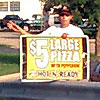
Professional Sign-holders Wanted

Former Radio Guy Matt Zeni recalls a radio interview on his station some years back:

“I saw a want ad in the Branson daily newspaper for full-time opening(s) for people to hold advertising signs on Highway 76 and the job included full benefits! The job paid $8.50 – $9.00 per hour plus medical and insurance. You could only keep the job, according to the owner of the advertising business, if you constantly waved to all the cars driving or stuck in traffic.”

Radio: Media comfort food

A couple of new services from Sprint allows “some subscribers to stream live music to the phone in a radio-type format without having to buy a new phone or have lots of storage.”

I don’t have a mobile phone and wouldn’t buy one to stream live music (I didn’t think I’d buy and iPod either) but that’s not the point of this post. When I read this story (in the Seattle Times) I thought, “Where in the hell are the stories about cool things happening in radio?” I realize it is a “mature technology” but, come on… there’s got to be something going on out in radio land. Help me out here.

Dave, you work in/for/around radio. What’s the buzz? What has radio juices flowing? Bob, Morris… tell me something to get me excited. Send me a link and I’ll read/post it.

Then again, maybe radio is like your mom’s cooking. You take it for granted. No, it’s not hot or new or sexy…but it’s always there for you. A funnel cloud was sited near (?) Jefferson City tonight and I turned on my little transistor radio and listened to some pretty good coverage. Not very high tech but reliable and…comforting.

Companies don’t blog; people blog

The headline above was my big take-away from an excellent white paper (from The Content Factor) titled: To Blog or Not to Blog? How Business Can Get Closer to Their Markets through Blogging. Their “Ten Rules for Starting Your Corporate Blogging Off Right” are on the money (for my money). Nuggets:

* You can’t blog by committee.

* Conversations are already taking place among the millions of blogs that you can tap into. These conversations—about you, your industry, your company, your competitors, and your market—will occur whether you participate in them or not.

* The unique word-of-mouth marketing secret of the blogosphere: the human urge to tell people about things that interestus, adding our own impressions as we do. This is the DNA of conversation.

* Blogging has potentially the lowest barrier to entry of any communications medium to date aside from word of mouth, and offers the farthest reach for the least cost when done right For this reason alone, there is no question that your organization should be participating in the world of blogs. This is no time not to be part of the conversation.

If you own a company…work for a company…do business with a company… I encourage you to download and read this white paper (PDF).

Is the advertising pie big enough?

I’ve wondered about this but not as thoughtfully as Ben Compaine, who posts on the Rebuilding Media blog:

Can the media survive on advertising? Lots of folks are counting on it. Broadcasters have always had this single revenue stream. Daily newspapers get about 80% of revenue from advertising and the hot print properties, such as the give-away Metro dailies, depend about 100% on advertising. Now much of the Web is counting on advertising: Google, Yahoo! and increasingly AOL to name just a few of the biggies.

Either the pie gets bigger or somebody gets a smaller slice.