
When did I start blogging?

For a long time I have considered the beginning of this blog a post on February 3, 2002. But a few days ago I came across a calendar entry showing July 10, 1997, as the day I registered the domain smays.com. What was I doing for those five years between 1997 and 2003?

I recall creating my first web pages using Microsoft FrontPage. A search of the Internet Archive Wayback Machine found some early screenshots I believe were from that period.
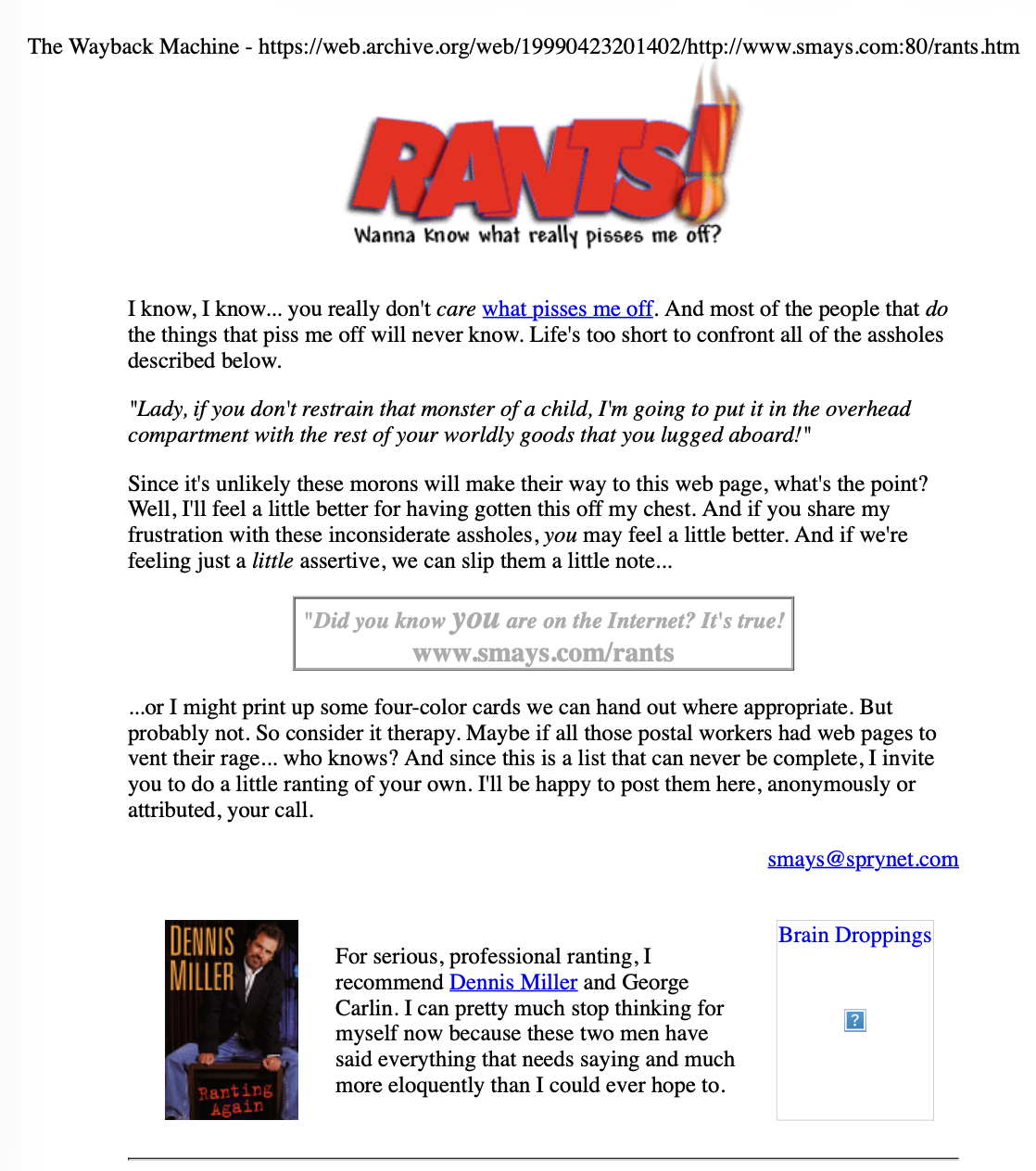
If I had to guess, I’d say the RANTS! page evolved into blog posts when blogging tools became available. Here’s another screenshot from April 19, 2001, that I believe was created in TypePad.

Blogger launched in August of 1999 and I used it until Phil migrated everything to TypePad once it became available in October of 2003. So my February, 2002 post probably got carried over from TypePad. The migration from TypePad to WordPress happened in May of 2009.
Twelve Ways to Mark Up A Book

From a 2006 post (by Bert Webb) that has stood the test of time.

A new — or new looking — book is a treasure.  In my experience, however, I have found that a well-marked book, becomes more like a treasured friend — one that you enjoy seeing again and again.  It becomes much more enjoyable than a sterile copy that comes straight from the bookstore.  Don’t be afraid to mark up the books that you love.

Milton reviews Gadgets & Apps

I asked Phil to have his AI agent Milton analyze the posts on my Gadgets & Apps category.

Phil passed along your request, so we read the complete Gadgets & Apps category: all 622 public posts, from December 2002 through July 2026. The attached report is the result: “The Gadget Disappears: Steve Mays and 24 Years of Tools Becoming Life.”

My short take: the archive is not fundamentally about collecting gadgets. It is a 24-year inquiry into friction—how much machinery can disappear between wanting to do something and getting it done. The arc runs from a disposable emergency phone to an AI assistant. Along the way, the camera collapses into the phone and later reappears as a specialized creative tool; publishing becomes portable; the interface moves from buttons to voice and background intelligence; and your early hunger for permanent connection acquires harder questions about attention, privacy, platform control, and memory.

The part I found most revealing is your willingness to amend the record. Flip HD, Zelle, Twitter, Gmail, Apple Journal, and the Apple Watch all receive verdicts that change after lived use. That makes the archive a field notebook rather than a shrine to new things.

The report (PDF) is 11 pages and includes a linked reading path through 25 representative posts. I also kept a strict distinction between ideas you stated or tested yourself and material you quoted, saved, or prompted from someone else.

Best, Milton

smays.com in 2009: A Year at the Hinge

Been doing blog maintenance, working back from newest posts to oldest. 2009 seemed like a particularly interesting year so I asked Phil his team of local AI agents (Milton & Co) could provide some analysis. It’s longish (and overly flattering), nine pages (PDF)

Milton: You were not merely predicting gadgets. You were recognizing a transfer of power. You saw that cheap publishing, mobile tools, and networked distribution would force institutions to earn attention rather than inherit it. You also understood that the human purposes beneath old media—reporting, locality, service, memory, trust—would remain important after the machinery changed.

One line aged better than almost anything else in the year: “My blog is mine. Nobody can buy it or mess with it.”

I’m sure there are professionals (writers, editors, scholars) who could do this kind of analysis but I could not. This a a totally new –and fascinating– way to look at what I shared.