
 The tagline on the Art Text website is: “Where text becomes art,” and that’s pretty much right on. I’ve been looking for an app that would compensate for my lack of graphic design skills and this comes close. If you have the Photoshop chops you can probably do everything that Art Text does but even then it’s going to take you longer. This graphic for the Coffee Zone took about 5 minutes to create.
Ashcroft booed for Obama-Osama gaffe
From rawstory.com: “Former Attorney General John Ashcroft drew the ire of students at liberal Skidmore College this week when he confused the name of Barack Obama with that of Osama bin Laden.
“All I’m saying about the Patriot Act,” Ashcroft began, “is that the elected representatives of this country, including Osama …”
His words were met with a roar of disbelief and disapproval, as he continued stammering, “uh … you know … not … Obama.”
Ashcroft attempted to say “I’m sorry” but was drowned out by prolonged boos.
“I did not mean to … I’m sorry about that … I apologize publicly,” Ashcroft went on as the boos gradually subsided.”
Accident or strategy? Watch the video.
Howard Beale: “I don’t have to tell you things are bad”
I love the movie Network. I went back to a post in September of 2006 to review the prophetic words of Paddy Chayefsky:
“I don’t have to tell you things are bad. Everybody knows things are bad. It’s a depression. Everybody’s out of work or scared of losing their job. The dollar buys a nickel’s worth. Banks are going bust. Shopkeepers keep a gun under the counter. Punks are running wild in the street and there’s no one anywhere that seems to know what to do with us. Now into it. We know the air is unfit to breathe, our food is unfit to eat, and we sit watching our TVs while some local newscaster tells us that today we had 15 homicides and 63 violent crimes as if that’s the way it’s supposed to be. We know things are bad. Worse than bad. They’re crazy. It’s like everything everywhere is going crazy so we don’t go out anymore. We sit in a house as slowly the world we’re living in is getting smaller and all we say is, “Please, at least leave us alone in our living rooms. Let me have my toaster, and TV, and my steel belted radials and I won’t say anything.”
Well I’m not going to leave you alone. I want you to get mad. I don’t want you to protest. I don’t want you to riot. I don’t want you to write to your congressman because I wouldn’t know what to tell you to write. I don’t know what to do about the depression and the inflation and the Russians and the crying in the streets. All I know is first you’ve got to get mad. You’ve got to say, “I’m a human being. God Dammit, my life has value.”
So, I want you to get up now. I want all of you to get up out of your chairs. I want you to get up right now and go to the window, open it, and stick your head out, and yell, “I’m as mad as hell, and I’m not going to take this anymore!” I want you to get up right now. Get up. Go to your windows, open your windows, and stick your head out, and yell, “I’m as mad as hell and I’m not going to take this anymore!” Things have got to change my friends. You’ve got to get mad. You’ve got to say, “I’m as mad as hell and I’m not going to take this anymore!” Then we’ll figure out what to do about the depression and the inflation and the oil crisis. But first get up out of your chairs, open your window, stick your head out and yell, “I’m as mad as hell and I’m not going to take this anymore!”
I am (not) “Howard Beale”
There. It’s out in the open. I feel better already. I am the political blogger who posts under the pseudonym “Howard Beale.” Because I so passionately believe all the things I write, I can no longer hide behind a curtain of secrecy. I’m out, baby!
I’m still trying to figure out how to work my blogging software so I can start using my real name on my blog posts, so you’ll still see “Howard Beale” for a while. But it’s me, smays.com.
And I call on my fellow phantom bloggers to pull off their masks and take ownership of their words. Trust me, you’ll feel better.
UPDATE: Okay, joke’s over. Even my closest friends didn’t spot this as a hoax. That’s scary. This ridiculous post (and photo) should be obvious as a spoof. Looks like the real “Howard Beale” is safe for now.
NOBODY beats the Claw Machine!
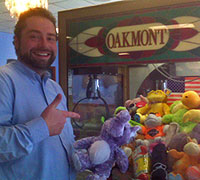 Chinese for lunch. As we were leaving, Scott dropped some quarters in The Claw Machine. JUST missed the purple elephant on the first try and got him on the second.
I have NEVER seen anyone beat The Claw Machine. They make the “claw” so feeble it can’t hold any weight. But Scott beat it. As we left, the owner was coming over with a screwdriver to loosen up the old claw.
NPR story on Internet doctor visits
From NPR: "As more doctors go online to communicate with patients, two of the country’s biggest health insurers have started reimbursing patients for the Internet visits. But critics say the online advising could lead to errors, and patient privacy could be compromised."
When it’s too risky to sign your name
Technology in the Missouri Senate
 I got a few minutes with Missouri State Senator Charlie Shields this morning. Senator Shields –the Majority Floor Leader– was kind enough to let me ask a few questions at a very busy time for the legislature. I wanted his take on how the Senate uses –or doesn’t– use technologies like laptops, the web, smart phones, Blackberry’s, blogs and podcasting.
The House allows laptops in the chamber but the Senate doesn’t. The concern seems to be that senators would be surfing the web or checking email and not paying attention to debate and the business of the senate. Senator Shields does not agree with that position and feels it’s just a matter of time until laptops are allowed.
I asked about Blackberry’s and smart phones, which are allowed. He said you don’t have to look hard to find a Senator checking his email.
The media can have laptops in the press gallery at the press table. I didn’t ask but assume there is wifi access for the media because I could get it in the hallway waiting to talk with the senator.
I asked if any bloggers had requested permission to cover the senate. He said not to his knowledge. I wasn’t entirely clear on his answer to the question, would bloggers be allowed to cover the proceedings. I think both the House and Senate make a pretty clear distinction between the “real” media and bloggers.
Senator Shields was unaware of any of his senate colleagues blogging. It surprises me a bit that some of the more clued-in haven’t discovered the power of this tool.
As for personal tech gadgets, Senator Shields has a Blackberry and an iPod on which he sometimes listens to jazz podcasts and NPR’s Car Talk.
He concluded with the prediction that the role of technology in the Senate will increase dramatically in coming years. No doubt.
Update: Missourinet News Director Bob Priddy –who has been covering the Missouri legislature since the early 70’s– adds and clarifies:
“We actually don’t have a press gallery as the House does. We have a press table which is on the Senate floor. The senate, of course, has had its sessions on the internet, first on our site, then on others, and then on its own site for many years.
The irony of the idea that Senators will be at their desks checking email or playing games or bidding on ebay is that most senators don’t stay on the floor unless the legislation being considered is really big or unless they have a specific role with any bill. They can be in their offices checking their email or playing games or shopping on ebay.
The use of blackberries and smart phones on the Senate floor is a mixed blessing. It does enable the senators to get information from their office or their staff without leaving their desks. But it also enables lobbyists to send them messages from the hallways, giving lobbyists access to the Senate floor although the rules don’t allow them in the chamber in person. For some folks, that’s not a comfortable relationship but nobody has figured out a way to control that access, nor do they seem to want to.
The use of the computer has helped the amendment process. Senate staff sits at the other table at the front side of the chamber and can prepare amendments on the computer and run them into a printer pretty quickly. It’s been several years since I’ve seen a Senator write an amendment at the desk. In fact, debate is often slowed or stopped so a Senator can go to the staff table and have the staff write an amendment.
Of course the computer has made it a whole lot easier for the people in the clerk’s office to compile the journal, prepare copies of bills with amendments included in them before the bill goes up for final passage—-and just generally manage the flow of documents that go through the place.”
PS: If you’re wondering why I didn’t just post the audio of the interview… I hit the wrong button on my new fancy-pants digital recorder and erased the interview. Please don’t take my car keys.
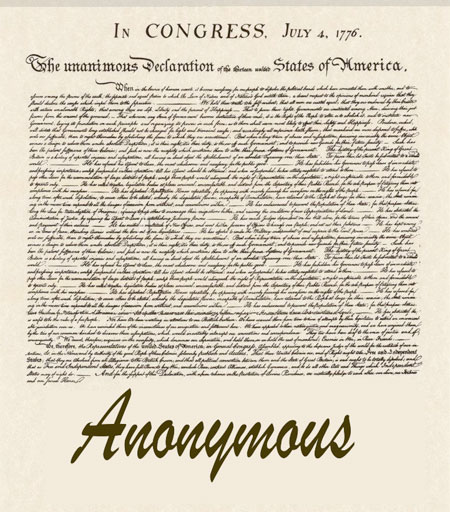
“I’m mad as hell and… anonymous!”
 One of our reporters stepped on blogger toes earlier this week. Steve Walsh is a reporter for The Missourinet, a radio network headquartered in Jefferson City. He took over the network blog a few weeks back and has been doing a good job with it. The post in question attempted to make some “distinctions” between MSM bloggers and “political” bloggers.
“…while the MSM bloggers represent their media outlets and, therefore, must be truthful and accurate … the vast majority of the political bloggers are unaccountable … and sometimes fall short of telling “the truth, the whole truth, and nothing but the truth.”
Ouch. That’s a commonly held view by a lot of reporters. And a lot of folks –bloggers and the public alike– would question the “must be truthful and accurate” part but that’s not what this post is about.
One of the blogs Steve “called out” is Fired Up Missouri. The blog represents the Democratic view of things and the blogger goes by the pseudonym “Howard Beale.” Howard Beale was the fictional news anchor in the film Network.
“Howard Beale” fired back and called Steve to task for a story he did some months ago. Your normal blogosphere kerfuffle.
Steve responded and made what I consider the check-mate move. He pointed out one key difference between MSM blogs like his and Fired Up Missouri. Steve signs his posts and the blogger at Fired Up Missouri does not.
This point trumps all others in my opinion. And adds heavy irony to the choice of the pseudonym “Howard Beale.”
“I want you to get up out of your chairs… go over to your computers… and post an angry rant to your blog… anonymously.” See? Doesn’t work.
But as luck –and some good detective work– I have discovered the identity of “Howard Beale” and will reveal it here at 5:00 p.m. this Friday. I think you’ll be shocked.
Disclosure: The company I work for, Learfield, is the parent company of The Missourinet, the company Steve Walsh works for. I should also point out that I have come out here as supporting Barack Obama. I don’t think of myself as a Democrat because if he wasn’t running I wouldn’t be voting for the Democratic candidate. But if I have a leaning, it’s more toward the views expressed on Fired Up Missouri.
Concrete Art
Clarence Lee Shirrell is one of those lucky people who seem to really love his work. He has a “lawn ornament farm” on Interstate 55 just north of Cape Girardeau, MO. I stopped by this week because I happened to notice Miss C, Clarence’s camel (“You can pet her. She won’t spit at you.”)
I can’t explain my fascination with concrete art (if I may use that word). I think it has more to do with the subjects chosen than the process. Which I assume involves pouring concrete into a mold. I think Clarence Lee said he buys the pieces already cast, so is there a big lawn ornament outfit somewhere and how do they decide what pieces will sell? And who came up with the 8 foot polar bear throwing a snowball?
I had a dozen questions for Clarence Lee but didn’t have time to ask them. For example, which is the better seller: the life-size (whatever that might be) demon or the Virgin Mary. And where would you put the demon?
How did he find Crista Meyer, the lady who paints some of his pieces. And do painted pieces sell better than unpainted? And what prompted the loin cloth on the buff young (Greek?) man. Did someone complain about his tiny concrete pecker and balls (yes, I peeked)?
Perhaps the most interesting thing I found at Concrete Castings was the cryptic message on the back of Clarence Lee’s business card: “Finished files are the result of years of scientific study combined with the experience of many years.”
I think that might be up there with “What’s the frequency, Kenneth?”