
Land Rover: Problem with fuel line

After a lifetime of pumping gasoline into my cars, I’ll have to remember to pull up to the diesel pump. I thought it wouldn’t hurt to have a little reminder like the one in the photo below (not my truck).
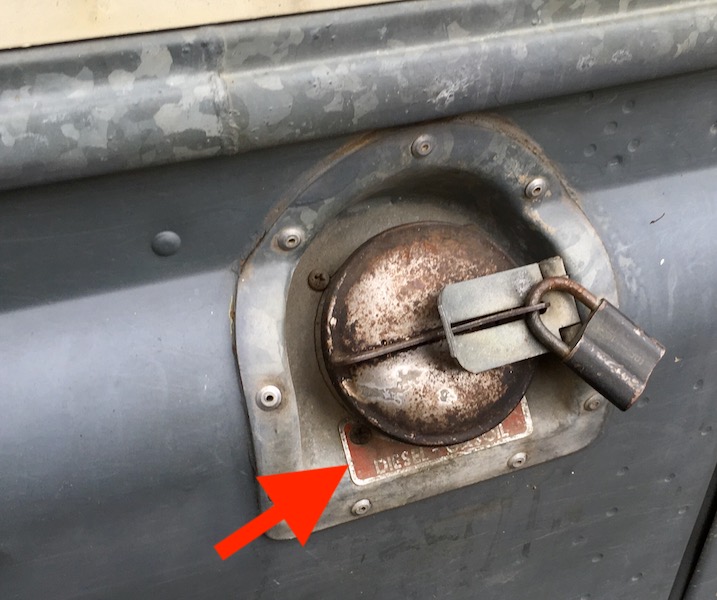
In order to add this little badge, Mr. Wolf had to remove a cowling inside the tub of the the truck.
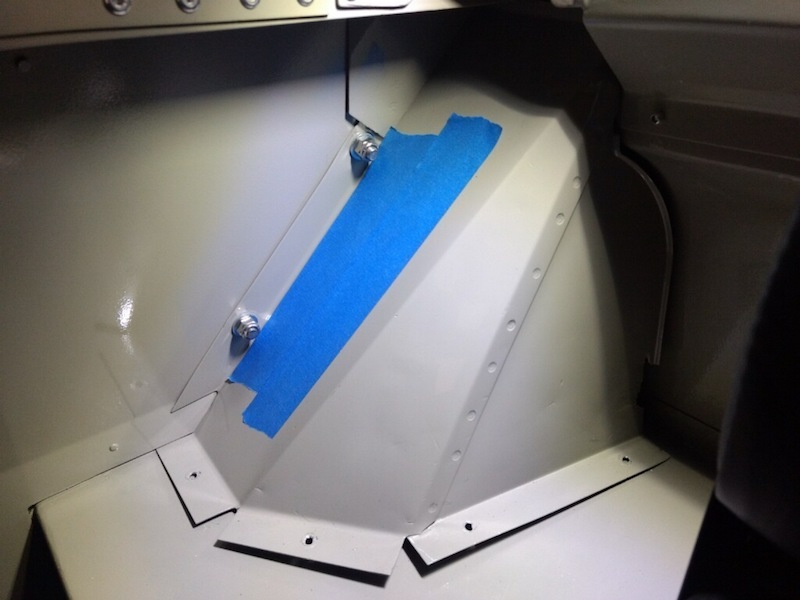
“I am glad you sent me that Diesel Only emblem to install under the filler neck, because installing it meant I had to remove the cowling inside the truck that covers the filler neck, and when I removed it I found that where the rubber hose that connects the filler neck to the tank goes through the floor of the truck, the hose was pressed up against the edge of the opening, cutting into the hose. Then further down toward the tank the hose was severely kinked, which explains why I had such a hard time filling it with diesel the one time I fueled it up. Also, there was no gasket between the metal filler neck and the body. I can’t find one in any parts diagram, so maybe there wasn’t one originally, but I could see this being a water ingress point, so I am going to make a gasket for it.”

This is my first experience with a frame-off restoration but there sure seems to have been a lot of little (?) mistakes like this. All’s well that ends well.

1996 F355 Ferrari Challenge


“1996 Ferrari F355 Challenge. Factory built race car, non street legal. So naturally I drove it down from San Francisco today. I’m doing some fettling to bring it up to par then selling it.”

“In 1995, Ferrari introduced a race-ready F355 Challenge model for use specifically in the Ferrari Challenge. The Ferrari F355 Challenge model was created by starting with a standard Ferrari F355 Berlinetta model and modifying it with a $30,000 factory-to-dealer supplied kit. The initial 1995 cars came with cage mounts factory fitted and carpets removed, each year the cars arrived with more and more race parts factory fitted, culminating in 1998 with full-evolution cars which were supplied as virtually complete race cars though parts such as the rear wing still needed to be fitted.” (Wikipedia)

PS: To illustrate just how small a world it is, this from my friend Andrew: “I rode in a Ferrari challenge car this week. Didn’t drive it cause I didn’t have $330,000 to replace it. But it was amazing. Pure 100% race car. I bet Mr Wolf has been to the track I was at in Arizona.”

What are the odds that I’d be acquainted with two people who were in one of these cars in the same week?

A world without jobs

This article is way too long for anyone with a job to read. So here are a few nuggets:

“Work is … how we give our lives meaning when religion, party politics and community fall away.”

Whether you look at a screen all day, or sell other underpaid people goods they can’t afford, more and more work feels pointless or even socially damaging – what the American anthropologist David Graeber called “bullshit jobs”

“I do think there is a fear of freedom – a fear among the powerful that people might find something better to do than create profits for capitalism.”

As all such articles do, this one mentioned UBI (Universal Basic Income). I don’t know if that’s a good idea or not. But I can almost imagine a world in which — for whatever reasons — there are just a whole bunch of people without jobs. And I can only see two options for dealing with them: Let them starve or provide them with food and shelter. Some way, somehow. I’m counting on smarter people to come up with more options.

Beyond the Bitcoin Bubble

Excerpts from a really good article by Steven Johnson in the New York Times.

The real promise of these new technologies, many of their evangelists believe, lies not in displacing our currencies but in replacing much of what we now think of as the internet, while at the same time returning the online world to a more decentralized and egalitarian system. If you believe the evangelists, the blockchain is the future. But it is also a way of getting back to the internet’s roots.

After a period of experimentation in which we dabbled in social-media start-ups like Myspace and Friendster, the market settled on what is essentially a proprietary standard for establishing who you are and whom you know. That standard is Facebook.

What Nakamoto ushered into the world was a way of agreeing on the contents of a database without anyone being “in charge” of the database, and a way of compensating people for helping make that database more valuable, without those people being on an official payroll or owning shares in a corporate entity.

If you think the internet is not working in its current incarnation, you can’t change the system through think-pieces and F.C.C. regulations alone. You need new code.