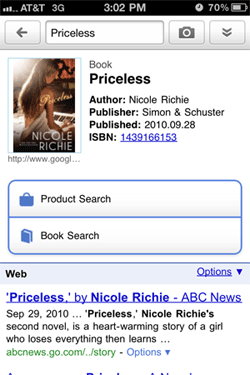
Blackberry users will ask, “Why?” iPhone users ask, “Why wouldn’t you?”
The importance of design at Apple
“…a friend of mine was at meetings at Apple and Microsoft on the same day and this was in the last year, so this was recently. He went into the Apple meeting (he’s a vendor for Apple) and when he went into the meeting at Apple as soon as the designers walked in the room, everyone stopped talking because the designers are the most respected people in the organization. Everyone knows the designers speak for Steve because they have direct reporting to him. It is only at Apple where design reports directly to the CEO.
Later in the day he was at Microsoft. When he went into the Microsoft meeting, everybody was talking and then the meeting starts and no designers ever walk into the room. All the technical people are sitting there trying to add their ideas of what ought to be in the design. That’s a recipe for disaster.”
Radio by any other name would sound as sweet
Mark Ramsey was listening to Fresh Air on NPR the other day and heard Terry Gross reading the credits, which included a reference to “the Chief Content Officer.” That what most stations call their “Program Director.” (A job I once held)
Mr. Ramsey also mentioned that back in July National Public Radio annoucned it would hereafter be known as NPR. It’s been National Public Radio since 1971 but switched tothe acronym because –according to the Washington Post– “Its news, music and informational programming is heard over a variety of digital devices that aren’t radios.”
Hmm.
Our company operates several news networks, including:
Radio Iowa
Wisconsin Radio Network
South Carolina Radio Network
Nebraska Radio Network
We (not me) came up with Radio Iowa back in 1996 and thought it was pretty cool at the time. Like, “Radio Free Iowa.” I was not involved with nameing the others.
We have websites, Twitter feeds and Facebook pages but are first and foremost radio networks.
If someone were starting a new radio network today, what would they call it? I have no idea.
“Information network” vs “social network”
Ben Parr writes a column for Mashable called The Social Analyst. Here is an exceprt from his comparison of Facebook and Twitter:
“On Facebook, you’re supposed to connect with close friends. Becoming friends with someone means he or she gets to see your content, but you also get to see his or her content in return. On Twitter, that’s not the case: you choose what information you want to receive, and you have no obligation to follow anybody. Facebook emphasizes profiles and people, while Twitter emphasizes the actual content (in its case, tweets).”
“The result is that the stream of information is simply different on both services. You’re more likely to talk about personal issues, happy birthday wishes, gossip about a changed Facebook relationship status, and postings about parties on your Facebook News Feed. On Twitter, you’re more likely to find links and news, and you’re more likely to follow brands, news sources and other entities outside of your social graph. In fact, Twitter tells me that one out of every four tweets includes a link to some form of content.”
I think if you boil it down, for me it’s the difference between “Friending” and “Following”
“Unlike most social networks, following on Twitter is not mutual. Someone who thinks you’re interesting can follow you, and you don’t have to approve, or follow back.”
Digital Life After Death
“Future.tk is a social network with an online messaging service that lets anyone schedule messages up to 50 years in advance. Using the free post-mortem feature, it can also schedule messages to be sent to recipients after a death. To use this feature, the sender must select trusted sources to notify Futuris.tk of their passing, after which your messages can be sent.”
Radio’s Future
The American Youth Study 2010 “surveys the the media and technology habits of America’s 12-24 year-olds, and represents a sequel to a study originally conducted by Edison in 2000.” Among the findings:
- Young people spend twice as much time on the Internet now as they do listening to radio.
- Radio continues to be the medium most often used for music discovery, with 51% of 12-24 year-olds reporting that they “frequently” find out about new music by listening to the radio. Other significant sources include friends (46%), YouTube (31%) and social networking sites (16%).
- 3 times as many young people are listening to Pandora radio as listen to traditional radio broadcasts via the Internet.
- More than four in five 12-24s own a mobile phone in 2010 (up from only 29% in 2000), and these young Americans are using these phones as media convergence devices.
“A radical pessimist’s guide to the next 10 years”
(October 10, 2010) There are no shortage of scary predictions on the net. But Douglas Coupland’s “45 tips for survival” give me a shiver. Here are a few of my least-favorites from his list:
6) The middle class is over. It’s not coming back – Remember travel agents? Remember how they just kind of vanished one day? That’s where all the other jobs that once made us middle-class are going – to that same, magical, class-killing, job-sucking wormhole into which travel-agency jobs vanished, never to return. However, this won’t stop people from self-identifying as middle-class, and as the years pass we’ll be entering a replay of the antebellum South, when people defined themselves by the social status of their ancestors three generations back. Enjoy the new monoclass!
13) Enjoy lettuce while you still can – And anything else that arrives in your life from a truck, for that matter. For vegetables, get used to whatever it is they served in railway hotels in the 1890s. Jams. Preserves. Pickled everything.
17) You may well burn out on the effort of being an individual – You’ve become a notch in the Internet’s belt. Don’t try to delude yourself that you’re a romantic lone individual. To the new order, you’re just a node. There is no escape
20) North America can easily fragment quickly as did the Eastern Bloc in 1989 – Quebec will decide to quietly and quite pleasantly leave Canada. California contemplates splitting into two states, fiscal and non-fiscal. Cuba becomes a Club Med with weapons. The Hate States will form a coalition.
41) The future of politics is the careful and effective implanting into the minds of voters images that can never be removed
43) Getting to work will provide vibrant and fun new challenges – Gravel roads, potholes, outhouses, overcrowded buses, short-term hired bodyguards, highwaymen, kidnapping, overnight camping in fields, snaggle-toothed crazy ladies casting spells on you, frightened villagers, organ thieves, exhibitionists and lots of healthy fresh air.
45) We will accept the obvious truth that we brought this upon ourselves
Useful dog tricks
Scott Adams: Founding Fathers 2.0
“It was designed hundreds of years ago, and it gradually worsened over time, just like everything else that was designed hundreds of years ago. It’s the ultimate legacy system, bloated and hopelessly in need of replacement. And now, thanks to the brainwashing that all American kids get about the magic and wonder of our political system, and the near Godliness of our Founding Fathers, we’re unable to see the system itself as entirely broken. Instead, we assume the problem is that the people within the system are corrupt or incompetent. Or maybe the problem is the Tea Party, or the crazy Liberals, or anything but the system itself. There’s plenty of blame to spread around, but a good system should be excreting the crazies instead of embracing them. Why can’t we have that system?
And he has a solution:
“Suppose, just as a mental exercise, a new set of geniuses, call them the Founding Fathers Version 2.0, hold a convention and come up with a new form of government that fits the challenges of the modern age. Then, after a lengthy public debate, a constitutional vote is held in which every citizen can decide on keeping the old system or moving to the new one. If the new one wins, a transition plan is drawn up, and the move is made over maybe five years, so there is limited shock to the system.
GOP: We’re back! Did you miss us?
I started reading Rolling Stone back in the late ’60’s. I remember it as a different magazine. Or maybe I was just different (sure bet). I loved the pieces by Hunter S. Thompson. I had never read any reporting like that.
I recently subscribed to Rolling Stone, for one reason: Matt Tiabbi. I’ve been following his stuff or a few years now. I trust him and believe his reporting. I remember how disappointed I was when he called out the Obama administration for bringing in a batch of Wall Street crooks. But I didn’t doubt the accuracy of his reporting (or his outrage).
I’ve been trying to wrap my mind around the Tea Party movement (without subjecting myself to being in their presence). Here’s some excerpts from Mr. Taibbi’s piece in the October Rolling Stone: Continue reading