
An emotion-sensing smartphone app
“An emotion-sensing smartphone app that automatically generates someone’s “mood diary” could give psychologists all the data they need. It’s the brainchild of Matt Dobson and Duncan Barclay, founders of speech recognition firm EI Technologies, based in Saffron Walden, UK. Instead of relying on people writing diaries, the app, called Xpression, listens for telltale changes in a person’s voice that indicate whether they are in one of five emotional states: calm, happy, sad, angry or anxious/frightened. It then lists a person’s moods against the times they change, and automatically emails the list to their psychologist at the end of the day.” (New Scientist)
An aging America
“By 2015 we’ll have more Americans over 60 than under 15 — and that’s just the beginning. Demographers are predicting that more than half the children born in the developed world since 2000 will live to 100. We can expect to spend 6,000 days — nearly two decades — in retirement, while others state the first person to live to 150 is already alive.”
A New Vision for Retirement (Harvard Business Review)
So I said to myself, “Self…”
If someone offered you a thousand dollars to write a 500 word essay titled “Who Am I?”… you could do that. You could knock out 500 words but I suspect most people have not given five minutes thought to this timeless, existential question.
A first draft would probably be heavily biographical. Your name; what you look like; where you’ve lived; what you do for living; maybe important relationships. You’d tell your story. So, are you your story?
The more introspective might try to describe some “essential self.” That “Real Me” that no one knows. “Thine own self” to which Polonius said we should be true. This is where you start listing all of the things you believe/know/think/fear.
Now, let’s say I give you a thousand bucks to write this essay every five years, starting at, oh, let’s say, fifteen. Now you’re 65 and we have your ten essays in front of us. Which one of those “you’s” is The Real You?
“All of them,” you explain. “That’s me at 25, that’s me at 40 (and so forth).” So, the essence, the core of who you are changes from year to year? How about month-to-month? Daily? Hourly? Sounds like there are many different Real You’s.
This is an ancient question that really smart people have thought about for thousands of years. My reading has lead me to the camp that finds no evidence of an essential, unchanging, permanent self.
I need a visual metaphor to even begin to *think* about stuff like this. Let’s try one.
Shortly after you’re born, you’re issued a little backpack. This is where you keep everything. The image of the giant people who take care of you; the smell of the places around you; the feeling you get when you’re hungry or you’ve pooped yourself. Since everything’s new at this point, your little backpack fills up pretty quickly but that’s okay because you get a bigger one whenever as needed.
All your experiences get stuffed into the backpack. If you need to know if you’re good or bad; smart or dumb; afraid or fearless… the answers are in the bag. It can get confusing because nothing ever comes _out_ of the bag but if it’s in there, it’s part of who you are.
By the time you reach your early teens you’ve traded in your backpack for a duffle bag and it’s packed! Including a couple of quarts of hormones that have soaked all those memories and feelings and beliefs. It is messy.
By the time you’re an adult, you’re dragging around a steamer trunk and adding more stuff every day. If the question, “Who am I?” comes up, well, you open the trunk and the stuff on top is you.
After dragging that fucker around for 60+ years, I’m ready to leave it behind. All the memories (good and bad) and fears and ideas and concepts and beliefs. Turns out, a lot of the stuff in that trunk was put there by someone else. Family, friends, strangers, you name it. After dragging it around for ten or fifteen years, it became “mine/me.”
The reason we don’t go insane thinking about this is we have something called the ego. But that’s just a character, like Willy Loman. A little different every time he walks onstage. Not real. For most of my life, I didn’t know it was a play. I thought I was Willy Loman. Now I’m sort of watching from the wings. I can see the make-up is a little different each performance, lines are delivered with slightly different inflection. I’m becoming aware it is a performance and that the lines aren’t mine.
“The self is impermanent. […] It is constantly changing, decaying, and being reconstructed again, always slightly differently, depending on the circumstances of the moment. […] It never repeats itself. Whenever you look, it is slightly different.” — Jon Kabat-Zinn, Wherever You Go There You Are
Why deconstruct the concept of the self (ego)? Apparently, that is the source of all suffering.
[This is where I ran out of gas on this post. Fortunately, I came across this post by Brian Hines who takes this idea on down the road.]
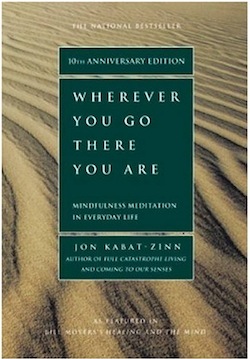
Wherever You Go There You Are by Jon Kabat-Zinn
Mindfulness Meditation in Everyday Life by Jon Kabat-Zinn (Amazon)
What happens now, in this moment, influences what happens next.
We tend to be particularly unaware that we are thinking virtually all the time. […] Meditation means learning how to get out of this current.
Meditation is the only intentional, systematic human activity which at the bottom is about not trying to improve yourself or get anywhere else, but simply to realize where you already are.
Let go of wanting something else to happen in this moment.
Is it possible for you to contemplate that this may actually be the best season, the best moment of your life?
Look at other people and ask yourself if you are really seeing them or just your thoughts about them. Sometimes our thoughts act like “dream glasses.”
If you do decide to start meditation, there’s no need to tell other people about it, or talk about why you are doing it or what it’s doing for you. […] Just look at (this) as more thinking.
Meditation is neither shutting things out nor off. It is seeing things clear4ly, and deliberately positioning yourself differently in relationship to them.
Meditation is not about feeling a certain way. It’s about feeling the way you feel. It’s not about making the mind empty or still. […] Meditation is about letting the mind be as it is.
Even our leisure tends to be busy and mindless. The joy of non-doing is that nothing else needs to happen for this moment to be complete.
“To affect the quality of the day, that is the highest of arts.” — Thoreau
(We meditate to realize) “…that things are already perfect.”
We tend to see things through tinted glasses: through the lens of whether something is good for me or bad for me, or whether or not it conforms to my beliefs or philosophy.
At the deepest level, there is no giver, no gift, and no recipient… only the universe rearranging itself.
Voluntary Simplicity: “…intentionally doing only one thing at a time and making sure I am here for it.
If mindfulness is deeply important to you, then every moment is an opporunity to practice.
Meditation is more rightly thought of as “Way” than as a technique.
Awareness is not the same as thought. It lies beyond thinking. […] Awareness is more like a vessel which can hold and contain our thinking.
Meditation involves watching thought itself.
The posture itself is the meditation. The posture speaks of not looking for anything more, but simply digesting what is.
Mindfullness: Allowing one moment to unfold intot he next without analyzing, discoursing, judging, condemning, or doubting; simply observing, embracing, opening, letting be, accepting. Right now. Only this step. Only this moment.
We often see our thoughts, or someone else’s, instead of seeing what is right in front of us or inside of us.
When we perceive our intrinsic wholeness, there is truly no place to go and nothing to do.
What we call “the self” is really a construct of our own mind.
Stop trying so hard to be “somebody” and instead just experience being. […] You are only you in relationship to all other forces and events in the world.
You are who you already are. But who you are is not your name, your age, your childhood, your beliefes, your fears. They are part of it, but not the whole.
The self is impermanent. […] It is constantly changing, decaying, and being reconstructed again, always slightly differently, depending on the circumstances of the moment. […] It never repeats itself. Whenever you look, it is slightly different.
“They were playing chess while we were playing checkers”
Robert Draper asks the question in a longish piece (Can the Republicans Be Saved From Obsolescence?) in the NY Times. The pieces that grabbed my attention had to do with technology. A few examples (from many):
“1.25 million more young people supported Obama in 2012 over 2008.”
“Obama was the very first candidate to appear on Reddit. We ask our clients, ‘Do you know what Reddit is?’ And only one of them did. Then we show them this photo of Obama hugging his wife with the caption ‘Four more years’ — an image no conservative likes. And we tell them, ‘Because of the way the Obama campaign used things like Reddit, that photo is the single-most popular image ever seen on Twitter or Facebook.’ ”
“Romney’s senior strategist, Stuart Stevens, may well be remembered by historians, as one House Republican senior staff member put it to me, “as the last guy to run a presidential campaign who never tweeted.”
“They were playing chess while we were playing checkers,” a senior member of the campaign’s digital team somberly told another top Romney aide shortly after the election.
Lucy Stink Eye
Scott Adams: Our Robot Future
“Some say robots will take 75% of all jobs. But that is only a problem if the average person who has a job is unable to purchase his own robot when the time comes and lease its services to a corporation, or put it to work directly. The robot will work around the clock and send its “paycheck” to your bank account. In effect, humans will become investors while robots become labor.”
“One can imagine that for every human taxpayer there might someday be fifty humans living off the government. […] In the future, people who have actual jobs might be a rarity. And one business-owner with a fleet of robots might earn so much money that supporting a million unemployed people doesn’t feel like a burden. I can imagine business taxes approaching 95% and no one complaining because the remaining 5% is more than Exxon’s total earnings today.”
“For example, when robots start doing all of the medical research, the speed of discoveries will increase a hundredfold. Robots will simply try every idea until someday there is a cheap pill that keeps your body young and healthy. The government will get out of the healthcare field when the cost of medical services becomes trivial, and I think robots will get us there.”
Hattie and Lucy in repose
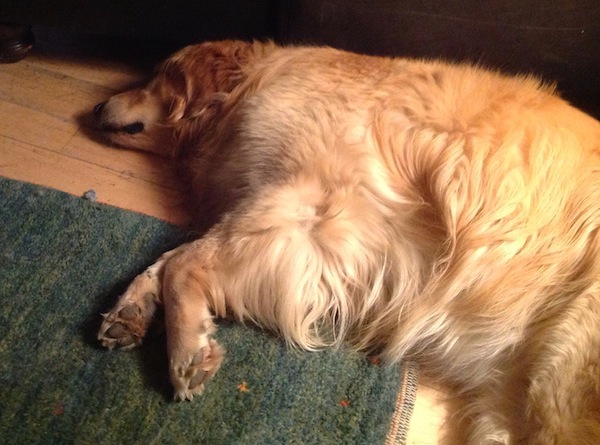
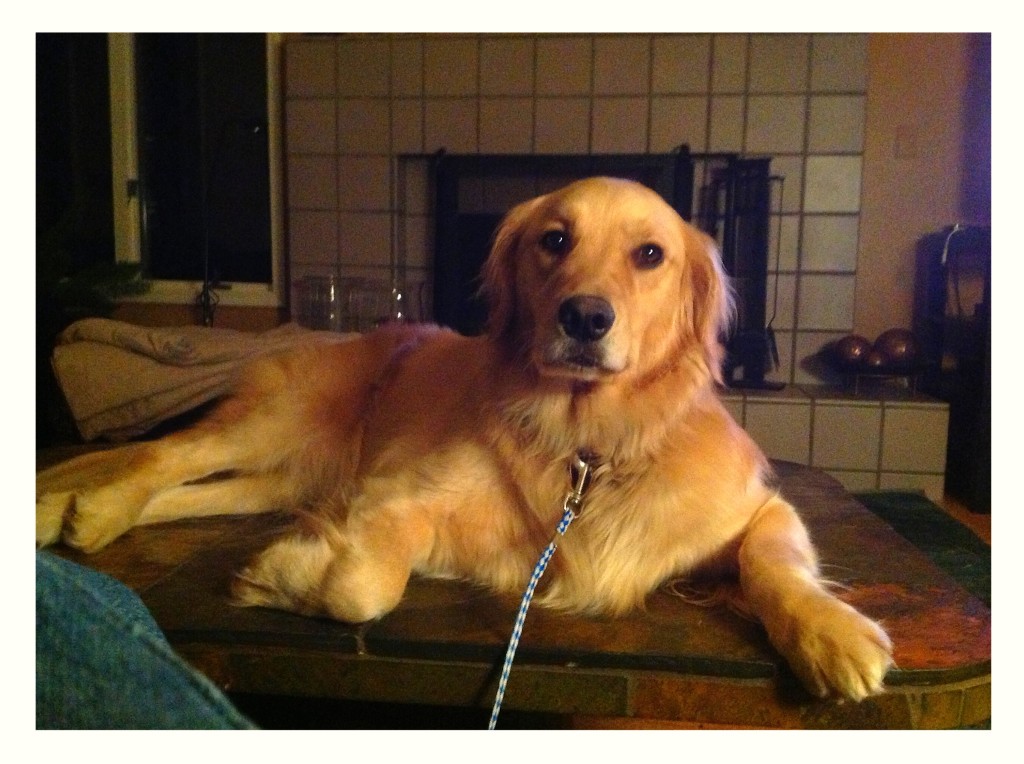
Hattie
Silence in the House of God
Easily the most powerful and disturbing documentary I’ve ever watched. Filled with unspeakable evil and inspiring courage. I watched it on HBO but assume/hope it is available elsewhere.