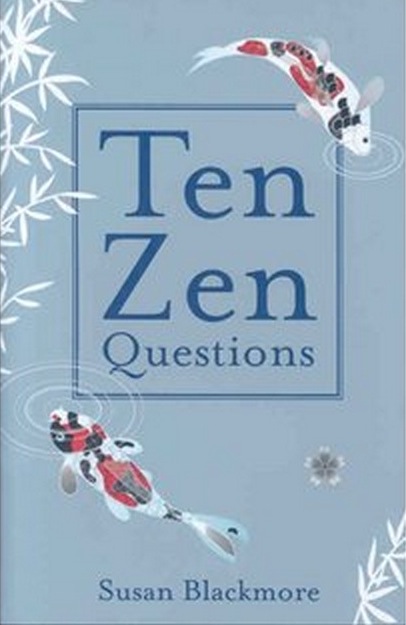
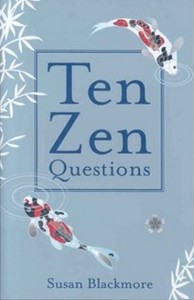
 Susan Blackmore describes her fascinating book as “my own attempt to combine science and personal practice in the investigation of consciousness.”
“Learning to meditate means nothing more than learning to sit still and pay attention, staying relaxed and alert, without getting tangled up in trains of thoughts, emotions or inner conversations.”
“Now I understood the need for a calm mind. We were told that calming the mind is the starting point of all meditation, but that it can also take you all the way. We were told even scarier things; that what you are searching for is here right now, that there is really nothing to strive for and that once you arrive you will realise there was nowhere to go in the first płace; that however hard you work, and you must work hard, in the end you will know that there is nothing to be done.”
“Being in the present moment […] meant that I was not to think about the next moment, not to dwell on what I had just done, not to think about what I might have said instead, not to imagine a conversaton that I might have later, not to look forward to lunch, not to look forward to weekends, or holidays or… anything.”
“The present moment is always all right. All my troubles lay in the thoughts I was letting go of. […] The body seemed to keep on doing relevant and sensible things, apparently without all the agonising I had assumed was essential.”
“Idealism: The idea that there is no separate physical world, and everything in the universe is made up of thoughts, or ideas or consciousness.”
“Materialism: The idea that there is no separate mental world, and everything in the universe is mad of matter.”
“Actions exist, and also their consequences, but the person that acts does not. — Buddhist saying
“Am I conscious now? It troubles me that I seem so often to be unconscious. I wonder what this unconsciousness is. I cannot believe I spend most of my life in a kind of darkness. Surely that cannot be so. Yet every time I ask the question it feels as though I am waking up, or that a light is switching on.”
“How can I look into the darkness, when looking makes it light?”
“The words aren’t really necessary anymore. Rather, there just seems to be a questioning attitude, an openness of mind. Am I conscious now? Yes, I am, keep on that way, and now, and now, and gently now. […] Awareness does become more continuous with practice — it can just take a very long time.”
“I can grab a now. I can grasp out with my attention. This and this. They happened at once, didn’t they. It was a now, I am sure, even though it was gone by the time I can have that certanty. […] I cannot work out what it would mean for there to be no now. And yet there does not seem to be a now. […] When I sit quietly, doing nothing, there is no obvious choice of what is now. Stuff just happens.”
“I was looking for the me that was looking and I found only the world. I am, it seems, the world I see.”
“There is not a separate me as well as the experience. It is hard to accept that I am all those people walking down the street.”
“I see and hear and feel but name nothing. […] It is something like paying attention equally to everything.”
“How can I tell the clouds have moved? Because from one moment to the next I can remember what came before.”
“There are multiple brain processes going on, some of which take up more of the brain’s capacity than others, but there is no me who experiences them, and no time at which they become conscious.”
“The world we think we see or hear — is always a memory. and what is a memory?”
“Do past and future look different? […] They’re all just the same stuff — memory stuff; imagination stuff. Past and future can be held in mind as equivalent.”
“Mindfullness is being fully here in the present moment. But now I know that there is no such moment. So what is mindfullness?” [What I understand as ‘now’ is really just a memory of just-past moment]
“What was I conscious of a moment ago? I found whole streams of experience that seemed to have already been going on, for someone, before I noticed them.”
“There is no thinker other than the thoughts. […] I’ve always treated thoughts as a problem, or something to be dealt with. Now, instead of either fighting them or watching them, I am simply to be them.”
“The universe seems to be causlly closed. That is, everything that happens is caused by something else. Nothing happens by magical forces intervening from outside the web of causes and effects, for everything is interconnected with everything else. […] Yet I feel as though I can act freely. Indeed this magical view is probably how most people in most cultures have always thought about themselves, imagining a non-physical mental entity that has wishes and desires, can think and plan, and carry out those plans by acting on the world.”
“Decision are made because of countless interacting events, and afterwards a little voice inside says, ‘I did that’, ‘I decided to do that.’ […] I am not separate from the perceptions, thoughts and actions that make up my world. And if I am what seems to be the world, the we are in this together. Me and the world, world/me are doing all these actions that now just seem to act of their own accord.”
“The world had summed up the options, chose one, carried it out, and moved on. This action was a result of everything I had learned and done before. […] Could I just trust the world and this body to woirk all by itself without me doing anything?”
“I am not a continuous conscious being at all. What seems to be me just arises along with whatever is being experienced. […] Every time some experience comes along, the me is allowed to go, along with the ending of the experience, as though experience and experiencer arise and then snuff out together. […] There never was a continuous I. […] The ‘same me’ was never recreated. […] Will I be snuffed out like a candle? Yes, just as I have been a thousand, million times before.” #
“Consciousness is an illusion; an enticing and convincing illusion that lures us into believing that our minds are separate from our bodies.”
“(My selves) arise along with the sensations, perceptions and thoughts that they seem to be having, and die along with them. With every new ‘this’ there is a new ‘me’ who was looking into it.”
There is nothing it is like to be me.
I am not a persisting conscious entity.
I do not consciously cause sthe actions of my body.
Consciousness is not a stream of experiences.
Seeing entails no vivid mental pictures or movie in the brain.
There is no unity of consciousness either in a given moment or through time.
Brain activity is neither conscious no unconscious.
There are no contents of consciousness.
There is no now.
“At any time in a human brain there are multiple parallel processes going on, conjuring up perceptions, thoughts, opinions, sensations and volitions. None of these is either in or out of consciousness for there is no such place. Most of the time there is no observer: if consciousness is involved at all it is an attribudon made later, on the basis of remembering events and assuming that someone must have been experiencing them in the past, when in fact no one was.”