
“Everything is made of some other thing. And those things in turn are made of other things. Over the next hundred years, scientists will uncover layer after layer of building blocks, each smaller than the last. At each layer the differences between types of matter will be fewer. At the lowest layer everything is exactly the same. Matter is uniform. Those are the bits of God.”
— God’s Debris by Scott Adams
“Matter is incredibly, mind-bogglingly empty. An atom is like a miniature Solar System, with a tight nucleus playing the role of a Sun orbited by electrons like planets. But the nucleus is incredibly tiny compared with the orbits of the electrons. Tom Stoppard, the playwright, had the best image. He said, if the nucleus is like the altar of St Paul’s cathedral, an electron is like a moth in the cathedral, one moment by the altar, the next by the dome. Imagine squeezing all the space out of an atom. Well, if you did that to all the atoms in all the people in the world, you could indeed fit the entire human race in the volume of a sugar cube.” — Physics.org
A few months ago I read James Gleick’s biography of Richard Feynman (Genius: The Life and Science of Richard Feynman). Lots of math and physics (all way over my head, but fascinating nonetheless) and a deep-dive into particle physics, at least for me. My simplistic take-away: 1) Matter and energy are the same thing. Sometimes. 2) Everything is made of this energy/matter. Everything. My hat. My body. Donald Trump. All made of the same stuff.
It would be difficult to get through the day if we experienced reality at this sub-atomic level so our brains (consciousness?) process it in a way that won’t make our heads explode. Nevertheless, I find it comforting to think of it in this way. Little bits of god or the Universe or whatever… winking in and out of existence.

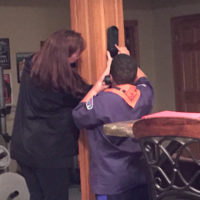 My friend Jason shared this photo taken at a Cub Scout meeting where the scouts learned how to use a landline telephone. He insists some of them had never used one. What’s to learn, you ask? What’s a “dial tone” and why do you have to wait until you hear it before dialing the number.
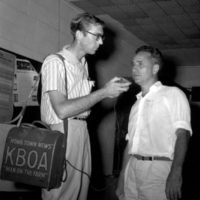 I remember the first recorded interview I did (1972). It was with Bill Walsh and Jack McDaniel, two local businessmen who organized the Fall Festival Parade every year in the little town where we lived. When I got back to the studio and dubbed the audio from a cassette to reel-to-reel tape, I was horrified to hear how awful I sounded. Long, rambling questions. It still makes me cringe.