DSL Repair

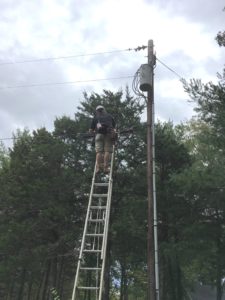
phoneguyBeen having problems with my DSL service (losing connection, slow speed) and the phone company sent a tech this morning. (Second time someone has been out in the last week or so) He could see there was a problem with the line, somewhere upstream, and — to save time — called the tech who came out previously since it was recent enough he might remember the call. He did and provide useful info.

I asked Mike (the tech who came out this morning) if he could access records from the previous call. From his reply I gathered only the barest minimum of information is recorded. Not surprising because who wants to write up a report once the problem is fixed.

But would it really be that difficult? Take out your smartphone, dictate brief summary of the call, save it as PDF and upload it to the company cloud where it can be accessed by the next service tech if needed. And by the customer.

My physician does this routinely. Within 24 hours of a visit. It’s readily available, along with my lab and test results.

Time Travel: A History by James Gleick

screen-shot-2016-10-05-at-12-01-53-pm“From the acclaimed author of The Information and Chaos, here is a mind-bending exploration of time travel: its subversive origins, its evolution in literature and science, and its influence on understanding time itself.”

Sleeping into the future is what we do every night.

“Man can do what he will, but he cannot will what he wills.” — Arthur Schopenhauer

“People living in different countries kill each other at irregular time intervals, so that also for this reason anyone who thinks about the future must live in fear and terror. I trust that posterity will read these statements with a feeling of proud and justified superiority.” — Albert Einstein’s message in the time capsule buried at the 1939 New York World’s Fair

We know that complete certainty must always elude us. We know that for certain.

“Time and space are modes by which we think, and not conditions in which we live.” — Albert Einstein

“I have approximate answers and possible beliefs and different degrees of certainty about different things, but I am not absolutely sure of anything.” — Richard Feynman

What is time? Things change, and time is how we keep track.

Schopenhauer asserted that life and dreams are pages from the same book. To read them in their proper order is to live, but to browse among them is to dream.

No one can really explain how memories are formed and retrieved. Nor can anyone explain away Proust’s paradoxical contention: that the past cannot truly be recovered by searching our memories, by interrogating them, by rewinding the film or reaching back into the drawer; rather, that the essence of the past, when it comes to us at all,comes unbidden.

If you ever see yourself coming out of a time machine, run the other way as fast as you can. Nothing good can come from meeting yourself. — Charles Yu

We experience childhood one way when we’re living it and another way when we relive it in memory.

But if memory is the action of recollection, the act of remembrance, then it implies an ability to hold in the mind two constructs, one representing the present and another representing the past, and to compare them, one against the other. How did we learn to distinguish memory from experience?

Our conscious brains invent the concept of time over and over again, inferring it from memory and extrapolating from change. And time is indispensable to our awareness of self. […] You order the slices of your life. You edit the film even as it records.

“There were buttons and switches everywhere—buttons to call for food, for music, for clothing. There was the hot-bath button, by pressure of which a basin of (imitation) marble rose out of the floor, filled to the brim with a warm deodorized liquid. There was the cold-bath button. There was the button that produced literature, and there were of course the buttons by which she communicated with her friends. The room, though it contained nothing, was in touch with all that she cared for in the world.” — The Machine Stops by E. M. Forster

Why do we need time travel, when we already travel through space so far and fast? For history. For mystery. For nostalgia. For hope. To examine our potential and explore our memories. To counter regret for the life we lived, the only life, one dimension, beginning to end.

“We know it all now, with our thoughts travelling at the speed of tweet. We are time travelers into our own future. We are Time Lords.” — Ali Smith

If we confuse the real world with our many virtual worlds, it’s because so much of the real world is virtual.

Time’s winged chariot isn’t taking us anywhere good. […] The past, in which we did not exist, is bearable, but the future, in which we will not exist, troubles us more.

“We perceive time only because we know we have to die.” — Heidegger

Time Travel: A History (review)

Maria Popova describes James Gleick’s new book Time Travel: A History, “a dizzying tour of science, philosophy, and their interaction with literature.” A few snippets from her lengthy review:

“Why do we need time travel, when we already travel through space so far and fast? For history. For mystery. For nostalgia. For hope. To examine our potential and explore our memories. To counter regret for the life we lived, the only life, one dimension, beginning to end.”

“Things have been, says the legal mind, and so we are here. The creative mind says we are here because things have yet to be.”

“The mind is what we experience most immediately and what does the experiencing.”

“If we have only the one universe — if the universe is all there is — then time murders possibility. It erases the lives we might have had.”

One of my favorite topics by one of my favorite writers.

UPDATE: From a good piece in The Guardian: “Howard and his editors also manage a number of celebrity Beatle-fan coups, like the day when, to their astonishment, they spotted a 14-year-old Sigourney Weaver looming lankily over her fellow teenyboppers in footage of a 1964 show.”

Dark Matter

Screen Shot 2016-08-27 at 11.51.17 AMIn this novel the multiverse is real (are real?) and the protagonist (and others) can visit these other realities which include other versions of himself. One would expect a novel based on quantum entanglement to get confusing and this one did. (There were moments in the story that reminded me of Philip Jose Farmer’s Riverworld series.) If you’ve ever pondered what you life would have been like if you had taken that other fork in the road, you might enjoy this novel. I found it well written but disturbing. I was eager to get to the end. (Amazon)

Questions an AI might ask

“She wanted to know whether a person could die by spontaneous combustion. The odds against a letter slipped under the door slipping under the carpet as well. Ishmael’s real name. Who this “Reader” was, and why he rated knowing who married whom. Whether single men with fortunes really needed wives. What home would be without Plumtree’s Potted Meats. How long it would take to compile a key to all mythologies. What the son of a fish looked like. Where Uncle Toby was wounded. Why anyone wanted to imagine unquiet slumbers for sleepers in quiet earth. Whether Conrad was a racist. Why Huck Finn was taken out of libraries. Which end of an egg to break. Why people read. Why they stopped reading. What it meant to be “only a novel.” What use half a locket was to anyone. Why it would be mistake not to live all you can.”

Galatea 2.2 by Richard Powers

Lexicon by Max Barry

“At an exclusive school somewhere outside of Arlington, Virginia, students aren’t taught history, geography, or mathematics–at least not in the usual ways. Instead, they are taught to persuade. Here the art of coercion has been raised to a science. Students harness the hidden power of language to manipulate the mind and learn to break down individuals by psychographic markers in order to take control of their thoughts. The very best will graduate as “poets”, adept wielders of language who belong to a nameless organization that is as influential as it is secretive.” (Amazon)

I can’t say I thought Lexicon was a great read but the neurolinguistics thing was interesting. I kept hearing echoes from Neal Stephenson’s Snow Crash:

“As Stephenson describes it, one goddess/semi-historical figure, Asherah, took it upon herself to create a dangerous biolinguistic virus and infect humanity with it; this virus was stopped by Enki, who used his skills as a “neurolinguistic hacker” to create an inoculating “nam-shub” that would protect humanity by making it impossible to use and respond to the Sumerian tongue. This forced the creation of “acquired languages” and gave rise to the Biblical story of the Tower of Babel.”

If I read Wikipedia correctly, there’s a difference between Neurolinguistics and Neuro-linguistic programming (NLP). The notion of someone using words and language to “program” my thinking is disturbing. This came up again for me last year when Scott Adams begin writing a long series of posts about Donald Trump using Master Persuader techniques. I was skeptical at first now I’m not so sure.

Jim Jones talks his followers into drinking poison Kool Aide? Tony Robbins convinces folks to pay him for the privilege of walking on hot coals? David Koresh, Scientology, etc etc. Are we just “moist robots” (Scott Adam’s term) that can be programmed with a few well chosen words?

And while we’re on the subject of words… I don’t remember the last time I saw an NBC newscast that didn’t include repeated references to “devastation,” “tragedy,” “terror,” and similar fear words. I’m trying to stop watching and listening to network and cable news programs because I feel (physically) bad after watching/listening. Which I’ve concluded is the point.

Reading list: Consciousness

  • The Big Picture: On the Origins of Life, Meaning, and the Universe Itself – Sean Carroll | My notes
  • Consciousness and the Social Brain – Michael S. A. Graziano | My notes
  • What Technology Wants – Kevin Kelly | My notes
  • The Ego Trick – Julian Baggini | My Notes
  • The Self Illusion: How the Social Brain Creates Identity – Bruce Hood | My Notes
  • Thinking, Fast and Slow – Daniel Kahneman | My notes
  • Incognito: The Secret Lives of the Brain – David Eagleman | My notes
  • The Ego Tunnel: The Science of the Mind and the Myth of the Self – Thomas Metzinger | My notes
  • Quantum Enigma: Physics Encounters Consciousness – Bruce Rosenblum | My notes
  • Biocentrism: How Life and Consciousness Are the Keys to Understanding the True Nature of the Universe – Robert Lanza | My notes

The Big Picture

The Big Picture: On the Origins of Life, Meaning, and the Universe Itself. By Sean Carroll

Life is a process, not a substance, and it is necessarily temporary.
For a long time, there has been a shared view that there is some meaning, out there somewhere, waiting to be discovered and acknowledged. There is a point to all this; things happen for a reason. […] Gradually, our confidence in this view has begun to erode.

“Life” and “consciousness” do not denote essences distinct from matter; they are ways of talking about phenomena that emerge from the interplay of extraordinarily complex systems.

At a fundamental level, there aren’t separate “living things” and “nonliving things,” “things here on Earth” and “things up in the sky,” “matter” and “spirit.” There is just the basic stuff of reality, appearing to us in many different forms. […] We will ultimately understand the world as a single, unified reality, not caused or sustained or influenced by anything outside itself. That’s a big deal.

The only reliable way of learning about the world is by observing it. Continue reading

The Inevitable

inevitable“Thousands of years from now, when historians review the past, our ancient time here at the beginning of the third millennium will be seen as an amazing moment. This is the time when inhabitants of this planet first linked themselves together into one very large thing. Later the very large thing would become even larger, but you and I are alive at the moment when it first awoke. Future people will envy us, wishing they could have witnessed the birth we saw.”

“This very large thing (the net) provides a new way of thinking (perfect search, total recall, planetary scope) and a new mind for an old species. It is the Beginning. […] At its core 7 billion humans, soon to be 9 billion, are quickly cloaking themselves with an always-on layer of connectivity that comes close to directly linking their brains to each other. […] By the year 2025 every person alive — that is, 100 percent of the planet’s inhabitants — will have access to this platform via some almost-free device. Everyone will be on it. Or in it. Or, simply, everyone will be it.”

While reading Kevin Kelly’s The Inevitable, I underlined passages so I could post them here for future reference. I do this with each book I read. I’m not going to do that for this book because my highlights filled 11 pages The Inevitable (Kevin Kelly) (PDF)