What Technology Wants by Kevin Kelly (TED Talk)

I finished Kevin Kelly’s What Technology Wants (PDF) this weekend. I rank this book up there with Ray Kurzweil’s The Singularity is Near in terms of importance. I won’t attempt to review the book, since I’m still try to absorb some of the mind-bending ideas. Like the evolution of technology:

Here are a few ideas that got some highlighter:

Technology and life must share some fundamental essence. … However you define life, its essence does not reside in material forms like DNA, tissue, or flesh, but in the intangible organization of the energy and information contained in those material forms. Both life and technology seem to be based on immaterial flows of information.” – pg 10

Technium – The greater, global, massively interconnected system of technology vibrating around us. – pg 11

How many neurons do you need to have a mind? – pg 13

We can think of technology as our extended body. – pg 44

Ideas fly in flocks. To hold one idea in mind means to hold a cloud of them. – pg 45

Even the tiniest disposable item with a bar code shares a thin sliver of our collective mind. – pg 48

For most humans, for most of time, real change was rarely experienced. – pg 73

“What was impossible billions of years ago becomes increasingly inevitable.” — Simon Conway pg 126

There is only one life. All life today is descended along an unbroken line of duplication from one ancient molecule that worked inside one primeval cell that worked. – pg 127

Continue reading

COMDEX

I found this convention badge on a closet shelf this morning and it brought back memories. First, a little background from Wikipedia:

“COMDEX (an abbreviation of Computer Dealers’ Exhibition) was a computer expo held in Las Vegas, Nevada, each November from 1979 to 2003. It was one of the largest computer trade shows in the world, and by many accounts one of the largest trade shows in any industry sector. The first COMDEX was held in 1979 at the MGM Grand, with 167 exhibitors and 3904 attendees.”

I don’t remember what year I first attended COMDEX. Sometime in the lates 80’s or early 90’s if I had to guess. It was my first exposure to geek culture and I loved it. Not sure how I persuaded Clyde to attend (or how I ended up with his badge) but he’s sort of a geek wannabe like me.

The move from the NAB Radio Show to COMDEX marked the beginning of my shift in interest and career path.

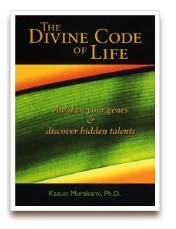
The Divine Code of Life

According to the back flap on his book, Dr. Kazuo Murakami is “one of the top geneticists in the world and Professor Emeritus at the University of Tsukuba, one of Japan’s leading research universities.”

In The Divine Code of Life, he makes his case for the idea that how we think can activate good dormant genes and switch off negative ones. Here are a few factoids that got some high-liter:

  • “For any one child, there are seventy trillion possible combinations of genes.”
  • “As far as we can tell, only about 5 to 10 percent of our genes are actually working; what the rest are doing remains unknown.”
  • “All living things use the same genetic code.”
  • “Imagine that you could collect all the DNA from the world’s population of six billion people. It would weigh only as much as a single grain of rice.”
  • “The information contained in our genes, if printed in book form, would amount to three thousand volumes each a thousand pages long.”

I can’t say that this was a fun read, but I like the idea that we can have some control over something as… basic? … as our genes. I suspect this is where some of the really big medical breakthroughs will happen. Are happening.

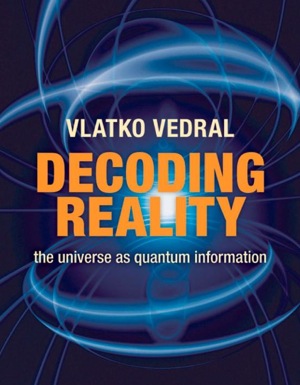
Decoding Reality: The Universe as Quantum Information

I confess the title of this book hooked me. I saw an interview with Oxford professor Vlatko Vedral and was intrigued by the idea that everything (me and the universe) can be reduced to bits of information. (Wikipedia)

But I can’t say I enjoyed (or understood) most of the book. I suspect he knows his stuff but just isn’t very good at explaining it to non-phyicists. Better reads: Quantum Enigma; Biocentrism.

Truth 2.0

Arianna Huffington makes some predictions of what comes next for the Internet and I sure hope she’s right. A few excerpts:

  • “An online tool that makes it possible to instantly fact-check a story as you are reading it — or watching it on video. Picture this: It’s last summer and you are reading or watching a story about health care, and Sarah Palin or Betsy McCaughey is prattling on about death panels. Instantly, a box pops up with the actual language from the bill or a tape rolls with a factual explanation of what the provision in question really does. And this is a non-partisan tool. So when, in the midst of the legislative debate, President Obama says “I didn’t campaign on the public option,” the software will fire up and instantly show you where support for the public option appeared in his campaign plan, and clips of all the times he mentioned it in public after he got elected.
  • A .com innovation that immediately provides a reader or viewer with the background knowledge needed to better understand the data and information being delivered as news. The powers-that-be — both political and corporate — have mastered the dark art of making information deliberately convoluted and indecipherable. For them, complexity is not a bug, it’s a feature.
  • Our future tool will also automatically simplify needlessly complicated laws, contracts, and linguistic smoke screens. So when a politician or Wall Street CEO performs the usual verbal gymnastics in an attempt to befuddle and bamboozle us, his words will immediately be translated into clear and precise language. It will be Truth 2.0.
  • In the future, software will be created that allows us to pull the curtain back on the corridors of power and see who is really pulling the levers. A great early iteration of this was provided by the Sunlight Foundation during the recent health care summit. During its live streaming of the discussion, the Foundation offered a dose of transparency by showing, as each of our elected officials was speaking, a list of his or her major campaign contributors. It was simple, powerful, and spoke volumes about the extent to which many players in the summit were bought and paid for.

I think this will happen because it can happen. I hope this scares the shit out of the politicians and power-brokers.

Verizon, NFL to stream NFL draft, games

From Digital Sports Daily:

The NFL and Verizon wireless have struck a deal to put live games on mobile phones, the Wall Street Journal reports on Tuesday. The two companies will partner in time to stream the NFL draft which begins on April 22, on to mobile devices.

In addition to the NFL draft, Verizon will stream NBC’s Sunday night football, the NFL Network and the Red Zone channel but not games shown on FOX, CBS or ESPN.

The NFL Red Zone channel, which was previously only available on satellite and cable, airs live look-ins of every key play and touchdown from Sunday afternoon games.

Verizon Wireless will pay the NFL $720 million over four-years to be the exclusive mobile home of the NFL. The ability to watch every out-of-market MLB game on iPhone came last summer, making the NFL just the second pro sports league to show pocket sized games.

The games will be available on Verizon’s 3G network so users aren’t required to find a Wi-Fi hotspot to watch games. NFL mobile will then go to 4G network as Verizon replaces its 3G network by from this year to the end of 2013.

TED Talk: Time and gravity

Prof. dr. Wubbo J. Ockels is a Dutch physicist, and also the Netherlands’ original astronaut. He is a Professor of Aerospace Sustainable Engineering and Technology at the University of Delft.

TEDxAmsterdam: Wubbo Ockels from TEDxAmsterdam on Vimeo.

Ockels explains how ‘time’ is created by human beings, as a way our brains can make sense of gravity. The speed of light is constant, because it is made by us: it’s the clock by which we have calibrated our existence.

The God Theory

My interest in quantum theory, time and the relationship between consciousness and reality lead me to a book by Bernard Haisch titled The God Theory. (I’ve included a chunk of Dr. Haisch’s bio below). I include this post for my own reference.

“If you look up at the faint smudge in the night sky that is really the distant, huge Andromeda galaxy, you might see light that, from your point of  view, took two million years to traverse hat vast intergalactic distance before it was absorbed in your retina and registered as an image. For a beam of light itself, however, things look different. Instead of radiating from some star in the Andromeda galaxy and racing through space for two million years, every single photon sees itself, metaphorically speaking, as born and instantaneously absorbed in your eye. It is one simple jump that takes no time at all, according to the theory of special relativity. That’s because, in the reference frame of a particle traveling at the speed of light, all distances shrink to zero and all time collapses to nothing. From its own perspective, the photon of light leaps instantaneously from there to here because distance has no place in its existence. We can almost say that the photon was created because it had someplace to land and, in an instant, it jumped from there to here, even across two million light years of space from our perspective.”

“Bernard Haisch, Ph.D., is an astrophysicist and author of over 130 scientific publications. He served as a scientific editor of the Astrophysical Journal for ten years, and was Principal Investigator on several NASA research projects. After earning his Ph.D. from the University of Wisconsin in Madison, Haisch did postdoctoral research at the Joint Institute for Laboratory Astrophysics, University of Colorado at Boulder and the University of Utrecht, the Netherlands. His professional positions include Staff Scientist at the Lockheed Martin Solar and Astrophysics Laboratory; Deputy Director of the Center for Extreme Ultraviolet Astrophysics at the University of California, Berkeley; and Visiting Scientist at the Max-Planck-Institut fuer Extraterrestrische Physik in Garching, Germany. He was also Editor-in-Chief of the Journal of Scientific Exploration.”