Covering election returns

Election night was a big night for radio station news departments. Or, they were back in the 70’s in the little town where I worked.

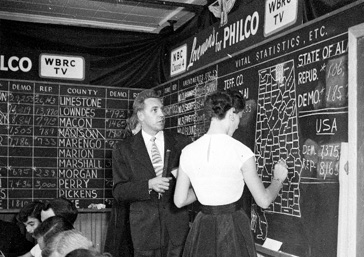
The candidates would crowd into the county clerk’s office and watch as the votes were written on a big chalk board. The radio station news guy would setup a small transmitter and send back updates that were broadcast live. You were either there… listened to us… or heard the results the next morning at the local coffee shop.

When I started working with The Missourinet (a statewide radio network) in the mid-80’s, it wasn’t that different. One of our reporters would set up at the Secretary of State’s office with a dedicated land-line (before cell phones). Maybe they used one of the state’s phones, I don’t recall. But the reporter would phone in regular updates to the network newsroom where they’d go out to affiliate stations around the state.

Sometime in the 90’s technology improved to the point where we could Telnet into the the state computers (via very slow modem’s) and access the numbers directly. And then report them over the network.

Fast forward to the Web. No more Telnet but those early websites were very glitchy. And slow. But they got better every election. It was a wonderful thing. Anyone with internet access could see the returns as they were tabulated. But it was still easier for radio stations (and their listeners) to take our reports than produce their own.

Last week one of our news directors stopped by my office to talk about what we would do online for the upcoming election. Missouri’s Senate race is the Main Event and we’ll have reporters at both candidates venue. They’ll do interviews and feed those back to the network where reporters will be working the Secretary of State’s website.

One the other end of the information pipe, people will still be listening to the radio and watching TV but I expect Twitter and Facbook to be where many get their first information. (Does the Secretary of State have a Twitter feed?). And most of it will be mobile.

Eventually we’ll all vote electronically, without standing in line. And we’ll see the results in near real time.

Will this elections more susceptible to fraud? Girl, please! Is the TSA making flying safer?
Radio by any other name would sound as sweet

Mark Ramsey was listening to Fresh Air on NPR the other day and heard Terry Gross reading the credits, which included a reference to “the Chief Content Officer.” That what most stations call their “Program Director.” (A job I once held)

Mr. Ramsey also mentioned that back in July National Public Radio annoucned it would hereafter be known as NPR. It’s been National Public Radio since 1971 but switched tothe acronym because –according to the Washington Post– “Its news, music and informational programming is heard over a variety of digital devices that aren’t radios.”

Hmm.

Our company operates several news networks, including:

Radio Iowa
Wisconsin Radio Network
South Carolina Radio Network
Nebraska Radio Network

We (not me) came up with Radio Iowa back in 1996 and thought it was pretty cool at the time. Like, “Radio Free Iowa.” I was not involved with nameing the others.

We have websites, Twitter feeds and Facebook pages but are first and foremost radio networks.

If someone were starting a new radio network today, what would they call it? I have no idea.

Radio’s Future

The American Youth Study 2010 “surveys the the media and technology habits of America’s 12-24 year-olds, and represents a sequel to a study originally conducted by Edison in 2000.” Among the findings:

  • Young people spend twice as much time on the Internet now as they do listening to radio.
  • Radio continues to be the medium most often used for music discovery, with 51% of 12-24 year-olds reporting that they “frequently” find out about new music by listening to the radio. Other significant sources include friends (46%), YouTube (31%) and social networking sites (16%).
  • 3 times as many young people are listening to Pandora radio as listen to traditional radio broadcasts via the Internet.
  • More than four in five 12-24s own a mobile phone in 2010 (up from only 29% in 2000), and these young Americans are using these phones as media convergence devices.

Survey of radio newsrooms (1988)

A big part of my job during my early days at Learfield was affiate relations. Periodically, I would survey the stations to learn more about how they used our news and sports. Here’s a snapshot from 1988.

  • 2/3 of stations had a full-time news person (I’ll bet it’s not 1/3 today)
  • I was insensitive or stupid or both in asking about sex. It was a different time.
  • Almost half had a wire service?! Amazing. Can’t be more than 10% now.
  • “Cassette recorders” – Ah, my favorite. A world before digital recording.

Back in those pre-web days, we also did a newsletter each month. One page, front and back. I typed it on a typewriter, made copies and put them in the mail. Example: Missourinet newsletter – Jan87

The whole process now seems … quaint. Typewriters and envelopes, once a month. But there was a simplicity that seems appealing in retrospect.

Pandora

I really, really hope small town radio stations figure out how to survive and thrive in this new media world in which they find themselves. If I had The Secret Nazi Formula, I send guys out on motorcycles (with sidecars) to each and every station. But I don’t.

I’m taking a vacation day, sitting in the Coffee Zone fine-tuning one of my Pandora channels (“stations?”). I’d like to share just a couple of features:

For those unfamiliar with Pandora, it’s a streaming music service. You start by picking a song or artist and Pandora starts playing songs based on that information. You vote thumbs up or thumbs down on each song, and Pandora just keeps refining the music you hear.

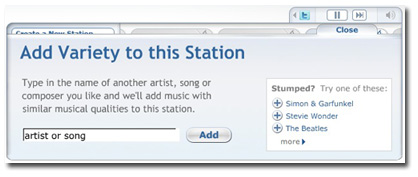
If it all starts sounding a bit too similar, you can “Add Variety” (see image above). For example, I added Paul Simon and Brandi Carlile to my Pomplamoose channel. The result is so finely tuned to my musical tastes, I don’t see how any radio station could match it. They could not. And with every song I listen to (or don’t) my channel gets better.

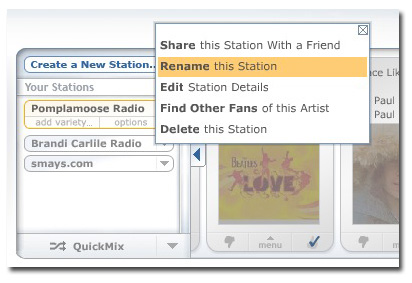
Pandora also gives me the option to share my creation and find others who like the same music.

So. What’s missing? Commercials? Weather? Sports? News about the oil gushing into the Gulf? A funny guy to talk over the beginning of my songs? Weekly specials from my local supermarket? Maybe.