38 Life Lessons

From Leo Babauta. There are a few of my favorites. The entire list is worth a read.

“You can’t motivate people. The best you can hope for is to inspire them with your actions. People who think they can use behavioral “science” or management techniques have not spent enough time on the receiving end of either.”

“Let go of expectations. When you have expectations of something — a person, an experience, a vacation, a job, a book — you put it in a predetermined box that has little to do with reality. You set up an idealized version of the thing (or person) and then try to fit the reality into this ideal, and are often disappointed. Instead, try to experience reality as it is, appreciate it for what it is, and be happy that it is.”

“Do less. Most people try to do too much. They fill life with checklists, and try to crank out tasks as if they were widget machines. Throw out the checklists and just figure out what’s important. Stop being a machine and focus on what you love. Do it lovingly.”

via 38 Life Lessons I’ve Learned in 38 Years | zen habits

“Why did the world shatter at the touch of a hyperlink?”

Dr. David Weinberger asks (and answers?) the question: “Why did the world shatter at the touch of a hyperlink?”

“Newspapers, encyclopedias, record companies, telephones, politics, education, analytics, scientifics, genetics, libraries, mass media, high culture, television, classrooms, assholism, channels, columns, stations, tours, travel, marketing, picketing, knitting, hectoring, picturing, gossiping, friendship redefined, attention redefined, leadership redefined, defamation redefined, curating, editing, publishing, correcting, crowds, mobs, shopping, bar-hopping, catalogs, sing-alongs, fact-checking, being together, being apart, staying together, moving on. Social forms and major institutions, many set in the Earth on stone foundations, fell down at the flick of a hyperlink.”

This started me thinking about tech changes over the last ten years. Digital cameras; high speed Internet access; social media (blogs, Twitter, Facebook); iTunes; smart phones; Google; Tivo; ebooks and on and on.

And, finally, how has our company changed during the past ten years? Can we list the Ten Biggest Changes? Five? Three? And is that even a relevant question?

Scott Adams: “The sum of your actions”

“You’re a collection of molecules and those molecules are made of smaller bits, and those bits are made of even smaller bits. The smallest bits in the universe are all identical. You are made of the same stuff as the concrete in the floor and the fly on the window. Your basic matter cannot be created or destroyed. All that will survive of what you call your life is the sum of your actions. Some might call the unending ripple effect of those actions a soul, or a spirit.”

— Scott Adams, The Religion War

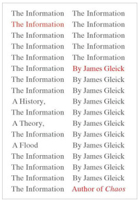
The Information, by James Gleick

Publishers Weekly review on Amazon:

“In 1948, Bell Laboratories announced the invention of the electronic semiconductor and its revolutionary ability to do anything a vacuum tube could do but more efficiently. While the revolution in communications was taking these steps, Bell Labs scientist Claude Shannon helped to write a monograph for them, A Mathematical Theory of Communication, in which he coined the word bit to name a fundamental unit of computer information. As bestselling author Gleick (Chaos) astutely argues, Shannon’s neologism profoundly changed our view of the world; his brilliant work introduced us to the notion that a tiny piece of hardware could transmit messages that contained meaning and that a physical unit, a bit, could measure a quality as elusive as information. Shannon’s story is only one of many in this sprawling history of information.  Gleick’s exceptional history of culture concludes that information is indeed the blood, the fuel, and the vital principle on which our world runs.”

The following got some highlighter during my read:

“In the long run, history is the story of information becoming aware of itself.” pg 12

“With words we begin to leave traces behind us like breadcrumbs: memories in symbols for others to follow.” pg 31

“All known alphabets, used today or found buried on tablets and stone, descend from the same original ancestor.” pg 33

“The written word was a prerequisite for conscious thought as we understand it.” pg 37

Continue reading

“The new normal”

“What’s actually happening is this: we’re realizing that the industrial revolution is fading. The 80 year long run that brought ever-increasing productivity (and along with it, well-paying jobs for an ever-expanding middle class) is ending. The promise that you can get paid really well to do precisely what your boss instructs you to do is now a dream, no longer a reality.”

From a post by Seth Godin.

“The Cultural Imperative For A Social Business”


That’s the title of a blog post by Maria Ogneva that has been stuck in my head for a week or so. It’s about how businesses and organizations communicate and share information. A topic of discussion in our company recently. Here are a few of my take-away’s from Maria’s post:

“Transparency and openness require the braveness of “opening up the kimono”, not when convenient, but all the time. It involves letting people know what’s happening and why, with advance notice, providing a channel to share feedback, and closing the feedback loop – in the open.”

I give us a B- on that one. We’d like to be there but aren’t quite.

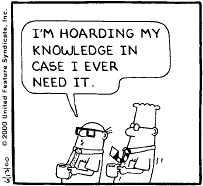
“Knowledge hoarding is replaced by sharing. Traditionally, our educational systems have emphasized becoming a specialist. We have hoarded our knowledge in fear that if we shared what we knew, we will become more replaceable.”

Ouch. Been guilty of that myself. I suspect we still have pockets but by the very nature of hoarding, it’s difficult to know.

“Command and control mindset: Traditionally, corporations have been structured with tightly managed controls at the top, which were passed down through levels of management, down to the people who actually performed the work. Tasks to be done, as well as the processes by which these tasks had to be done, were mandated from the top.”

The C&C manager often has an “I-know-best-that’s-why-I’m-the-manager” mindset. Takes a lot of self-confidence to break free of this approach. But the command and control style of management be less and less effective in any event:

“Rigid hierarchies: Scarcity of information pre-Internet, combined with specialization, has contributed to knowledge hoarding. At times, this asymmetry of information, and not the right leadership skills, allowed people to rise up the corporate ladder. Hierarchies were developed to preserve this status quo. However, things are changing rapidly, and democratization of information is definitely putting the emphasis back on leadership style, and not access to information, as a competitive advantage.”

This is why I’m all in on the Network and shared information. It’s breaking down these 20th century approaches to business, communication and everything else.

If you manage a company or work at a company, you should take a few minutes to read this insightful post. I’ll let you know how things come out at our company.

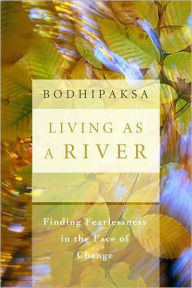
Living As A River by Bodhipaksa

living-riverFinding Fearlessness in the Face of Change


The ultimate act of letting go is to abandon the delusion that consciousness and the world are separate things.

Because we fear our own eventual extinction, we construct the idea of a permanent self.

(The Buddha) saw the self as composed of a number of ever-changing processes.

Knowing that I exist, it’s hard for me to imagine never having existed, and so in my own mind there’s a certain inevitability about my existence.

When we try to imagine death, what comes to mind is imagining an experience of nothingness, as if we’d still be around to have a non-experience. […] We simply cannot imagine not being able to experience anything at all, because experience is all we know, and so we’re forced to imagine experiencing non-experience.

Since we assume that the self existed before conception and will exist after death, we’ll inevitably imagine that it persists — unchanged — throughout life.

Once we start naming things, our language reinforces our underlying tendency to see them as fixed. We name things, and then we assume that because the name is static, so too is the thing named. The mind takes the language it uses to label reality as if it were reality.

It is (the) flow of events that constitutes what we call consciousness. Consciousness is not seen as being something separate that “has” experiences. Consciousness is the activity of experiencing.

The sage at peace recognizes that aging and dying are simply stories we weave for ourselves.

The opposite of suffering turns out not to be simple happiness, but something indefinable.

We may try to shelter ourselves from an awareness of impermanence by identifying with a nation or religion or with an abstract principle such as progress. […] To cling is to seek a stable refuge in the midst of a torrent of impermanence. […] The more our sense of well-being is dependent upon something impermanent, the more there is an undercurrent of fear. […] Fear leads to clinging, which leads to fear.

Insight is not the same as intellectual understanding but is a direct recognition of impermanence in our experience.

Everything that constitutes us is in fact a process, rather than a thing or object.

“Verbal thinking” – a scrolling tickertape of more-or-less connected words that streams endlessly through the mind.

(The body is) a process that has continuity rather than identity. […] There is no being, only becoming. There is no identity, only change.

In sensing my body as a river, I begin to realize that I do not know what I am. I begin to realize that there is nothing — “no thing” — to cling to or to identify with. One cannot hold onto a river.

If the earth were shrunk to the size of a soccer ball, the average depth of the ocean covering it would be sixty-five microns, or about twice the thickness of a grocery-store plastic bag.

Life is the sustainable self-organization of energy within the material world. […] Life itself is flow, and the energy of life cannot be grasped or possessed.

We need to hold definitions lightly, remembering that they are the map rather than the territory.

Despite Copernicus, we tend to think that we are at the center of the universe — that it all exists in order to serve us. But rather, we are scavengers of energy, peripheral to the vast processes unfolding around us.

Clouds make a good analogy for the illusory nature of the self. There’s nothing permanent in a cloud, just as there’s nothing permanent to be found in the self. The cloud is not separate from its environment, just as my self has no separateness. Just as the cloud lacks the essential qualities I assume a “thing” has, so too does my self lack the qualities I assume a self has. In looking at mists or a cloud; we can see a form, often with an apparently well-defined edge, and yet there’s nothing there that can be grasped. The fact that we name something a “cloud” often seems to create in the mind the assumption that the thing that’s being named is as static as the label applied to it. Often we’ll glance at a particular cloud and then look at it a short while later. Nothing much seems to have changed, because the human mind is not well-equipped to perceive change—especially not in something as amorphous as a cloud.

All concepts are simply labels superimposed upon the reality we perceive.

As we move toward the idea of abandoning the idea of a separate selfhood, we may need to go through a phase of treating the whole of creation as if it were us. […] Extend the idea of the self out far enough, and the idea of the self becomes meaningless.

As I sit breathing in my meditation practice, I might find myself wondering exactly at what point a particular molecule of air could be said to be “in” the body. Is it when it crosses some arbitrarily drawn plane enclosed by the rims of my nostrils? Is it once it’s crossed into the bloodstream? Or bonded to a molecule of hemoglobin? Any line I choose to draw would be purely arbitrary. I look for the boundary of my physical self and can’t find one.

Noticing how my gaze can often fixate on a narrow area in front of me, I become aware of the entirety of my visual field, allowing into awareness everything from the center of my visual field to the periphery. It’s like moving from a kind of “dial-up” connection between the world and my brain to a “broadband” one. Doing this generally has a very calming effect on my inner chatter, as if the sheer volume of incoming data I’m paying attention to leaves no bandwidth available for my inner dramas.

All experience takes place in the mind. […] We can know nothing beyond our sensory experience.

Consciousness is the activity of being aware of something. There can, by definition, be no consciousness separate from the things of which it is aware. […] We can never know objective things separate from our sense-impressions, which are interpretations rather than reality.

There can be no consciousness without something to be conscious of.

There is nothing stable within the mind. There is no permanent core. Perceptions, feelings, thoughts, and emotions are simply flowing through us, but are not us. Consciousness is an activity. It’s there when it happens.

Our identity depends on the internalization of the consciousness of others. Consciousness, like all the other elements, is therefore something that extends beyond the individual and that, in some sense, flows through us like a river.

Each event of cognizing is “a consciousness.” Since perceptions come and go, so too will consciousness come and go. Each response to a perception is another consciousness. There is no enduring consciousness, no permanent watcher at the helm of our being, observing everything that happens and making decisions. There are just the multiple overlapping waves of consciousness, rising and falling, rising and falling.

Our decision-making is a post-hoc conscious labeling of activities that begin outside of awareness.

Where is the self when conscious awareness is absent?

Memories are not etched permanently in the brain. Instead, every time a memory is retrieved, it is destroyed and then re-created, and it becomes a memory of a memory. Any current memories we have are copies of copies of copies… many times over depending on how many times we have recalled that particular experience. Because of this process of creating, destroying, and re-creating memories, our recollections are unstable and subject to alteration. Each time we recall an event from our lives, the memory of that event can change. […] We never have a full recollection of anything that’s happened to us, and our memories are constructed from hints, scraps and traces found within the mind.

“We are never conscious of anything but a particular perception; man is a bundle or collection of different perceptions that succeed one another with an inconceivable rapidity and are in perpetual flux and movement.” — David Hume

The underlying principle of selfhood in Buddhism: there is continuity but no identity.

I am a field of awareness in which all my experiences arise.

It’s largely our thoughts, and the emotional qualities associated with them that create our experience. […] In every moment of perception, we are able to choose between (fear and love). Fear is marked by clinging, aggression, doubt, anxiety, and denial. Love is marked by letting go, being flexible, compassionate regard, confidence, and intelligent curiosity. We have these choices in every moment of our lives.

Every time we make a choice, we play a part in forming a new version of the self, and we also remind ourselves of the self’s unfixed nature. We begin to see more and more clearly that our present experience is produced by largely unconscious patterns of thought.

There is no succession of fleetingly short selves, but instead a never-ending process of change. (No self!)

We simply let go of identifying any part of our experience as the self. Since we don’t cling to anything as being the self, we also don’t think of anything as being other than the self. […] There is simply experience, with no absolute distinction between subject and object. There is no idea “I am perceiving.” there’s no idea that there’s a separate world being perceived. There’s just experience.

“The Internet is over”

The Guardian sent Oliver Burkeman to SxSW where he realized the Internet is over:

“If Web 2.0 was the moment when the collaborative promise of the internet seemed finally to be realized – with ordinary users creating instead of just consuming, on sites from Flickr to Facebook to Wikipedia – Web 3.0 is the moment they forget they’re doing it. When the GPS system in your phone or iPad can relay your location to any site or device you like, when Facebook uses facial recognition on photographs posted there, when your financial transactions are tracked, and when the location of your car can influence a constantly changing, sensor-driven congestion-charging scheme, all in real time, something has qualitatively changed.”

We can probably stop saying “digital” media since all media is digital. Same for “online identity.” We only have one identity and unless you’re hunkered down in a Montana cabin, it’s online.

As long predicted, the Internet/Net/Web is woven in to all that we do. Like electricity and indoor plumbing. We don’t think about it. It has become invisible. We’ll stop saying (as I did above) “online” because we’ll never be “off line.” (Yes, I realize there are lots of people in the world for whom this is not the case. It will be.)

I wonder if I will miss the Internet when it is no longer an identifiable thing? Something I can “get on?” A place to go.

“The Net is the new TV & radio”

“Smartphones and other portable Net-connected devices are now the closest things we have to universal receivers and transmitters of live news. Not many of us carry radios in our pockets any more. Small portable TVs became passé decades ago. Smartphones and tablets are replacing radios and TVs in our pockets, purses and carry-bags.”

“Television has also become almost entirely an entertainment system, rather than a news one. News matters to TV networks, but it’s gravy. Mostly they’re entertainment businesses that also do news.”

“…emergencies such as wars and earthquakes demonstrate a simple and permanent fact of media life: that the Net is the new TV and the new radio, because it has subsumed both. It would be best for both TV and radio to normalize to the Net and quit protecting their old distribution systems.”

— From a post by Doc Searls, co-author of The Cluetrain Manifesto.

“The Future of Work”

Chris Brogan thinks work will be more and more modular, mobile, cause-balanced, smaller/bigger, and goal-aligned.

“Many of us will start using “project” as the unit of measurement of work. Meaning, a job won’t be a job any more, but a collection of projects, sometimes with the same employer and sometimes not. We will all work a bit more like Hollywood’s film industry, gathering the right team for the right project, and having more than one “picture” in the works at all time. This will require a lot more self-organizing and a lot more self-discipline, but people who define work around the unit of “project” instead of the unit of “job” will definitely have a better chance of succeeding.”

Brogan notes that “management styles are still based around “butt in chair” metrics.” While you might just be hoping to have a job in the future, this short –but insightful post– is worth a read if you want a peek at what things will be like in the future.