“It’s a Class War, Stupid”

My favorite political pundit, Matt Taibbi, penned a cheerful article about politics, media and class in America. Since nobody is going to click on a link to an article thus described, here’s the final paragraph:

“These fantasy elections we’ve been having — overblown sports contests with great production values, decided by haircuts and sound bytes and high-tech mudslinging campaigns — those were sort of fun while they lasted, and were certainly useful in providing jerk-off pundit-dickheads like me with high-paying jobs. But we just can’t afford them anymore. We have officially spent and mismanaged our way out of la-la land and back to the ugly place where politics really lives — a depressingly serious and desperate argument about how to keep large numbers of us from starving and freezing to death. Or losing our homes, or having our cars repossessed. For a long time America has been too embarrassed to talk about class; we all liked to imagine ourselves in the wealthy column, or at least potentially so, flush enough to afford this pissing away of our political power on meaningless game-show debates once every four years. The reality is much different, and this might be the year we’re all forced to admit it.”

The TSA Show

KnifeI recently asked a friend, who travels frequently, about airport check-in security. He laughed and pulled out his Swiss Army knife. Not one of the tiny pin knives, but a knife with a four-inch blade.

“I forgot I had this in my pocket and went right through security.”

Isolated incident? Maybe. But does any reasonable person honestly believe we’re any safer on a plane than we were on September 10th? Do you think a terrorist group couldn’t smuggle a Stinger shoulder-fired missile into this country, park near a major U.S. airport, and knock down a plane? Remember, he’s not trying to get away.

So what’s all the TSA frenzy about. Show. A highly visible charade that accomplishes two things: 1. Persuade the American public their government is doing something to keep them safe. 2. Remind them they must be fearful and trust the government… to keep them safe.

You are your lapel pin

LapelpinsI’m not much on symbols. Like the endless array of ribbons you can stick on the back of your car. Or the little red Fight AIDS ribbons that were so much in vogue. And flag pins for your lapel. Senator Obama caught a lot of shit because he sometimes didn’t wear one. So he must not love his country, right. Uh huh.

I sometimes wear a little computer mouse pin in my lapel and it drives people nuts trying to figure out what it is. Sometimes a button that reads: Never Shake. The actual reference is to babies, but I choose to use it as a warning not to shake someone my age (we pee very easily).

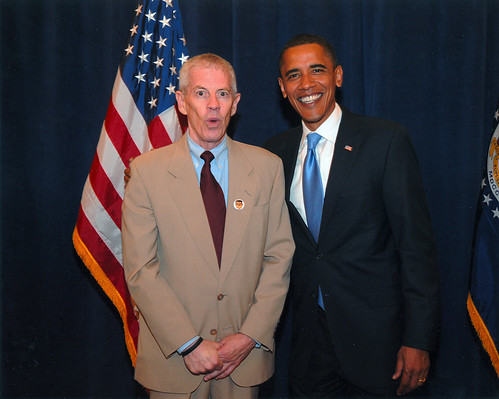
I debated pin or no-pin for my photo with Senator Obama a couple of weeks back but finally opted to show my support for Gnomies everywhere.

“The Beltway-Blog Battle”

Writing in Time Magazine, James Poniewozek has an interesting take (The Beltway-Blog Battle) on the passing of Tim Russert.

“…the press lost its most authoritative mass-market journalist, just as it is losing its authority and its mass market.”

The New Meida vs. Old Media argument got tiresome a long time ago, but Mr. Poniewozek offers a fresh take. A few paragraphs to wet your whistle:

“In their original division of labor, the old media broke news while the blogs dispensed opinion. But look at two of the biggest stories of the Democratic primary: Barack Obama’s comments that working-class voters are “bitter” and Bill Clinton’s rope-line rant that a reporter who profiled him was a “scumbag.” Both were broken by a volunteer for the Huffington Post website, Mayhill Fowler.

Traditional reporters were aghast at Fowler’s methods–the Obama meeting was closed to press (she got in as a donor), and Fowler did not identify herself when speaking to Clinton. But mainstream media had no problem treating the scoops as big news; if she had overheard both quotes in the same way but told them to a newspaper instead of publishing them, that would have been considered a coup.

The case against Fowler, in other words, was about process and credentials, not content. If sources stop trusting us, reporters asked, how will we do our jobs? But however sneaky her methods, Fowler’s stories prove that one reason sites like Huffington have an audience is the perception that Establishment journalism has gotten better at serving its powerful sources than its public. Fiascoes like the Iraq-WMD reporting gave many the impression that the old rules mainly protect consultant-cosseted public officials who need protection least.”

[For more on the Mayhill Fowler story, here’s a bit of audio with Arianna Huffington, speaking at Guardian News & Media’s internal Future of Journalism event on 18th June 2008.]

Mr. Poniewozik poses this rather rude question regarding MSM: “…if 3 million people read Drudge and 65,000 read the New Republic, which is mainstream?”

Obama-McCain Twitter Debate

This is probably one of those ideas that sounds more interesting than they turn out to be. But I’ll be following along, just because I have the hots for AMC.

“Starting tonight, a designated representative of both of the major presidential campaigns are going to participate in a free-wheeling debate on technology and government, moderated by Time magazine blogger Ana Marie Cox and channeled via Twitter.” – Personal Democracy Forum/techPresident

“When was the last time you saw a dead American soldier on TV?”

FlagdrapedcoffiinI was talking with a co-worker about Lara Logan’s (CBS Chief Foreign Correspondent) recent appearance on The Daily Show. She posed the question, “When was the last time you saw a dead American soldier on TV?” She was making the point that media in the U. S. has been MIA on the war in Iraq (except for that victorious march into Baghdad).

My co-worker’s take was: “The only reason to show a dead American soldier would be to turn someone against the war.”

Or maybe that war is news and death is part of the story?

Actually, I didn’t have a response. I can understand that view coming from W or Rumsfeld (back in the day). But how many citizens feel the same? How many would rather not to see the bloody reality of war on their TV screens?

By this logic, we also shouldn’t be seeing the critically wounded at Walter Reed. Or can we translate missing limbs to a “don’t-let-their-sacrifices-be-in-vain” message?

So I’m asking myself why we saw more dead troops during the Viet Nam war, and it came to me. We had lots of reporters on the front lines in that war. But not so many on the mean streets of Baghdad.

In the old days, you could make a career filing reports from the front lines. Sure, you could shot, but you weren’t likely to wind up the star of a YouTube beheading video.

Naw, American journalism took a pass on this war. Better to let the Brits cover this one.

Already missing Tim Russert (and my dad)

Johnmays250

And I’m not sure why. I didn’t “know” the man but, like many of his faithful viewers, felt as though I did. NBC devoted the full half-hour of the evening newscast to memories of Tim (“Mr. Russert” doesn’t feel right).

Maybe it’s my new-found interest in politics… or Father’s Day rolling around again… but I’m reminded of my pop, who died six years ago.

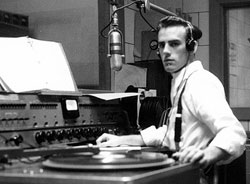
Dad was not the “family man” Tim Russert was reported to be. At least not demonstrably so. But he had his passions and radio was one of them. One I shared.

So, in memory of Tim Russert –and my dad– I share this interview I did with my dad shortly before he retired from radio.
Obama’s spirituality

In 2004, Chicago Sun-Times religion writer Cathleen Falsani interviewed freshman state legislator Barack Obama about his spiritual beliefs. Earlier this year, she republished the entire interview on her blog. Here are a few paragraphs from that interview [pulled selectively]:

"I’m rooted in the Christian tradition. I believe that there are many paths to the same place, and that is a belief that there is a higher power, a belief that we are connected as a people. That there are values that transcend race or culture, that move us forward, and there’s an obligation for all of us individually as well as collectively to take responsibility to make those values lived."

"I’m not somebody who is always comfortable with language that implies I’ve got a monopoly on the truth, or that my faith is automatically transferable to others."

"I’m a big believer in tolerance. I think that religion at it’s best comes with a big dose of doubt. I’m suspicious of too much certainty in the pursuit of understanding just because I think people are limited in their understanding."

"The most powerful political moments for me come when I feel like my actions are aligned with a certain truth. I can feel it. When I’m talking to a group and I’m saying something truthful, I can feel a power that comes out of those statements that is different than when I’m just being glib or clever.
I think there is an enormous danger on the part of public figures to rationalize or justify their actions by claiming God’s mandate."

"I think there is this tendency that I don’t think is healthy for public figures to wear religion on their sleeve as a means to insulate themselves from criticism, or dialogue with people who disagree with them."

"What I believe in is that if I live my life as well as I can, that I will be rewarded. I don’t presume to have knowledge of what happens after I die. But I feel very strongly that whether the reward is in the here and now or in the hereafter, the aligning myself to my faith and my values is a good thing."

For all the sturm and drang –and endless showing of a couple of video clips– surrounding the Reverend Wright… I don’t even know what to call it… issue? We learned precious little about Senator Obama’s faith and spirituality. This blog post offers a useful insight.