
As near as I can tell I am neither Ship A nor Ship B, nor any of the parts thereof. Rather, the process — the activity — of A becoming B. So, what seems to be more accurate than who.
Category Archives: Philosophy
Life from Above and Beyond (with words by Alan Watts)
Eternal Now
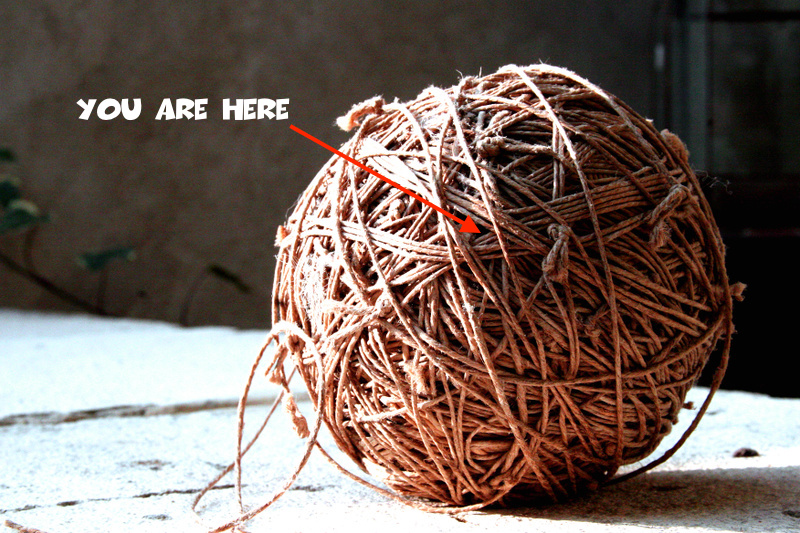
“The days and nights of Brahman are spread out in time in rather the same way as a ball of thread an inch in diameter is unrolled to the length of a hundred yards. Its real state resembles the ball but to be presented to the human mind it has to be unrolled. For our idea of time is spatial; it has length, which is a spatial dimension. But eternity has no length, and the nearest thing to it in our experience is what we call the present moment. It cannot be measured, but it is always here.”
My favorite excerpts from Become What You Are (Alan Watts) (PDF)
What Is Tao?
 Taoism regards the entire natural world as the operation of the Tao, a process that defies intellectual comprehension.
Taoists understand the practice of wu wei, the attribute of not forcing or grasping.
Jen – a human being will always be greater than anything they can say about themselves, and anything they can think about themselves.
Tao is a sort of nonsense syllable, indicating the mystery that we can never understand — the unity that underlies the opposites. […] Tao is a reality that we apprehend deeply without being able to define it. […] Anything that is expressed about the Tao is not the Tao.
We have been trying to fit the order of the universe to the order of words. And it simply does not work. The real basis of Buddhism is not a set of ideas but an experience.
When we say that we are trying to make sense out of life, that means that we are trying to treat the real world as if it were a collection of words. (Words are just symbols)
We are taught to figure things out, and our first task is to learn the different names for everything. In this way we learn to treat all of the things of the world as separate objects.
Humans get in their own way because they are always observing and questioning themselves. They are always trying to fit the order of the world into the order of sense, the order of thought and words.
Every stream, every road, if followed persistently and meticulously to its end, leads nowhere at all. […] Any place where we are may be considered the center of the universe. Anywhere that we stand an be considered the destination of our journey.
“The mystery of life is not a problem to be solved, but a reality to be experienced.”
My Give-A-Shit bubble is shrinking
 I think I’m sliding off the back side of the culture bell curve. The list of pop culture events about which I give a shit is shrinking. Fast. Star Wars? Yawn. Super Bowl/World Series. No relevance to my life. Of late I’ve noticed it isn’t just pop culture. I’ve stopped caring about ‘important’ stuff.
ISIS seems to be a big deal these days. I know they’re doing bad things to innocent people but my level of shit giving is directly linked to how much I can do about the problem and the answer is, not much.
Gun violence in America? Bad. Very bad. But I don’t care as much as I did a year ago. Or a month ago. I get that this kind of apathy (?) contributes to the problem. Maybe if we had 1,000 people slaughtered every day that could move my meter again but what could I do about it? Climate change? Please. I’m kind of in car-going-over-a-cliff mode. Is there really any reason to keep my hands on the steering wheel?
Pretending (or really caring, for that matter) to care about seems to be important mostly to people who run things. Those in office and those who want to be. Making me care enough about the ‘right’ things can be very helpful to a politician or a political party. People at Trump rallies care. Same for the people lining up to see Bernie.
But Steve, you say, you’re looking at this from too high a level. There are lots of things you can do close to home to make a positive difference. To change things. And you’re right. That I’m not doing much of that suggests that I don’t much give a shit at all levels.
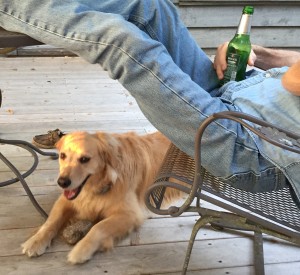
Let me assure you (too late?) that I’m not depressed for hopelessly forlorn. I’m surrounded by things that matter to me. My dogs. My sweetie. Good books. The view from the deck. So maybe my Give-A-Shit bubble is shrinking (as am I). Appears to be about 100 feet in any direction.