
“The whole point of life is to be fully aware of it as it happens.” — Alan Watts
Category Archives: Philosophy
Like feeling warm or cold
“Don’t try to get rid of the ego-sensation. Take it, so long as it lasts, as a feature or play of the total process — like a cloud or wave, or like feeling warm or cold, or anything else that happens of itself. Getting rid of one’s ego is the last resort of invincible egoism! It simply confirms and strengthens the reality of the feeling. But when this feeling of separateness is approached and accepted like any other sensation, it evaporates like the mirage that it is.” — Alan Watts
Stephen Fry on God
Panpsychism
The dizzying notion that everything in the universe might be conscious, or at least potentially conscious, or conscious when put into certain configurations. […] It is the argument that anything at all could be conscious, providing that the information it contains is sufficiently interconnected and organised. The human brain certainly fits the bill; so do the brains of cats and dogs, though their consciousness probably doesn’t resemble ours. But in principle the same might apply to the internet, or a smartphone, or a thermostat.
This is one tiny part of a longer, broader look at The Hard Problem (Consciousness). If this is your thing I recommend this piece by Oliver Burkeman.
Alan Watts: Think of Nothing
Pick a line
There’s an image in my head of two long lines of people, stretching off in different directions. In one line are the people who believe torturing our enemies is okay. And that police officers who shoot unarmed black men are just doing their job. The people in the other line — let’s call it the Sob Sister line — think differently.
Few things in life are black and white but it seems I can only stand in one of those lines so here I am in the Sob Sister line and as I look around, I don’t recognize most of the people in this line. But there are so many familiar faces in that other line. People I grew up with. People I worked with. Of course I think I’m in the “right” line, but so do all those people in the other line.
Up and down the line people are shouting back and forth, pretending to have a “conversation.” (Boy, I hate that word) But that’s not what’s really happening. Here’s what I think is really going on.
If the people in the Other line are right, then I must be wrong. Being wrong about really important stuff like torture and shooting people goes right to the core of who I am. Scary stuff.
Here’s my dilemma: I’m having trouble meeting the gaze of people I know in the Other line. They want to talk. To explain why I’m in the wrong line and persuade me to join them. But I smile awkwardly and look away, convinced nothing good can come from such “conversations.” Ideas, and the words we use to express them, are losing their power and meaning for me. They’re just sounds. Like those dogs whose owners think they can speak or sing. I’m focusing more these days on what I do. Actions seem like real things to me.
Am I being cowardly? Maybe. And I haven’t pefected my Stand Mute strategy yet. It’s difficult to be silent. To be still. But here I am in the Sob Sister line, hands in my pockets. Lips tight, eyes straight ahead.
UPDATE: My analogy is flawed. We need more than two lines. Not a third line, maybe, but a place for people to stand who aren’t comfortable in the two lines I described above. Picture that big infield area at the Indy 500.
These folks believe there are times when a police officer might have to shoot (12 times) an unarmed suspect. You have to look at the facts of each case and try to put yourself in the shoes of the officer. And clearly there are time when torture is justified. If a kidnapper has buried your family alive out in the desert and the only way you could save them was to torture the guy, wouldn’t you do it? Of course you would. So, see? You have to take each case on its merits. I don’t belong in either of your lines. Life’s not that cut and dried. Now. What did I miss?
Still the Mind by Alan Watts
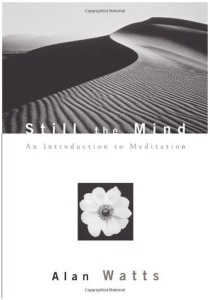 Excerpts from Alan Watts’ Still the Mind (An Introduction to Meditation)
We fail to distinguish between the way things are and the way they are described.
One’s actual organic being is inseparable from the universe.
I found out that unless one has something to give people, there is nothing one can do to help them. Just because I thought I ought to help, it didn’t mean that I had anything to give.
The whole energy of the universe is coming at you and through you, and you are that energy.
You can only know what you can compare with something else.
What we call the past is simply the traces, the fade-outs trailing away from the present. Continue reading
Tao: The Watercourse Way
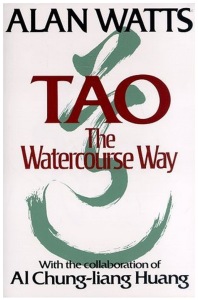 Excerpts from Tao: The Watercourse Way by Alan Watts.
The Tao which can be spoken is not the eternal (or regular) Tao.
Our organisms have ways of intelligent understanding beyond words and conscious attention.
The supposition that knowing requires a knower is based on a linguistic and not an existential rule.
Alphabetic writing is a representation of sound. A sign for a sound which is the name of a thing.
Li is the pattern of behavior which comes about when one is in accord with the Tao, the watercourse of nature.
We and our surroundings are the process of a unified field, which is what the Chinese call Tao. #
Technology is destructive only in the hands of people who do not realize that they are one and the same process as the universe.
It is the great and imaginary terror of Western man that nothingness will be the permanent end of the universe. We do not easily grasp the point that the void is creative, and that being comes from nonbeing as sound from silence and light from space.
I find it impossible to conceive any form whatsoever without the component of relatively empty space. […] I cannot get away from the sense that space and my awareness of the universe are the same.
How would you know that you are alive unless you had once been dead? How can one speak of reality or is-ness except in the context of the polar apprehension of void.
There is something in us which may be called upon for a higher wisdom than can be figured out by logic.
The nervous system can integrate more variables than the scanning process of conscious attention.
It is a matter of realizing that oneself and nature are one and the same process. […] The whole cosmos is implicit in every member of it, and every point in it may be regarded as its center.
There is no point in trying to suppress the babble of words and ideas that goes on in most adult brains, so if it won’t stop, let it go on as it will, and listen to it as if it were the sound of traffic or the clucking of hens.
Tao is just a name for whatever happens. […] Yet the Tao is most certainly the ultimate reality and energy of the universe, the Ground of being and nonbeing.
Tao cannot be defined in words and is not an idea or concept.
Verbal description and definition may be compared to the latitudinal and longitudinal nets which we visualize upon the earth and heavens to define and enclose the positions of mountains and lakes, planets and stars. But earth and heaven are not cut by these imaginary strings.
It is basic to the Taoist view of the world that every thing-event is what it is only in relation to all others.
Nature has no “parts” except those which are distinguished by human systems of classification.
The Tao is the pattern of things, but not the enforced law. […] The universe is a harmony or symbiosis of patterns which cannot exist without each other.
Just as every point on the surface of a sphere may be seen as the center of the surface, so every organ of the body and every being in the cosmos may be seen as its center and ruler.
As the universe produces our consciousness, our consciousness evokes the universe.
The only single event is the universe itself.
Pantheism: The idea that the universe, considered as a mass of distinct things and events, is simply God by another name.
But if, as is the case, the Tao is simply inconceivable, what is the use of having the word and saying anything at all about it? Simply because we know intuitively that there is a dimension of ourselves and of nature which eludes us because it is too close, too general, and too all-embracing to be singled out as a particular object.
Taoists do not look upon meditation as “practice,” except in the sense that a doctor “practices” medicine. […] Meditate for the joy of meditation.
“You” cannot go along with “things” unless there is the understanding that there is, in truth, no alternative since you and the things are the same process — the non-streaming Tao. The feeling that there is a difference is also that process. There is nothing to do about it. There is nothing not to do about it. […] In realizing that you are the Tao, you automatically manifest its magic.
As a way of contemplation, (Tao) is being aware of life without thinking about it.
To be anxious to survive is to wear oneself out. […] If, deep down inside, you want most desperately to survive and be in control of things, you cannot genuinely take the attitude of not worrying about it. You must allow yourself the freedom to worry — to let the mind think whatever it wants to think.”
Hebrew, Islamic, and Catholic scholastics, as well as Protestant fundamentalists, are like tourists who study guidebooks and maps instead of wandering freely and looking at the view.
True knowledge can be encompassed only by instinct and by actual experience.
Scott Adams: Marriage and Happiness
“Marriage is probably a great solution for 20% of the public. The rest of us need better systems. […] I don’t think traditional marriage is going away anytime soon. But it probably isn’t a coincidence that there are more single and divorced people than ever. Traditional marriage is the biggest obstacle to happiness in the United States. I give it twenty years before society acknowledges it to be a bad fit for modern times.”
Scott Adams on traditional marriage »
Waking Up
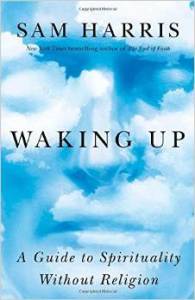 Just finished Waking Up – A Guide to Spirituality Without Religion by Sam Harris. Amazon reviews here; more about Mr. Harris here. Ideas I found highlighter-worthy below.
Our minds are all we have. They are all we have ever had. And they are all we can offer others. Every experience you have ever had has been shaped by your mind.
It is your mind, rather than circumstances themselves, that determine the quality of your life.
Everything we want to accomplish is something that promises, if done, it would allow us to finally relax and enjoy our lives in the present. […] Each of us is looking for a path back to the present: We are trying to find good enough reasons to be satisfied now.
Twenty percent of Americans describe themselves as “spiritual but not religious.”
Is it possible to be happy before anything happens, before one’s desires are gratified, in spite of life’s difficulties, in the very midst of physical pain, old age, disease, and death?
On one level, wisdom is nothing more profound than an ability to follow one’s own advice.
A true spiritual practitioner is someone who has discovered that it is possible to be at ease in the world for no reason, if only for a few moments at a time.
It is impossible for any faith, no matter how elastic, to fully honor the truth claims of another.
We manage to avoid being happy while struggling to become happy.
(Mindfulness is ) a state of clear, nonjudgmental, and undistracted attention to the contents of consciousness. […] Being mindful is not a matter of thinking more clearly about experience; it is the act of experiencing more clearly, including the arising of thoughts themselves.
The problem is not thoughts themselves but the state of thinking without knowing we are thinking.
Most people who believe they are meditating are merely thinking with their eyes closed.
Most of us spend every waking moment lost in the movie of our lives.
Meditation is a technique for waking up.
Investigating the nature of consciousness is the basis of spiritual life.
Consciousness is the one thing in this universe that cannot be an illusion.
If you shut your eyes at this moment, the contents of your consciousness change quite drastically, but your consciousness (arguably) does not.
Are we unconsciousness during sleep or merely unable to remember what sleep is like?
We are not aware of all the information that influences our thoughts, feelings, and actions.
I’ve forgotten most of what has happened to me over the course of my life.
Subjectively speaking, the only thing that actually exists is consciousness and its contents. […] Reality vastly exceeds our awareness of it.
(I am) a continuum of experience.
The feeling of “I” is a product of thought. […] Having an ego is what it feels like to be thinking without knowing that you are thinking.
(Thoughts are) transient appearances in consciousness.
We tell ourselves the story of the present, as though some blind person were inside our heads who required continuous narration to know what is happening.
Even if your life depended on it, you could not spend a full minute free of thought. […] We spend our lives lost in thought. […] Taking oneself to be the thinking of one’s thoughts is a delusion.
One must be able to pay attention closely enough to glimpse what consciousness is like between thoughts — that is, prior to the arising of the next one.
We imagine that we are conscious of our selves within our bodies. We seem to be riding around inside our bodies.
(The self) is the feeling that there is an inner subject, behind our eyes, thinking our thoughts and experiencing our experience.
It may be that an awareness of other minds is a necessary condition for an awareness of one’s own.
Consciousness is the prior condition of every experience; the self or ego is an illusory appearance within it; look closely for what you are calling “I,” and the feeling of being a separate self will disappear; what remains, as a matter of experience, is a field of consciousness — uncontaminated by its ever-changing contents.
Consciousness is intrinsically free of self.
That which is aware of sadness is not sad. That which is aware of fear is not fearful. Notice thoughts as they emerge and recognize them to be transitory appearances in consciousness. In subjective terms, you are consciousness itself — you are not the next, evanescent image or string of words that appears in your mind.
Consciousness is intrinsically undivided.
Nothing is intrinsically boring — boredom is simply a lack of attention.
We need not come to the end of the path to experience the benefits of walking it.
We read for the pleasure of thinking another person’s thoughts.
It is by ceasing to cling to the contents of consciousness — to our thought, moods, and desires — that we make progress.
There is experience, and then there are the stories we tell about it.
Consciousness is never improved or harmed by what it knows.