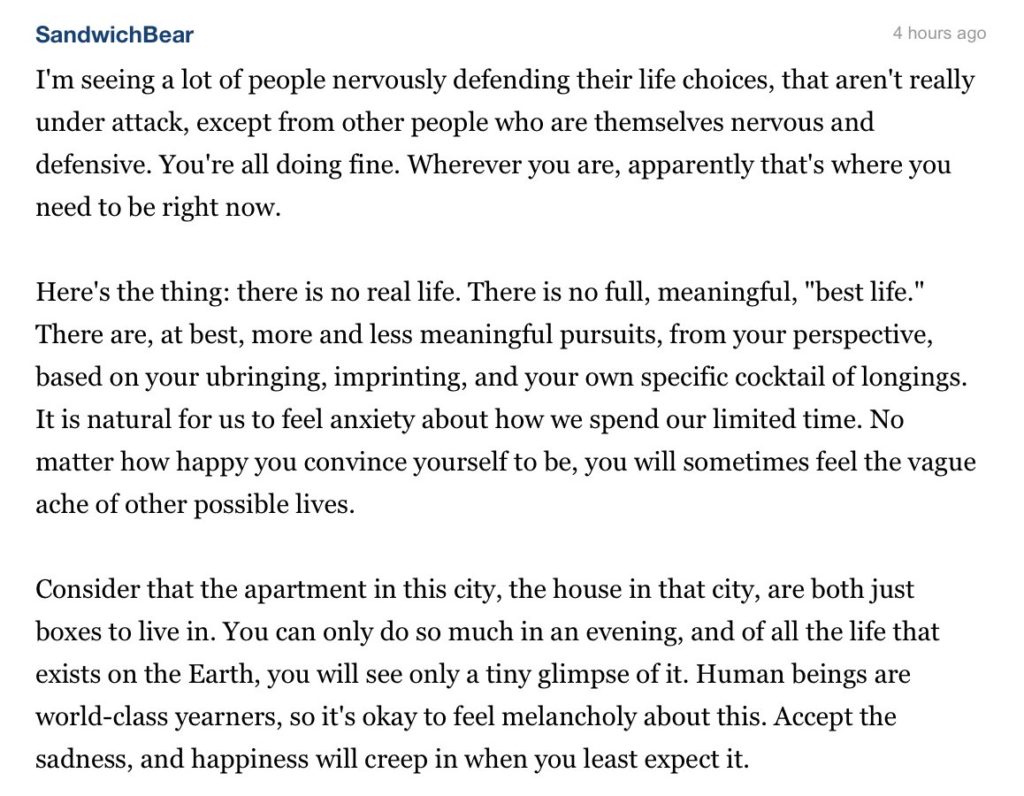
Truths About Life

David Cain has 88 of these on his list. These are just my favorites.

“If you go home with someone, and they don’t have any books, don’t fuck them.” — John Waters

The main reason we argue online is because it feels good, but we like to imagine it’s also somehow noble or helpful.

The news doesn’t show you how the world is. It shows you whatever will make you watch more news.

Every generation thinks the one that came before them and the one that came after them are the worst.

We evolved to go days without food. Missing a meal shouldn’t be a big deal, but if you skip the odd lunch people will assume you have an eating disorder.

We are all atheists, in a sense. Every person denies the existence of either most or all of the gods that have been proposed.

When a party has degenerated into people showing each other their favorite YouTube videos, it’s time to call a cab.

The Ruthless War on Stuff

I have a mental list of topics I try to avoid because — in my experience — they seem to make people a little (or a lot) crazy. Politics and Religion, of course. Apple products. And Marie Kondo, the best-selling author of The Life-Changing Magic of Tidying Up. I read her little book and did exactly what it said I should do to “change my life.” But I try to keep what I learned to myself (like religion and politics and Steve Jobs). But this New York Times piece is too good not to share. A few excerpts:

“By the time her book arrived, America had entered a time of peak stuff, when we had accumulated a mountain of disposable goods — from Costco toilet paper to Isaac Mizrahi swimwear by Target — but hadn’t (and still haven’t) learned how to dispose of them. We were caught between an older generation that bought a princess phone in 1970 for $25 that was still working and a generation that bought $600 iPhones, knowing they would have to replace them within two years. We had the princess phone and the iPhone, and we couldn’t dispose of either. We were burdened by our stuff; we were drowning in it.”

The success of Ms. Kondo’s book (and system) gets a big dollop of derision and smirking: “A parody book called “The Life-Changing Magic of Not Giving a [expletive],” and another one called “The Joy of Leaving Your [expletive] All Over the Place.”

But the lady seems to walk the walk: “The only visible possessions in her hotel room for a two-week trip from Tokyo were her husband’s laptop and a small silver suitcase the size of a typical man’s briefcase.”

The “organizing industry” is big in the U.S. and some of the old hands are quick to dismiss Kondo’s approach. Okay, a little more than just “dismiss”:

“Somehow the extra step of thanking the object or folding it a little differently enrages them. This rage hides behind the notion that things are different here in America, that our lives are more complicated and our stuff is more burdensome and our decisions are harder to make.”

A well-written article, whatever your thoughts on, or approach to, tidying up.

Reading List: Tao, Zen & Buddhism

  • What Is Tao? – Alan Watts [notes]
  • Tao: The Watercourse Way – Alan Watts [notes]
  • The Life-Changing Magic of Tidying Up: The Japanese Art of Decluttering and Organizing – Marie Kondo [notes]
  • Freedom from the Known – Jiddu Kirshnamurti
  • This Is It: and Other Essays on Zen and Spiritual Experience – Alan Watts [notes]
  • The Spirit of Zen: A Way of Life, Work and Art in the Far East [notes]
  • The Book: On the Taboo Against Knowing Who You Are – Alan Watts [notes]
  • Buddhism Without Beliefs: A Contemporary Guide to Awakening – Stephen Batchelor [notes]
  • The Sound of Silence: Selected Teachings of Ajahn Sumedho
  • Be As You Are: The Teachings of Sri Ramana Maharshi [notes]
  • Ten Zen Questions – Susan Blackmore [notes]
  • Wherever You Go, There You Are – Jon Kabat-Zinn [notes]
  • Opening the Hand of Thought: Foundations of Zen Buddhist Practice – Kosho Uchiyama Roshi
  • I Am That – Nisargadatta Maharaj [notes]
  • Rebel Buddha: A Guide to a Revolution of Mind – Dzogchen Ponlop
  • Awakening the Buddha Within: Tibetan Wisdom for the Western World – Lama Surya Das
  • Zen Mind, Beginner’s Mind – Shunryu Suzuki
  • Living As A River: Finding Fearlessness in the Face of Change – Bodhipaksa [notes]
  • The Tao of Zen – Ray Grigg [notes]
  • Buddhism Plain and Simple – Steve Hagen [notes]
  • The Way of Zen – Alan Watts [notes]
  • Buddha’s Brain: The Practical Neuroscience of Happiness, Love and Wisdom – Rick Hanson [notes]
  • Still the Mind: An Introduction to Meditation – Alan Watts [notes]
  • Meditation Now or Never – Steve Hagen [notes]
  • The Tao of Meditation: Way to Enlightenment – Jou Tsung Hwa

Reading list: Consciousness

  • The Big Picture: On the Origins of Life, Meaning, and the Universe Itself – Sean Carroll | My notes
  • Consciousness and the Social Brain – Michael S. A. Graziano | My notes
  • What Technology Wants – Kevin Kelly | My notes
  • The Ego Trick – Julian Baggini | My Notes
  • The Self Illusion: How the Social Brain Creates Identity – Bruce Hood | My Notes
  • Thinking, Fast and Slow – Daniel Kahneman | My notes
  • Incognito: The Secret Lives of the Brain – David Eagleman | My notes
  • The Ego Tunnel: The Science of the Mind and the Myth of the Self – Thomas Metzinger | My notes
  • Quantum Enigma: Physics Encounters Consciousness – Bruce Rosenblum | My notes
  • Biocentrism: How Life and Consciousness Are the Keys to Understanding the True Nature of the Universe – Robert Lanza | My notes

The Big Picture

The Big Picture: On the Origins of Life, Meaning, and the Universe Itself. By Sean Carroll

Life is a process, not a substance, and it is necessarily temporary.
For a long time, there has been a shared view that there is some meaning, out there somewhere, waiting to be discovered and acknowledged. There is a point to all this; things happen for a reason. […] Gradually, our confidence in this view has begun to erode.

“Life” and “consciousness” do not denote essences distinct from matter; they are ways of talking about phenomena that emerge from the interplay of extraordinarily complex systems.

At a fundamental level, there aren’t separate “living things” and “nonliving things,” “things here on Earth” and “things up in the sky,” “matter” and “spirit.” There is just the basic stuff of reality, appearing to us in many different forms. […] We will ultimately understand the world as a single, unified reality, not caused or sustained or influenced by anything outside itself. That’s a big deal.

The only reliable way of learning about the world is by observing it. Continue reading

What’s in your bag?

This Q&A with James Altucher might be the best thing I’ve come across about “minimalism” although he quickly disavows that label. I couldn’t live as he does but he’s not suggesting I should. A few snippets:

I have one bag of clothes, one backpack with a computer, iPad, and phone. I have zero other possessions.

For me, having little means I don’t have to think about things that I own.

I have 238,795 unread emails in my inbox. Emails are a suggestion but not an obligation.

I understand real books are beautiful. So I go to bookstores for hours and read them. But I won’t own them because they won’t fit in my one bag.

I never read random articles on the Internet unless they are by people I know.

I like this guy’s style. No idea what others should do… just some thoughts on what he should do. Today. Tomorrow? Who knows?

Become What You Are by Alan Watts

Excerpts from Alan Watts’ Become What You Are:


Though your thoughts may run into the past or the future they cannot escape the present moment.

A man does not really begin to be alive until he has lost himself, until he has released the anxious grasp which he normally holds upon his life, his property, his reputation and position.

The one important result of any serious attempt at self-renunciation or self-acceptance is the humiliating discovery that it is impossible. […] The people who have quite genuinely died to themselves make no claims of any kind to their own part in the process.

Our attempts to stand above (our) emotions and control them are the emotions themselves at play.

Your everyday mind is the Tao. Continue reading