Behind Your Radio Dial

Before television took over the airwaves, Rockefeller Center was home to the National Broadcasting Company during the golden age of radio. This promotional film from around 1948 chronicles the rise of the media company from a small collection of 20 affiliated stations, formed in 1926, to more than 170 stations two decades later. The 24-minute documentary, courtesy of the Prelinger Archive, introduces the network and goes behind the scenes at Rockefeller Center, peeking into the mail room, sound recording studios, and music library.

The documentary closes with a look at the network’s budding television enterprise. “Adding sight to sound, [NBC] opened an electronic window” when it launched the first commercial television station in 1941, the narrator explains. “More than two decades of NBC radio have been dedicated to the spirit of public service. Now, in bringing television, network television, out of the laboratory and into your living room, NBC rededicates itself in this same spirit to provide the greatest medium of mass information and mass entertainment in the world.” Radio junkies and30 Rock fans alike will enjoy this journey back in time.

“Threads of advertising-sponsored content”

“Advertising is becoming content, not message. Or, more specifically, the message is knit into the content.  Under that scenario there is no 30-second spot per se, there are simply threads of advertising-sponsored content.

Creating “content that people choose to watch (and share)” (and listen to) is the job of every company that calls itself “media.”  This goes to the heart of radio’s revenue model because it is clearly out of step with the direction of clients and their agencies.

This is why the structure of so much of radio is outdated.  We have sellers who move spots and programmers who mix music. What we need amongst these are content creators who match consumers with clients in the presence of our brands by bringing compelling ideas to life.”

— Mark Ramsey Media

DAR: Tivo for radio

This begs the question, “Does my local radio station have programs so compelling I want to record them and listen later?” Let’s hope so. If you have –or plan to– tried DAR, let me know what you think. (via Roger Gardner)

Everywhere media

Like many others, I followed news of the destruction of Joplin, Missouri, on Twitter. A tornado destroyed most of the southeast Missouri town and almost immediately videos and photos began showing up on YouTube, Facebook and Twitter.

It brought back memories of my radio days.

Our station had an old Army surplus radar that gave us something of a competitive edge when it came to storm coverage. We also relied on news from the National Weather Service that came in on a teletype. And the local weather spotters who radio’d eyeball reports in.

Then one night a big storm hit and I scurried out to the station only to discover power from the city was out. But we were able to broadcast thanks to a generator that just ran our transmitter and one studio. No radar, no teletype, zip.

So I started taking phone calls from listeners who described what was happening where they were. We did that for most of an hour.

Most old radio guys have lots of stories like that. Bad weather was radio’s time to shine.

When I started working for a statewide radio network in 1984, it was frustrating not to be able to talk directly to the listeners, especially when a big story –like a tornado– was breaking. We only got on the air if our affiliates chose to put us on the air.

Same deal for covering the story. If the story was hundreds of miles away, we had to rely on our affiliate stations to send us reports we then put on the statewide network. And many of them did/do a remarkable job.

Assuming the radio stations in Joplin are on the air, our newsroom was probably getting reports last night.

This is what I was thinking about last night as I watched my twitter feed fill up with links to video and photos and first-hand accounts of the “devastation” (a term that has now been used so many times as to be almost meaningless).

At least two of our reporters –one in Missouri and one in Wisconsin– were re-tweeting reports about the big storms in their respective states. I was glad to see that and not very worried about the accuracy. The sources they were re-tweeting were credible.

It reminded me of a story about the BBC which has “a special desk that sits in the middle of the newsroom and pulls in reports from Twitter, Facebook, Flickr, YouTube and anywhere else it can find information.”

Whatever the disaster… natural or man-made… someone is there with a video camera and within minutes the story is being “reported.” What this means for ‘traditional’ news organizations like ours is still being worked out but it’s clear it will never be like it was.

The end of radio coverage maps?

A radio station coverage map is just what it sounds like: a cirle showing how far your station’s signal reaches. The bigger the circle the better. Now a new BMW option might make coverage maps less important (obsolete?)

Yes, I know, not everyone can afford a BMW but is there any doubt this technology will find its way into every vehicle? Not for moi.

Mark Ramsey sees the car as “a digital lifestyle accessory” and wonders how broadcasters fit into the consumer’s mobile digital lifestyle?

“Maybe it’s with unique and exclusive content. Maybe it’s with digital bells and whistles that make your content sing. It’s not with the same old same old. And no number of debates about FM on mobile phones will solve this problem for you.”

On more than one occasion I’ve wondered what would I do to stay fresh and relevant if I were running a radio station. How might I insure that my station was on that BMW dashboard/iPhone? And I don’t have a good answer. But smarter folks than I are figuring this out.

Fan letter

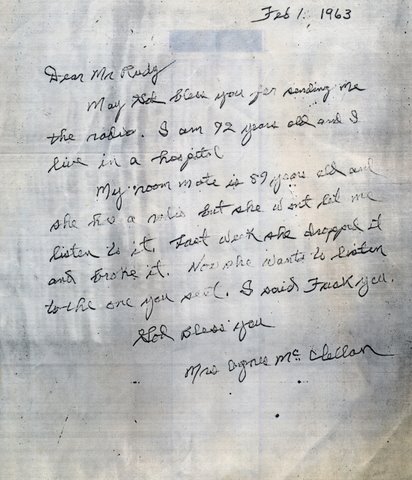
I had heard this story over the years but always assumed it was apocryphal. Too good to be true. Rudy Pylant (“Mister Rudy”) was a local radio personality in my hometown. His fans were legion and he got lots of letters. Like this one his daughter recently discovered and shares.

“The Net is the new TV & radio”

“Smartphones and other portable Net-connected devices are now the closest things we have to universal receivers and transmitters of live news. Not many of us carry radios in our pockets any more. Small portable TVs became passé decades ago. Smartphones and tablets are replacing radios and TVs in our pockets, purses and carry-bags.”

“Television has also become almost entirely an entertainment system, rather than a news one. News matters to TV networks, but it’s gravy. Mostly they’re entertainment businesses that also do news.”

“…emergencies such as wars and earthquakes demonstrate a simple and permanent fact of media life: that the Net is the new TV and the new radio, because it has subsumed both. It would be best for both TV and radio to normalize to the Net and quit protecting their old distribution systems.”

— From a post by Doc Searls, co-author of The Cluetrain Manifesto.