“Go-to device for local information”

Lost Remotes Corey Bergman predicts the iPhone (and the apps that will be written for it) will have huge impact on local news and information:

“…the location-aware phone (and similar phones that follow) will become the go-to devices for local information. In fact, I believe local information ultimately will be consumed more on mobile than PCs.”

Where have we been getting our local information? Oh yeah, radio.

Sports fan blogs

Interesting story on NPR this morning about a sports blog called The LoHud Yankees Blog. The blog seems to be a collaborative effort by Journal News beat writer Peter Abraham and a shit-load of fans. According to the NPR piece, a post can get as many as a thousand comments and readers will post to the blog form the stands, in the middle of a game.

I have a theory about blogs like this one. If the Yankees organization tried to create  such a successful blog, they couldn’t. Wouldn’t matter how much money they threw at it. There is some organic quality to really successful blogs like this one that is damned hard for big institutions to foster.

Smart companies will find and encourage and support efforts like this one. Is there a risk that someone will post something unflattering about the Yankees? Of course. But get a clue… they’ll do that anyway.

Most of the pro leagues have some sort of dumb-ass policy regarding live-blogging of games by reporters so I’m a little curious how the Journal News is pulling this off. If Mr. Abraham or someone from the paper stumbles across this post, I’d love to know the answer. Could it be the Yankees are smart enough to know a really good thing when they see it?

We’re gonna need a bigger dial

Mark Ramsey points us to this LA Times story about Chrysler’s plans to offer wireless Internet in its 2009 models. Something we all knew was coming. As always, Mr. Ramsey asks the good questions. Here’s one of them:

“What does it mean to be “radio” in a world where audio is fully integrated into an experience that includes video, text, interactivity, and personalization? The attraction to these services will not only be that they’re supplemental to radio, but that they expand the definition of radio. And that expansion will benefit only those broadcasters and their partners smart enough to recognize that the advantage of a broadcast tower is non-existent in this context.”

Or a satellite channel?

The Future Radio Morning Show

It isn’t simply streaming your current morning show. Or putting it online for download. Jerry Del Colliano lays it out — in ten easy steps — on his blog (invitation only).  #1 gives you the setup and #7 and #8 my favorites.

1. Start ten morning shows (other than the one that is airing on your terrestrial station). The content should aim at one demographic that is desirable to sell. Example: women 25-54. Ten shows that don’t air on the radio.

7. Hire the right person(s) to host this 45-minute show – not, I repeat, not anyone from your airstaff. Podcasting is not to be confused with broadcasting. You may be a professional broadcaster but it is not in your best interest to make these podcasts son of what is already on your air. Give the host a piece of the show and lock him or her into it for the long term. As it develops it will be a moneymaker for you and for your talent.

8. Do not include traditional spots in the podcast. Commercials have seen there better days. Young people don’t listen – but consider the “live read” approach that goes over very well with young people. If they are hooked on a podcast then they will listen to a “live read” by the host(s) if it is sincere and keeping with the overall approach of the show.

Mr. Del Colliano concludes his post with a bit of insight into Generation Y:

(Gen Y) went through childhood without a love for radio, unlike baby boomers or Gen X. They are attached to their iPods and smart phones – their new radio. If you still want to be in the content business when the last baby boomer passes into The Hall of Fame, learn about the new radio – podcasting.

The “ten morning shows” had me puzzled at first. But I’m guessing you need this many, all aimed at the same demo, to reach the numbers that will be attractive to advertisers. The advertises cares about reaching the demo (Women 25-54 in the example above) and not so much about how many shows he sponsors to reach them, assuming the price makes sense.

So let’s assume we have a 25 minute commute to Jefferson City (from Columbia or Loose Creek). Would I be willing to produce five, 25-min podcasts a week for a piece of the show? I would if Mr. Del Colliano was managing the station.

Radio for the blind and print-disabled

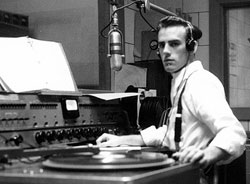
The Kansas Audio-Reader Network is “a reading and information service for blind, visually impaired, and print disabled individuals in Kansas and western Missouri. Services are offered free of charge to anyone in our listening area who is unable to read normal printed material.”

AUDIO: Excerpt from audio-reader network 6 min MP3

This would seem to be an invaluable service for those who cannot read a newspaper. I wonder what impact, if any, the Internet is having on services like this. I understand that not everyone has a computer and access to the web but that number is shrinking daily.

I assume the blind or visually impaired can have the text on any web page translated to spoken audio. While this would give the user more control over the information she consumes, it might be more… entertaining? …to have a human read it aloud. Or why not have both.

Already missing Tim Russert (and my dad)

Johnmays250

And I’m not sure why. I didn’t “know” the man but, like many of his faithful viewers, felt as though I did. NBC devoted the full half-hour of the evening newscast to memories of Tim (“Mr. Russert” doesn’t feel right).

Maybe it’s my new-found interest in politics… or Father’s Day rolling around again… but I’m reminded of my pop, who died six years ago.

Dad was not the “family man” Tim Russert was reported to be. At least not demonstrably so. But he had his passions and radio was one of them. One I shared.

So, in memory of Tim Russert –and my dad– I share this interview I did with my dad shortly before he retired from radio.

Next generation radio

Jerry Del Colliano shares a few ideas on “next generation radio” he’ll be presenting to an interactive session for radio executives next month:

“My view is that terrestrial radio is now a destination entertainment medium for available listeners – older members of Gen X and the baby boomers.”

“…there is no need to produce 24/7 programming online. … But the radio station of the future may only provide three hours of programming a day – that’s right, a day – and deliver it on a cell phone or mobile device.

“Podcasting will be the new radio for Gen Y.”

“The successful content provider in the future will have to unlock the genius of Steve Jobs in understanding a generation they are not in – and Jobs, arguably, knows Gen Y better than they know themselves.”

“In the past, a radio station had to be on-air, all the time and doing the same format over and over again. But in the future, new media will require radio broadcasters who want to play in this arena to be many things for which it does not presently have skills.”

If you’re interested in where radio might be headed, I encourage you to read the full post. Companies that provide programming to radio stations — like our company– are sure to be affected by the same forces. Are we ready?

The results business

Mark Ramsey points to a survey of marketing professionals that shows growing pressure on accountability:

“86% of marketers say pressure has increased on them to account for results; no one said that the pressure has decreased. Moreover, 68% of organizations are measuring the quantifiable contribution of marketing to the bottom line.

Message to radio: You’re no longer in the advertising business. You’re in the results business.
So which are you selling, advertising or results?”

I feel like I should have something to say about this… but I don’t know what it would be.

“The next generation doesn’t like radio.”

Jerry Del Colliano is a professor at USC, broadcaster and program director and founder of Inside Radio. And a blogger:

“The next generation doesn’t like radio. Not the stations. Not the concept. There’s simply less need for it in their lives.

New technologies will not only replace radio among the next generation, they already have. And this generation is huge — with as many Gen Y’ers as there are baby boomers.

Without the next generation the radio business will continue to hit the wall. Once the present economic downturn ends — still a long way off — there won’t be enough new young listeners to help radio continue to grow. It becomes a losing proposition. More radio listeners die and fewer new radio listeners use traditional radio.

The next generation wants to stop, start, time-delay and delete its programming. This generation wants to mash it up — have a say in what it sounds like or how it is used. They want to deliver it to each other — share it — at will. They want community (what we used to call local radio) through social networking online.

One of the hardest things for me to deal with in my years of working with the next generation is that they don’t like radio and don’t understand what I like about it. When I describe it, they say what I am describing is not what they hear on the radio.

We’re an industry in denial that technology has changed the game. But only radio people have the power to adapt and create new content for a new generation and on the devices they use.

But to begin, we have to understand that more has changed than how to deliver radio programming. It’s not about the technology. It’s the sociology.”

When I can safely speak to a young person (early teens), I ask them about radio and get pretty much the same responses as Professor Del Colliano. What’s the joke… denial is not just a river in Egypt?

Live webcast from D.C.

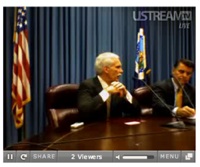
ZimmcastMy friend Chuck is in Washington D.C. at the National Association of Farm Broadcasters’ Washington Watch. A few days ago he was sitting with me in the Jefferson City Coffee Zone where I showed him how we had been playing with live video streaming with UStream.

As I write this, Chuck is streaming a news conference with the U. S. Secretary of Agriculture. No satellite truck. No cameraman. No sound man. Just Chuck and his MacBook Pro. I assume he’s recording and will post at AgWired.com.

Ag Secy is now praising “ag radio.” How many of the reporters in the room are recording his remarks to chop up and put in a report they’ll feed back to their stations for later broadcast? While Chuck is streaming live video.

Secy just said something about “you radio guys need 30 second sound bites and I can’t do that.” Uh, no Mr. Secretary, we’re live here at AgWired.com so you can go as long as you need. It’s not about sound bites anymore.

“The future is already here. It’s just not evenly distributed yet.” — William Gibson