
Broadcasting on the web

Interesting analysis of TV station websites by Graeme Newell. The piece is buried in a long, no-way-to-deeplink post on ShopTalk, so I’m posting the full article after the jump.

“The problem is our mindset. We’re trying to recreate broadcasting on the web. We do the web just like we do TV – broad. There is just a little bit of everything and not enough of anything. Because of its very nature, TV news has evolved to become a headline service. Our web sites mirror our on-air broadcast. You usually leave our web sites still hungry, wishing for a little more meat on the bone.”

“In the future, successful stations will have a hundred different broadband channels, all of them geared towards a specific demo. Give up your need to be a broadcaster. We are now nichecasters and the web gives us a whole new way to bring new audiences to our door.”

It’s worth a read because I think it applies to a lot of radio station websites as well as TV. Maybe even some radio network websites?
Continue reading

Google going forward with radio plans

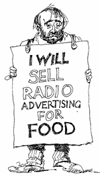
Will Sell Advertising for FoodGoogle CEO Eric Schmidt says Google’s plans to begin placing radio ads by the end of this year remain on schedule, contradicting recent talk within the industry that the company had postponed the project.
“The tests are going extremely well,” said Schmidt, who added Google eventually plans to employ about 1,000 workers in its radio division. [E-Commerce Times via Hear 2.0]

Internet advertising closing in on radio

The Internet will receive a greater share of global advertising spending this year than do outdoor outlets such as billboards, and it is set to overtake radio soon. That’s one of the findings in a report by ZenithOptimedia, a media planning and buying firm. The growth is being driven by smaller brands, which are turning to the Internet because it is relatively cheap and can target their markets effectively. (see The Long Tail) The company said it expected the spending share gap between the Internet and radio to narrow from 3.9 percentage points in 2005 to 0.7 in 2008. (Yahoo! News/Reuters)

If you understand how to market and sell online, this is not necessarily a bad thing. If you don’t… then pray that these are new dollars that won’t impact your sales.

Media Study: Radio Makes People Happy

That’s one of the findings in a new study by the Radio Advertising Effectiveness Lab. Harris International surveyed more than 2,500 people between the ages of 18 and 54 in June and July. (MediaWeek)

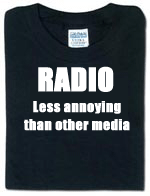
Less Annoying“Fifty-five percent of respondents said radio was the medium most likely to improve their mood compared to the other three media studied. The findings were generally true across all ages, genders, and ethnic groups, but especially strong for African-Americans and Hispanics.”


“Advertising on radio was also found to be less annoying than on other media. Comparing Internet ads to radio ads, 45 percent of respondents said radio ads are “repeated too often,” compared to 53 percent who said the same about Internet ads; 24 percent said radio ads “appear at inconvenient moments,” while 60 percent said the same of Internet advertising.”

The simple truth is most radio stations just have too many commercials. And too many of those commercials have no relevance for me. Yes, I understand that they ALL have relevance for someone… but in an iPod world, that truth is no longer relevant. I have to stop now, I’m out of italics. [Thanks, Chuck]

How to ruin a podcast

Mark Ramsey points to a classic example of MSM cluelessness (CBS in this instance). His post makes me uncomfortable because our networks produce a lot of programs (newscasts and sports reports) that are comprised of 3 minutes of programming and one minute of commercial.

What if we were only podcasting that program. Would listeners swallow that? I’m thinking not.

Back in the dark old days, when one of our networks was oversold, we’d just jam in more spots and ask stations to air programs that had more commercial content than programming. Shudder.

Mark sums it up nicely:

“In our zeal to monetize our online content, remember that podcasts are downloaded and played voluntarily. It’s because we like you and want more of you. Yes, we’ll tolerate advertising in podcasts – but not 30 out of 90 seconds!”

Podcasting candidate endorsements

Just listened to the latest podcast from the Missouri State Teachers Association. They call it The Pulse. Co-hosts Todd Fuller Gail McCray broke a little digital ground (I’m guessing) by using the podcast to announce the canidates the MSTA is endorsing in the November election. They spent the first part of the podcast explaining how their endorsement process works. Then they mentioned a few specific endorsements and pointed the listener back to their website for the full list of candidates.

Why do I think this is worth a post? As I listened to Todd and Gail explain this process, I kept thinking they would NEVER get airtime (radio or TV) for that kind of “deep dive.” But it’s important to their audience (teachers, candidates). And by using their podcast to make the announcement, it raises awareness of their podcast. (You now know about it because you read this blog which has nothing to do with education or politics.)

If you want to see/hear how to do an “association podcast,” check out MSTA’s The Pulse.

What new Arbitron rules mean for radio stations

“When listening is defined as broader than “radio” alone, then you are no longer in the “radio business.” You’re in the business of audio entertainment and information, regardless of distribution channel. That little home-grown Internet radio station from Zimbabwe is now your competitor. When “Listening” is defined according to things that do not require a radio, you are no longer in the “radio business.” Get it?” — Mark Ramsey

My kind of contract

Roger brought back a copy of the affiliation contract for The Davey Ramsey Show (financial advice?) from the recent meeting of the National Association of Broadcasters. They shove all kinds of promotional stuff under the door to your hotel room every night and this was in Roger’s pile one morning. I’m not familiar with the program but I love the contract. One page (front only). I spent my youth (okay, my middle years) trying to get people to sign affiliation contracts with our networks.

I did my best to keep them simple and understandable. But our attorneys never let me go this far. Here’s the full contract (PDF) and here are a few paragraphs:

Thank you for deciding to include The Dave Ramsey Show as part of your station lineup. Are you looking for a big, detailed contract? They are a pain and quite frankly, we don’t feel like dealing with them. Below you will find afew points that will guide our relationship. Please initial each one and return the contract via fax to 615-372-0573 (confidentiality assured).

1. You like us and we like you and therefore are agreeing to work together. You are going to start airing the program on station (station info)

3. Now that you have decided to carry The Dave Ramsey Show we will not be available for another station in your market. Don’t know why we have to state that we are not interested in cutting our legs out from under ourselves, but I guess this market exclusivity thing is a big deal.

5. Let’s try this. The Dave Ramsey Show should be carried LIVE. We think it is a mistake if it is not aired live. However, we understand that some stations are not able to make this happen. For now that is acceptable. All we want you to do is let us know that after we start winning for your station, that you will consider us for a live slot. You are not guaranteeing us this slot, you are not promising this slot, you are simply letting us know that you will consider it. Come on, is that too much to ask? We should be live anyway.

I don’t know how good this is from a legal standpoint, but it’s good marketing or PR or something. And in my experience, most contracts with radio stations weren’t worth much. My hat is off to whomever wrote this agreement.

WSJ: “How to get attention in a New-Media World”

Wall Street JournalThat’s the headline on a story in today’s Wall Street Journal. I won’t bother posting any of the many nuggets in this piece. You can read them yourself. And if you spend anytime online, you know a lot of this already.

Here’s what I want to know: How can any intelligent, semi-educated, reasonably well informed, man or woman entrusted with running a business (or some division or department of that business) not have at least heard about the things referenced in this story (blogs, podcasts, RSS, etc etc)?

We talk to people every day that insist (and I belive them) they’ve never even heard the terms. I don’t expect the average Joe (or Joanne) to be as into this “new media” (someday we won’t need the quotation marks) as I am… and I know that not everyone has access to the Internet. But if you own a TV set, a radio, read a newspaper or a magazine… how could you not have seen or heard one or two of the countless stories about “new media” during the last couple of years?

* I just read the local sports scores in The Daily Bugle
* I only watch Wheel of Fortune and QVC on TV
* I haven’t seen anything in People Magazine about all this stuff
* Cousin Bob on Country 108.7 would tell me if any of this stuff was important

What do you know? I answered my own question.

Let me stress that I’m not saying your business should be using any of the new media tools (you should)… but I remain mystified that there are people who have not a glimmer that something is happening.