Podcasts on your BlackBerry

A company called QuickPlay has come up with a way to stream podcasts directly from a central server, instead of downloading and storing on space-limited memory cards. They say they have lined up some high-profile content providers, ranging from ABC News to the Wall Street Journal. The service is available immediately for $8 per month and requires an existing BlackBerry connected to a cellular provider’s data plan.

It’s going to get easier and easier to watch/listen stuff on portable devices. Once that happens, I think we’ll stop using the term podcast.

A quarter of US homes have MP3 players

Nielsen Media Research has released findings from its 3rd Quarter Home Technology Report which show that MP3 players are now found in a quarter of US homes, and that more U.S. households now own DVD players (81.2% of all households) than VCRs (79.2% of households). The penetration of MP3 players has jumped by 150% in the last three years. [Podcasting News]

Results, not ears

“Who cares if people are hearing the spots unless they’re hearing those spots and acting on them or unless their opinions and intentions are being altered in such fashion that the advertising expenditure is an investment rather than money out the window?

We need to get past the issue of whether or not listeners stay tuned through a break and focus instead on giving the advertiser what they’re paying for: Results, not ears.”

— Mark Ramsey

How Google Audio Ads work (PowerPoint slides)

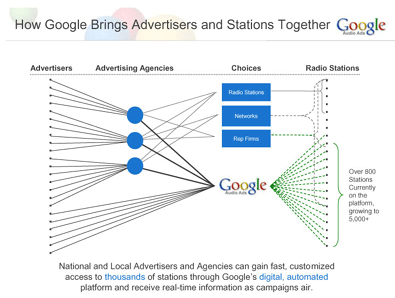
The folks at ZDNet’s Digital Markets have some PowerPoint slides that illustrates how Google Audio Ads work. And this from Voices.com:

“Google has positioned the Audio Ads system to serve both top-level advertisers, as well as the advertising agencies themselves. The graphic also shows 75% of the transactions coming from the agencies, and only 25% from independent advertisers. This is likely because advertising agencies already have media planning and media buying personnel, not to mention existing relationships with local and regional radio stations.”

The lables in the little blue rectangles are: Radio Stations, Networks and Rep Firms. Which suggests that advertisers will simply have another option for placing their ads on radio stations. And if Google can make it easier or cheaper or more effective (i.e. feedback, reports, etc)… they’ve added value to the process.

Clear Channel’s niche play online

“The days of listening to two or three radio stations on a regular basis are long gone, a sign of the times Clear Channel is more than willing to acknowledge. In a direct nod to podcasts and satellite radio, the terrestrial leader is looking to expand its online reach by creating its own hyper-targeted programming for two of the most underserved niche audiences on the airwaves — Nascar fans and the gay community.” — AdAge.com

RadioSomebody(s) at Clear Channel has figured out “this Internet thing.” This article is worth a read.

There are probably some NASCAR formats on the air but I’ve never heard one. And I sure don’t expect to hear a station programmed for the gay community. I think this is a brilliant move and would like to hear some of the stuff they produce.

In a very short time, Rock, Country, Easy Listening, News/Talk and similar formats will seem quaint and anachronistic.

I know what you’re thinking. Why not program for gay NASCAR drivers? Why indeed?

Update: Google Audio Ads

From Inside AdWords blog: “Over the last year, we’ve been working hard to integrate the dMarc advertising platform into Google AdWords. We’re happy to announce that the integration is now complete and we’ve recently begun a U.S. beta test of Google Audio Ads with a small group of AdWords advertisers.”

If you haven’t been keeping up, here’s how Google describes their Audio Ads:

“Google Audio Ads brings efficiency, accountability, and enhanced ROI to radio advertising by providing advertisers with an online interface for creating and launching radio campaigns. You’ll be able to target your customers by location, station type, day of the week, and time of day. After the radio ads are run, you will be able to view online reports that tell you exactly when your ad played.”

A couple of days ago, Mark Ramsey (Hear 2.0) pointed us to an application page on the Google website.

Ad Specialist Application — Thank you for your interest in joining the Google Ad Creation Marketplace. We’re looking for some of the top audio ad specialists to join our Ad Creation Marketplace – a searchable directory of talent to help AdWords advertisers to create radio advertisements. For advertisers new to the radio space, or who are starting a new campaign, the Marketplace provides an invaluable starting point for finding the talent they need.

So, I decide to buy some Google Audio Ads. I search the Google Ad Creation Marketplace database for someone to write and produce my spot. We agree on a price. I send some copy. They email back an MP3 file. I’m off to the races. Maybe. Mr. Ramsey is skeptical and I confess I am too. But if it works… it could have a profound change on how advertiser buy and place ads.

Update: According to News.com, the radio ads are running in more than 260 metropolitan markets, covering about 87 percent of the country

“Is it time to give up on radio?”

The sky is not falling!That’s one of the headlines in the latest issue of the StateNets newsletter. StateNets –formerly the National Association of State Radio Networks — is the marketing arm for most of the state radio networks in the country.
Jim Underwood of the Florida Radio Network wonders if it’s time to drop “radio” from their name.

“First of all, we are not really in the radio business, the broadcasting business or even the network radio broadcasting business. We are in the business of supplying information to people and charging clients a fee to include their message with that information.

We produce a lot of valuable, exclusive content about our states every day and we need to devise new ways to make that information available to people everywhere who may be interested in it. (We’re) working on software to make FRN – er rather maybe Florida Information Network – content available to websites of affiliates, then maybe newspapers. Why not supply State Government sites with the content?”

Such a rude question would have been considered heresy just a short time ago. Based on all that I’ve seen/heard, the future of state radio networks (including ours) is closely tied to that of the radio stations we serve. I’m convinced there are other markets for our content, but I still haven’t seen the business model that will replace –dollar for dollar– the revenue state networks have come to depend on. Stay tuned.

Voice recording on the iPod nano

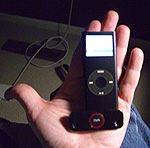
One of my rationalizations for buying a new iPod nano was the Voice Memo feature. Plug a mic in and record directly to the iPod. I had no idea how well this would work until tonight when I plugged in a tiny little mic called the iTalk Pro from Griffin Technology.

Pops into the bottom of the iPod and records in mono or stereo. The interface on the iPod is a wonder of simple design.

I’ll let you decide on the quality but I can certainly imagine recording an interview with this delightful little gadget. And I’ve always got the nano with me anyway, so…

Bruce Sterling: The Future of the Internet

“The future of the Internet lies not with institutions but with individuals. Low-cost connections will proliferate, encouraging creativity, collaboration, and telecommuting. The Net itself will recede into the background. If you’re under 21, you likely don’t care much about any supposed difference between virtual and actual, online and off. That’s because the two realms are penetrating each other; Google Earth mingles with Google Maps, and daily life shows up on Flickr. Like the real world, the Net will be increasingly international and decreasingly reliant on English.

“The Internet crawled out of a dank atomic fallout shelter to become the Mardi Gras parade of my generation. It was not a bolt of destructive lightning; it was the sun breaking through the clouds.” — Science fiction writer and futurist Bruce Sterling in his final column for Wired

This idea resonates with me because I have very little faith or confidence in institutions… and a lot of confidence in (some) individuals. And the Net allows me to find and connect with individuals in ways institutions can not.

Clear Channel does deal with Reuters for web content

Clear Channel Radio’s online division has announced that it will add news and video content from Reuters to its News on Demand service on CC Web sites.

“Clear Channel Radio’s News on Demand product combines on-demand video and text feeds from Reuters with CCR’s 24/7 coverage of breaking news, business/financial stories, entertainment news and human-interest features. The product also allows CCR stations to upload their own local news to their sites, giving both local and national news coverage from station sites on demand.”

I’d love to see exactly what “on demand” means but I can’t argue with the strategy. I hope more of our affiliates will get their online act together and inlcude our our state news and sports content on their sites. And I wonder where AP was/is in this mix. Too pricey perhaps? I’d love to hear more about this. SteveMays at Gmail dot com [Radio and Records]