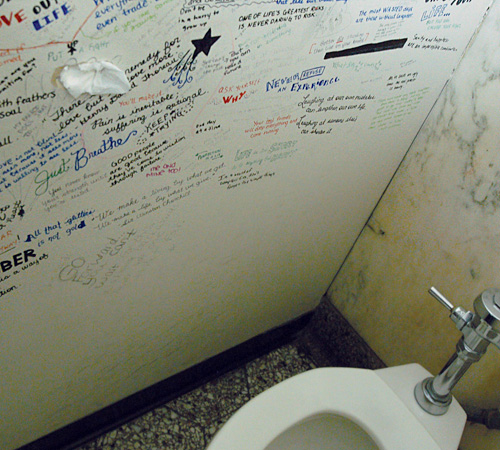
“My mother made me a homosexual.”
“If I buy the wool, will she make me one, too?
During my college days (late ’60s), graffiti became something of a fad within our little group (along with trivia). I’m talking about the kind of graffiti you found on the walls of bathroom stalls.
 It was common practice to tack a large piece of poster board to the back of your bathroom door with a Bic pin dangling from a string. These “conversations” could go on for weeks or months, becoming ever more baroque and obscure. We took great pride in our wit and when the poster was filled with scribbles, it was put on a wall someplace, like the pop art it was (or pretended to be).
I was reminded of this long-lost art by my first two weeks (back) on Facebook. What I’m seeing is mostly chit-chat. Short shout-outs and “Like’s” …maybe a photo here and there. And I do not mean to disparage these brief communications. I can see how Facebook has become a replacement for some/most email. A quick an easy way to ping your friends.
I think I get this kind of digital chatter. My friend David and I can string out an IM session composed of nothing but witless repartee. It’s fun. But I’m not getting this on Facebook, which probably says something about me and my expectations for the platform. As I try to understand the Facebook phenomenon, the first question that occurs to me is:
“What do I have in common with the people I have Friend’d and who have Friend’ed me?”
If the answer is: We went to highschool together 40 years ago or we work together… is that enough for anything but the most superficial relationship?
Every time I log onto Facebook, I get the same feeling I get at one of those management retreats when the “facilitator” tells everyone to “divide up into groups of four” or “turn to the person next to you and…” My buddy David would explain this by saying, “You just don’t like people.” I hope that’s not true but perhaps I wouldn’t be able to tell.
And on the subject of superficiality, I’ve been on Twitter since early days (6,000+ Tweets). But it’s a very different platform. More about “broadcasting” a thought or idea or link. If others find what you share interesting or amusing, they can “follow” along. If you happen to read their stuff and find it worth your time and attention, you can do the same. But you don’t have to be Friends.
I don’t know that I will ever acquire a taste for the Facebook Kool-Aid but that’s okay. There are lots of places to engage online, in a variety of ways. I’m growing ever more fond of Posterous (but won’t bore you with details). I’m a big Google fan and look forward to their next effort at social networking (Buzz didn’t click for me). And in a few weeks we’ll get a look at Diaspora, an open-source project by four young college students.
At work a few of us have been experimenting with a service called Yammer. It’s pretty much “Twitter” for a business or company. Only people who work for our company (and have a company email address) can use the service. This makes a lot of sense to me. There is sure to be a lighter, personal side to the “yams,” but it’s mainly to improve communication and productivity. I’m very interested in seeing if it gets traction.
As I reread the above it occurs to me that this might be the sort of stuff I’d like to see from my “Friends.” What are they thinking about?
But most folks aren’t comfortable with sharing too much about their lives. And Facebook isn’t the place if they did. So it’s beginning to make more sense to me. Facebook is place. And a good, comfortable place for a lot of people. I can pop in for a quick visit from time to time, but I won’t live here. Hope you’ll come visit.