Covering election returns

Election night was a big night for radio station news departments. Or, they were back in the 70’s in the little town where I worked.

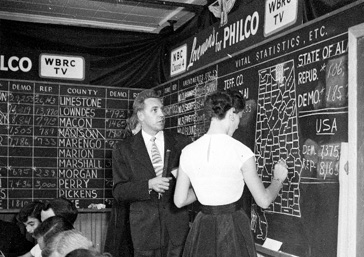
The candidates would crowd into the county clerk’s office and watch as the votes were written on a big chalk board. The radio station news guy would setup a small transmitter and send back updates that were broadcast live. You were either there… listened to us… or heard the results the next morning at the local coffee shop.

When I started working with The Missourinet (a statewide radio network) in the mid-80’s, it wasn’t that different. One of our reporters would set up at the Secretary of State’s office with a dedicated land-line (before cell phones). Maybe they used one of the state’s phones, I don’t recall. But the reporter would phone in regular updates to the network newsroom where they’d go out to affiliate stations around the state.

Sometime in the 90’s technology improved to the point where we could Telnet into the the state computers (via very slow modem’s) and access the numbers directly. And then report them over the network.

Fast forward to the Web. No more Telnet but those early websites were very glitchy. And slow. But they got better every election. It was a wonderful thing. Anyone with internet access could see the returns as they were tabulated. But it was still easier for radio stations (and their listeners) to take our reports than produce their own.

Last week one of our news directors stopped by my office to talk about what we would do online for the upcoming election. Missouri’s Senate race is the Main Event and we’ll have reporters at both candidates venue. They’ll do interviews and feed those back to the network where reporters will be working the Secretary of State’s website.

One the other end of the information pipe, people will still be listening to the radio and watching TV but I expect Twitter and Facbook to be where many get their first information. (Does the Secretary of State have a Twitter feed?). And most of it will be mobile.

Eventually we’ll all vote electronically, without standing in line. And we’ll see the results in near real time.

Will this elections more susceptible to fraud? Girl, please! Is the TSA making flying safer?
Radio by any other name would sound as sweet

Mark Ramsey was listening to Fresh Air on NPR the other day and heard Terry Gross reading the credits, which included a reference to “the Chief Content Officer.” That what most stations call their “Program Director.” (A job I once held)

Mr. Ramsey also mentioned that back in July National Public Radio annoucned it would hereafter be known as NPR. It’s been National Public Radio since 1971 but switched tothe acronym because –according to the Washington Post– “Its news, music and informational programming is heard over a variety of digital devices that aren’t radios.”

Hmm.

Our company operates several news networks, including:

Radio Iowa
Wisconsin Radio Network
South Carolina Radio Network
Nebraska Radio Network

We (not me) came up with Radio Iowa back in 1996 and thought it was pretty cool at the time. Like, “Radio Free Iowa.” I was not involved with nameing the others.

We have websites, Twitter feeds and Facebook pages but are first and foremost radio networks.

If someone were starting a new radio network today, what would they call it? I have no idea.

“Information network” vs “social network”

Ben Parr writes a column for Mashable called The Social Analyst. Here is an exceprt from his comparison of Facebook and Twitter:

“On Facebook, you’re supposed to connect with close friends. Becoming friends with someone means he or she gets to see your content, but you also get to see his or her content in return. On Twitter, that’s not the case: you choose what information you want to receive, and you have no obligation to follow anybody. Facebook emphasizes profiles and people, while Twitter emphasizes the actual content (in its case, tweets).”

“The result is that the stream of information is simply different on both services. You’re more likely to talk about personal issues, happy birthday wishes, gossip about a changed Facebook relationship status, and postings about parties on your Facebook News Feed. On Twitter, you’re more likely to find links and news, and you’re more likely to follow brands, news sources and other entities outside of your social graph. In fact, Twitter tells me that one out of every four tweets includes a link to some form of content.”

I think if you boil it down, for me it’s the difference between “Friending” and “Following”

“Unlike most social networks, following on Twitter is not mutual. Someone who thinks you’re interesting can follow you, and you don’t have to approve, or follow back.”

Radio’s Future

The American Youth Study 2010 “surveys the the media and technology habits of America’s 12-24 year-olds, and represents a sequel to a study originally conducted by Edison in 2000.” Among the findings:

  • Young people spend twice as much time on the Internet now as they do listening to radio.
  • Radio continues to be the medium most often used for music discovery, with 51% of 12-24 year-olds reporting that they “frequently” find out about new music by listening to the radio. Other significant sources include friends (46%), YouTube (31%) and social networking sites (16%).
  • 3 times as many young people are listening to Pandora radio as listen to traditional radio broadcasts via the Internet.
  • More than four in five 12-24s own a mobile phone in 2010 (up from only 29% in 2000), and these young Americans are using these phones as media convergence devices.

“A radical pessimist’s guide to the next 10 years”

(October 10, 2010) There are no shortage of scary predictions on the net. But Douglas Coupland’s “45 tips for survival” give me a shiver. Here are a few of my least-favorites from his list:

6) The middle class is over. It’s not coming back – Remember travel agents? Remember how they just kind of vanished one day? That’s where all the other jobs that once made us middle-class are going – to that same, magical, class-killing, job-sucking wormhole into which travel-agency jobs vanished, never to return. However, this won’t stop people from self-identifying as middle-class, and as the years pass we’ll be entering a replay of the antebellum South, when people defined themselves by the social status of their ancestors three generations back. Enjoy the new monoclass!

13) Enjoy lettuce while you still can – And anything else that arrives in your life from a truck, for that matter. For vegetables, get used to whatever it is they served in railway hotels in the 1890s. Jams. Preserves. Pickled everything.

17) You may well burn out on the effort of being an individual – You’ve become a notch in the Internet’s belt. Don’t try to delude yourself that you’re a romantic lone individual. To the new order, you’re just a node. There is no escape

20) North America can easily fragment quickly as did the Eastern Bloc in 1989 – Quebec will decide to quietly and quite pleasantly leave Canada. California contemplates splitting into two states, fiscal and non-fiscal. Cuba becomes a Club Med with weapons. The Hate States will form a coalition.

41) The future of politics is the careful and effective implanting into the minds of voters images that can never be removed

43) Getting to work will provide vibrant and fun new challenges – Gravel roads, potholes, outhouses, overcrowded buses, short-term hired bodyguards, highwaymen, kidnapping, overnight camping in fields, snaggle-toothed crazy ladies casting spells on you, frightened villagers, organ thieves, exhibitionists and lots of healthy fresh air.

45) We will accept the obvious truth that we brought this upon ourselves

Visiting Facebook

“My mother made me a homosexual.”
“If I buy the wool, will she make me one, too?

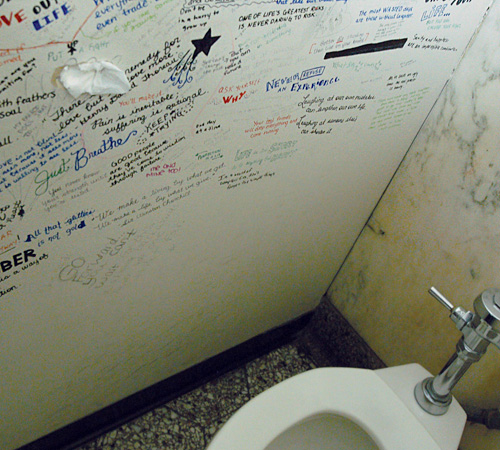
During my college days (late ’60s), graffiti became something of a fad within our little group (along with trivia). I’m talking about the kind of graffiti you found on the walls of bathroom stalls.

It was common practice to tack a large piece of poster board to the back of your bathroom door with a Bic pin dangling from a string. These “conversations” could go on for weeks or months, becoming ever more baroque and obscure. We took great pride in our wit and when the poster was filled with scribbles, it was put on a wall someplace, like the pop art it was (or pretended to be).

I was reminded of this long-lost art by my first two weeks (back) on Facebook. What I’m seeing is mostly chit-chat. Short shout-outs and “Like’s” …maybe a photo here and there. And I do not mean to disparage these brief communications. I can see how Facebook has become a replacement for some/most email. A quick an easy way to ping your friends.

I think I get this kind of digital chatter. My friend David and I can string out an IM session composed of nothing but witless repartee. It’s fun. But I’m not getting this on Facebook, which probably says something about me and my expectations for the platform. As I try to understand the Facebook phenomenon, the first question that occurs to me is:

“What do I have in common with the people I have Friend’d and who have Friend’ed me?”

If the answer is: We went to highschool together 40 years ago or we work together… is that enough for anything but the most superficial relationship?

Every time I log onto Facebook, I get the same feeling I get at one of those management retreats when the “facilitator” tells everyone to “divide up into groups of four” or “turn to the person next to you and…” My buddy David would explain this by saying, “You just don’t like people.” I hope that’s not true but perhaps I wouldn’t be able to tell.

And on the subject of superficiality, I’ve been on Twitter since early days (6,000+ Tweets). But it’s a very different platform. More about “broadcasting” a thought or idea or link. If others find what you share interesting or amusing, they can “follow” along. If you happen to read their stuff and find it worth your time and attention, you can do the same. But you don’t have to be Friends.

I don’t know that I will ever acquire a taste for the Facebook Kool-Aid but that’s okay. There are lots of places to engage online, in a variety of ways. I’m growing ever more fond of Posterous (but won’t bore you with details). I’m a big Google fan and look forward to their next effort at social networking (Buzz didn’t click for me). And in a few weeks we’ll get a look at Diaspora, an open-source project by four young college students.

At work a few of us have been experimenting with a service called Yammer. It’s pretty much “Twitter” for a business or company. Only people who work for our company (and have a company email address) can use the service. This makes a lot of sense to me. There is sure to be a lighter, personal side to the “yams,” but it’s mainly to improve communication and productivity. I’m very interested in seeing if it gets traction.

As I reread the above it occurs to me that this might be the sort of stuff I’d like to see from my “Friends.” What are they thinking about?

But most folks aren’t comfortable with sharing too much about their lives. And Facebook isn’t the place if they did. So it’s beginning to make more sense to me. Facebook is place. And a good, comfortable place for a lot of people. I can pop in for a quick visit from time to time, but I won’t live here. Hope you’ll come visit.

The End of Management

My favorite nuggets from a piece by WSJ Deputy Managing Editor Alan Murray:

“Corporations are bureaucracies and managers are bureaucrats. Their fundamental tendency is toward self-perpetuation. They are, almost by definition, resistant to change. They were designed and tasked, not with reinforcing market forces, but with supplanting and even resisting the market.”

“The big companies failed, not necessarily because they didn’t see the coming innovations, but because they failed to adequately invest in those innovations. To avoid this problem, the people who control large pools of capital need to act more like venture capitalists, and less like corporate finance departments. They need to make lots of bets, not just a few big ones, and they need to be willing to cut their losses.”

“The new model will have to instill in workers the kind of drive and creativity and innovative spirit more commonly found among entrepreneurs. It will have to push power and decision-making down the organization as much as possible, rather than leave it concentrated at the top. Traditional bureaucratic structures will have to be replaced with something more like ad-hoc teams of peers, who come together to tackle individual projects, and then disband.”

Mr. Murry’s new book is “The Wall Street Journal Essential Guide to Management.”

Facebook. One more time.

Yesterday I created a Facebook account. This is the third, possibly the fourth, time I have attempted Facebook. I say “attempted” because I have never quite “gotten” Facebook. I think I understand social networks as well as the next person but this platform has just never been a good fit for me. So why give it another shot?

A couple of reasons. One, I’d like to better understand why FB is home to half a billion people around the world. Two, social networking has become a bigger part of my job and I can’t properly support clients without a feel for Facebook.

Connecting and communicating with people you know seems to be at the core of Facebook. I send you a “Friend Request” and, if you accept it, I can see some for all of what you’re doing on Facebook, depending on how you have your privacy settings configured. If you don’t accept, I’m blocked.

I’ve had lots of conversations with Facebook users in an effort to understand it (without actually using it). A common theme goes something like this:

Jane is miffed that Bill refused to accept (or ignored?) her friend request. He doesn’t want her to be part of his online life and she’s not happy about it. She thought they were, well, friends.

In the next breath, Jane is explaining why she is getting creeped out by the co-worker who keeps sending her friend requests. The irony is completely lost on Jane.

Some Facebook users deal with this by just accepting all friend requests and ignoring the stuff from the not-really-friends. Others just ignore the requests.

I don’t plan on spending any more time on Facebook than is necessary to understand how it works. I’ll auto post from my blog, YouTube, Twitter and all the rest. So, there will be no shortage of stuff on my “wall,” but it all originates from somewhere else where anyone can see what I’m up to. But that’s clearly less convenient that seeing all within the Facebook compound.

How will I handle “friend” requests (assuming I get any)? I’ll probably ignore them unless we already have an online connection (and I probably won’t give you a kidney, either).

So I’m headed off to Facebook with the same enthusiasm as for my first boy-girl dance party mom made me attend (on Bill Wicker’s patio). I didn’t dance there either.