Early web influencers

My blog clean-up project (ongoing) reminded me of these early-web influencers (for me). Some of these folks are still around but most are no longer the “stars” they were in the early days. Link to my posts below. (Descriptions by GPT 4o)


Visionaries, Theorists, and Futurists

  • Bruce Sterling – A science fiction writer and cyberpunk pioneer who explored the social and cultural implications of digital technology.
  • Clay Shirky – An influential thinker on Internet culture, crowdsourcing, and the power of decentralized networks.
  • Douglas Coupland – Coined “Generation X” and explored the cultural impact of digital technology in novels and essays.
  • Douglas Rushkoff – A media theorist who wrote about cyberculture, the social effects of technology, and digital optimism.
  • Kevin Kelly – Founding editor of Wired and a deep thinker on how technology shapes society and the future.

Journalists and Media Analysts

  • Dan Gillmor – A pioneer in citizen journalism, advocating for the participatory nature of news in the digital era.
  • Jeff Jarvis – A media critic who has been vocal about how the Internet disrupts traditional journalism.
  • Steven Levy – A tech journalist who chronicled the history of computing and the rise of the digital age.
  • Steve Outing – An early advocate for online news, exploring how journalism adapted to the Internet.
  • Terry Heaton – A television executive who recognized the shift from traditional media to digital platforms.

Tech Pioneers and Web Innovators

  • Chris Pirillo – Founder of Lockergnome, one of the earliest online tech communities, helping people understand software and the web.
  • Dave Winer – A key figure in the development of blogging, RSS feeds, and podcasting technology.
  • David Weinberger – Co-author of The Cluetrain Manifesto, which framed how businesses should adapt to the Internet age.
  • Doc Searls – Another Cluetrain Manifesto author, emphasizing user empowerment and open-source principles.
  • Jakob Nielsen – The godfather of web usability, setting foundational principles for user-friendly web design.

Marketing and Culture Shapers

  • Halley Suitt – A prominent blogger and voice in the early blogosphere.
  • Hugh MacLeod – Known for his “gapingvoid” cartoons and commentary on creativity and business.
  • Mark Ramsey – A key voice in digital radio and podcasting strategy.
  • Scott Adams – Creator of Dilbert, which captured the absurdities of tech and office culture.
  • Seth Godin – A marketing guru who popularized permission-based marketing and how digital culture changes business.

Entrepreneurs and Digital Business Minds

  • Mark Cuban – Made his fortune selling Broadcast.com to Yahoo, later becoming a major figure in sports and media streaming.
  • Nikol Lohr – Less widely known, but active in early online DIY culture and communities.
4-Track Tape Players (Predecessor to 8-Track)

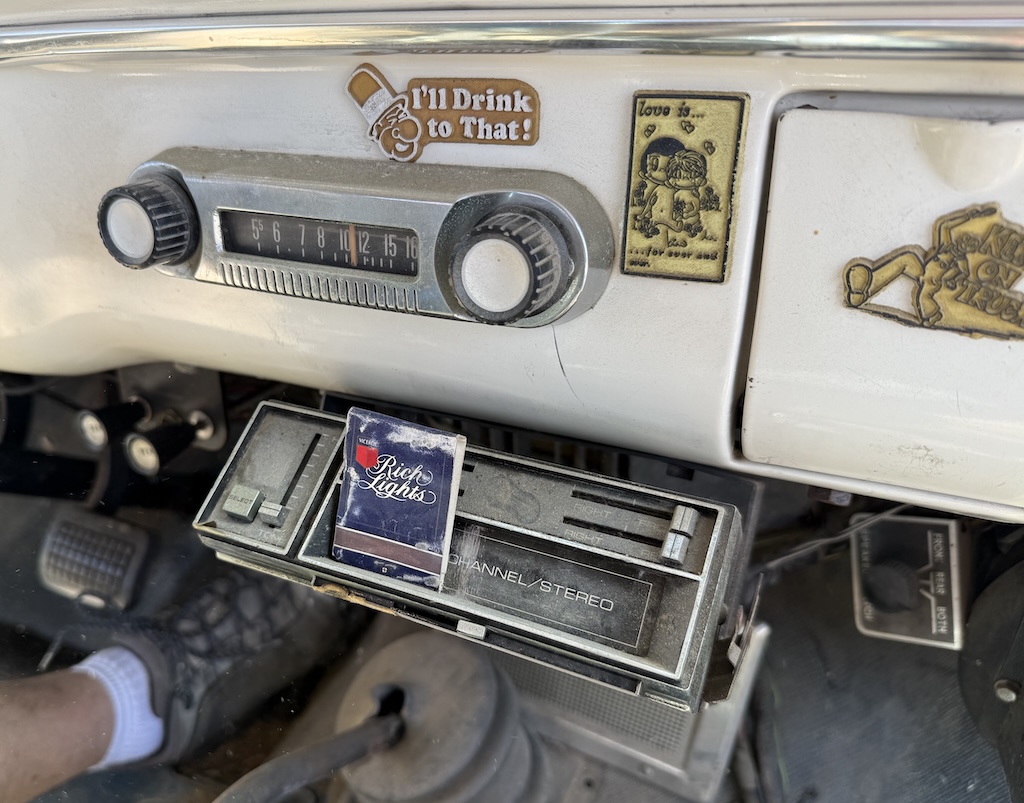
Before the 8-track tape, there was a 4-track cartridge system, commonly known as the Muntz Stereo-Pak or simply the 4-track tape system. It was developed in the early 1960s by Earl “Madman” Muntz, an entrepreneur known for his work in consumer electronics and cars.Key Facts About the 4-Track System:

  • Introduced: Early 1960s
  • Cartridge Design: Used a continuous loop of 1/4-inch tape inside a plastic shell, similar to the later 8-track format.
  • Audio Quality: Offered stereo sound and was considered to have slightly better fidelity than 8-tracks due to fewer tracks being crammed onto the tape.
  • Adoption: Mainly popular in automobiles, often installed in custom and high-end cars of the era.
  • Main Drawback: Required a pinch roller built into the player (instead of inside the cartridge like 8-tracks), making it less convenient.
  • Replaced By: The 8-track format, developed by Bill Lear (of Lear Jet fame) in 1964, became more commercially successful due to support from major automakers and tape manufacturers.

Though 4-track players had a brief run, the format laid the groundwork for the success of the 8-track, which dominated car audio until cassette tapes took over in the late 1970s. (GPT 4o)

Suno AI

“Suno AI is a generative artificial intelligence music creation program that allows users to generate realistic songs combining vocals and instrumentation based on text prompts. Suno has been widely available since December 20, 2023, after launching a web application and partnering with Microsoft to include Suno as a plugin in Microsoft Copilot.” (Wikipedia)

I had not heard of Suno until I received the following text from my friend David.

La Tiara, our favorite brand of taco shells, has been discontinued. I asked Claude for lyrics to a mariachi ballad in tribute, and fed them to Suno and got this.I asked for a mariachi style ballad. Was not expecting Spanish.

David and I worked together at Learfield Communications during the early days of the Internet. I was boring everyone to tears with my predictions about what a Big Deal it was going to be. Huge! Transformative! Bigger than radio! David shared my enthusiasm. To illustrate Suno’s magic…

I prompted for a song about a guy named Steve who’s trying to convince his company the internet is the next big thing, but they don’t believe him because all they know is radio.” It came up with the bizarrely accurate details on its own. [lyrics]

“Have you heard?”

I spent far too much of 2024 following the news and took a much needed break a couple of months ago. A total blackout on television and almost nothing leaks through online. My mood has noticeably improved.

I’ve reached the stage of life — philosophically, geographically, and financially — where very little that happens in the world touches my life in any meaningful way. (Yes, I know, good for you, Steve.)

Bottom line: I’m much happier not following world (or local for that matter) events. Not knowing, if you will. And it turns out, if there is anything I really need to know, someone will call or text me: “Have you heard?” Hasn’t happened yet.

“Almost Cut My Hair”

(Wikipedia)Almost Cut My Hair” is a song by Crosby, Stills, Nash & Young, originally released on the band’s 1970 album Déjà Vu. It was recorded at Wally Heider Studios on January 9, 1970.

The song describes a real-life dilemma faced by many hippies: whether to cut one’s hair to a more practical length, or leave it long as a symbol of rebellion.[3] It was written by David Crosby, and features solo vocals by Crosby, with the rest of the band joining in on instruments rather than on vocal harmony, as in many of their other songs. […] It was one of only two songs from the album that Neil Young joined in on, despite not writing.

Although the notion of long hair as a “freak flag” appeared earlier, notably in a 1967 Jimi Hendrix song “If 6 Was 9”, Crosby’s song has been credited with popularizing the idea of long hair as a deliberate and visible symbol of the wearer’s affiliation with the counterculture, and opposition to establishment values. The song also evokes the singer’s “paranoia” at seeing the police; James Perone writes that, “more than any other song of the entire era”, it “captures the extent to which the divisiveness in American society … had boiled over into violence and terror”.

It became one of Crosby’s signature songs, and “probably his most important political song”.Crosby himself stated “It was the most juvenile set of lyrics I’ve ever written … but it has a certain emotional impact, there’s no question about that.”

Hotel California guitar solo

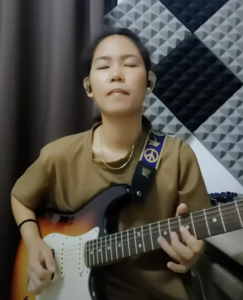
Chen is one of the daughters in a “family band” from the Philippines. She —and what I assume are her two sisters and father— perform amazing covers of hit songs. The still to the right is from a 2 1/2 minute video of her playing the guitar solo from The Eagles’ Hotel California. A couple of things about this short video grabbed me. Her obvious proficiency with this guitar solo but even more was the blissed out concentration that you see in the faces of the best guitar players. In the zone?

A couple of questions popped into my head: How long did it take her to master this iconic solo… followed by, Who wrote and first performed it. I went to Perplexity for the following, including reference sources:

According to interviews and accounts from Don Felder and others involved, the iconic guitar solos and dueling guitar parts on “Hotel California” by the Eagles came together in the following way:

  • Don Felder originally composed the music and recorded a demo for “Hotel California” at his home studio in Malibu in 1976. On this demo, he improvised and recorded sample guitar solos and parts that he envisioned for himself and Joe Walsh to play on the final recording.
  • When it came time to record the guitar solos and leads in the studio in Miami, Felder and Walsh initially started improvising new parts together. However, Don Henley stopped them and insisted they learn and play Felder’s original demo solo parts note-for-note.
  • The problem was Felder didn’t have the original demo tape with him in Miami. He had to call his housekeeper back in Malibu, have her find the cassette, play it over the phone, and Felder re-learned and transcribed his own improvised guitar parts from the demo.
  • Felder estimates that over half of the iconic guitar solos and dueling parts on the final “Hotel California” recording came directly from the original demo he recorded at home, with him and Walsh splitting up and learning those parts.
  • Specifically, Felder played the first half of the ending guitar solo, while Walsh played the second half. They then combined for the harmonized finale section.

So in summary, while Felder and Walsh did collaborate and split the guitar solos, a significant portion was actually Felder improvising alone on his original demo, which Henley insisted they recreate faithfully in the studio.

RadioGPT

I first read about –and started plays with– this technology in February of 2023. I wondered at the time how long it would be before radio station owners took notice. No time at all, it seams.

Futuri Launches RadioGPT, The World’s First AI-Driven Localized Radio Content

Cleveland, Ohio, February 23, 2023 — Futuri is revolutionizing the audio industry with the launch of RadioGPT™ — the world’s first AI-driven localized radio content solution. RadioGPT™ combines the power of GPT-3 technology with Futuri’s AI-driven targeted story discovery and social content system, TopicPulse, as well as AI voice tech to provide an unmatched localized radio experience for any market, any format.

RadioGPT™ uses TopicPulse technology, which scans Facebook, Twitter, Instagram, and 250k+ other sources of news and information, to identify which topics are trending in a local market. Then, using GPT-3 technology, RadioGPT™ creates a script for on-air use, and AI voices turn that script into compelling audio.

Stations can select from a variety of AI voices for single-, duo-, or trio-hosted shows, or train the AI with their existing personalities’ voices. Programming is available for individual dayparts, or Futuri’s RadioGPT™ can power the entire station. RadioGPT™ is available for all formats in a white-labeled fashion.

RadioGPT™ also generates social posts, blogs, and other content for digital platforms related to the content on the air in real-time. A TopicPulse Instant Video add-on creates AI-driven short videos on hot topics for social use. By adding on Futuri’s POST AI-enabled podcasting system, stations can take broadcast audio and immediately publish it on-demand with POST’s auto-publishing feature.

Two kinds of radio station

Last week the owner of Moberly, Missouri radio stations KWIX and KRES —Alpha Media— laid off all of their on-air staff. (Bob Priddy mourns)

The following is from a post and interview I did in 2007 with Dave Shepherd, the son of the man who put KWIX/KRES on the air.

Fifty years ago, Jerrell Shepherd mastered a form of broadcasting alchemy that turned small town radio lead into gold. It wasn’t much of a secret, however, since he readily shared it with countless radio station owners and managers who made the pilgrimage to Moberly, Missouri, in hopes of bringing some of Shepherd’s sales and programming magic back to their stations.

While most small market broadcasters were content to get “their fair share” of local advertising budgets (the bulk went to the local newspaper), Shepherd’s sales reps were trained to ask for it all and believed in their hearts they deserved it.

Mr. Shepherd’s approach to programming his stations was deceptively simple: report anything and everything that happened in each of the communities covered by his stations’ signals. The KWIX and KRES “Red Rovers” showed up just about every high school football game, junior high choral concert and chamber of commerce ribbon-cutting. And the Shepherd stations put it all on the air. Always with local sponsors. Lots of local sponsors.

The new owner, Alpha Media, owns a lot of radio stations including KBFF Live 95.5 FM in Portland, OR. Last June the station introduced the first AI-powered DJ, “AI Ashley.”

“Alpha Media’s EVP of content Phil Becker assured listeners that Elzinga’s job is safe and she’ll be receiving the same pay, telling TechCrunch that AI Ashley is a tool that will allow DJs to multitask like never before.”

I’d love to know what sort of prompt could result in an AI making a call and interacting with a listener as we heard in the clip above. As the program director of a small town radio station back in the 1970’s I was responsible for hiring and training weekend talent. I might have jumped at the chance to put an AI voice on the air.

Will the KWIX/KRES on-air staff be replaced with AI voices? If so, how will the station’s listeners and advertisers respond?

Sell me in thirty seconds

In my dozen years in small town radio I wrote a lot of commercials. Mostly thirty-second “spots” but lots of :60’s (more expensive). It wasn’t uncommon to finish a four-hour on-air shift and sit down at a manual typewriter and bang out ten or fifteen “spots” working from a newspaper “tear sheet” or a salesperson’ scribbled notes. And most of these commercials were scheduled to begin airing the following day so someone had to get in the studio and produce the ad. Point being, there was little demand or time for creativity and the sponsor wasn’t inclined to pay for it in any event.

For a variety of reasons, a :30 second ad had to be :30 seconds. Not 27, not 32. So we followed a rigid format. Given a normal reading speed, a thirty second ad was about 75 words, usually eight lines. Yeah, you could try to get cute and clever but the client wanted to hear about his business. His products or services. And if the client was a supermarket… price-and-item. As many as you could jam in.

So, no, this was rarely creative writing. It was short, simple, declarative sentences. Not a word or phrase to be wasted. I like to think I still write this way.

When email took over from letters and faxes people wrote long-winded tomes that went on for paragraphs. I went through a phase where I would put my entire message in the subject line with “see above” in the body. If it needed more space than that, I would call them or go see them. To this day I think of this approach as “write like you talk.” Which was the final test for radio commercials: reading the copy aloud before going into the studio.