Old TV, New TV.

A friend who had seen Jon Stewart savage the Crossfire weenies called to tell me about it and I remember thinking, “Crap. I missed it.” Then, I remember thinking, “I’ll be able to find it on the Net.” And I did. Jeff Jarvis calls it “the future of TV”:

“In old TV, a moment like this came, and if you missed it, you missed it. Tough luck. In new TV, you don’t need to worry about watching it live–live is so yesterday–because thousands of peers will be keeping an eye out for you to let you know what you should watch, and they’ll record it and distribute it.” [C|Net story]

Podcasting

“…allows you to subscribe to feeds, which include links to audio programs. Every time one of your subscriptions posts a new program, it automatically downloads onto your computer. You then transfer those shows to a portable music device, listen to it throughout your house via a wireless connection or take it with you wherever you go. Think of it as a personalized radio station that you program and change whenever you want.”

What are the choices again?

A new study for the Online Publishers Association asked: If you could choose only two media, what would they be? The Internet ranked No. 1, chosen as first (45.6 percent) or second (32.1 percent) by 77.7 percent of those surveyed. Television ranked No. 2, with 52.4 percent making it a first or second choice, trailed by books (18.5) and radio (12.9). Only 9.2 percent would choose newspapers in that media mix, and only 3.2 percent made newspapers a first choice.[E-Media Tidbits]

MSN Music Store

I just purchased my first song online. I downloaded a few songs back in the early days of Napster and KaZaA but never really got into it and –later– hated the way KaZaA scewed with your system. While I love the look of the iPod, I don’t have one and probably won’t buy one, again, just because I’m not into walking around with ear-buds. While the new MSN Music Store might be inferior in every way to iTunes, I found it very easy to use. My Net Passport info was already on file so it took about 15 seconds to agree to let them bill me for music downloads (which will play on just about any device). Jackson Browne’s Stay was my choice for first legal download. MS made this pretty easy and I suspect I’ll buy more music online than I ever have (or would) at the music store.

We the Media

“The Internet is the most important medium since the printing press. It subsumes all that has come before and is, in the most fundamental way, transformative. When anyone can be a writer, in the largest sense and for a global audience, many of us will be. The Net is overturning so many of the things we’ve assumed about media and business models that we can scarcely keep up with the changes; it’s difficult to maintain perspective amid the shift from a top-down hierarchy to something vastly more democratic and, yes, messy. But we have to try, and nowhere is that more essential than in that oldest form of information: the news. We will be blessed with new kinds of perspective in this emergent system, and we will learn how to make it work for everyone.

Blogs and other modern media are feedback systems. They work in something close to real time and capture — in the best sense of the word– the multitude of ideas and realities each of us can offer. On the Internet, we are defined by what we know and share. Now, for the first time in history, the feedback system can be global and nearly instantaneous.”  – Dan Gillmor’s We the Media (pg 236)

Who should read this book? Newsmakers, the reporters that cover them and anyone that reads, watches or listens to those reports.

National Association of Broadcasters

The cover story (by Scott Woolley) in the September issue of Forbes is really more about the National Association of Broadcasters than XM Radio.

“For decades the radio industry has crushed incipient competitors by wielding raw political muscle and arguments that are at once apocalyptic and apocryphal. Radio station owners, who formed the National Association of Broadcasters in 1923, have won laws and regulations that have banned, crippled or massively delayed every major new competitive technology since the first threat emerged in 1934: FM radio.”

What would radio be like if broadcasters put this much energy into doing better radio?

XM Radio to introduce digital storage

From NY Times story: Later this week, XM is set to introduce receivers capable of storing up to 30 minutes of any live broadcast to play back at a later time. With a function that works much like the pause control of a digital video recorder, the units will also be able to replay the last 30 minutes of the channel to which the unit was most recently tuned. Both companies also offer models that let users store the names of favorite artists and titles. When one of those is playing on another channel, the receiver beeps to alert the listener. In XM’s case, the unit will also automatically switch to that other station. Next month, Sirius will introduce its Sportster model, designed to complement its introduction of NFL Radio, which is a new talk channel, and several channels to transmit every NFL game. The radio can be programmed to jump automatically to the correct station when one of the user’s favorite teams is playing.

To appeal to investors, XM’s Roady2 can display continuously updated stock quotes across the screen. Sirius plans to introduce a radio with a similar feature. Beginning this fall, XM will offer NavTraffic, giving owners of the Acura RL and the Cadillac CTS the ability to combine XM’s continuously updated traffic information with the car’s navigation system, producing color-coded maps showing traffic delays, allowing drivers to obtain alternate routings.

To make it easier to receive satellite radio in the home, Sirius will introduce a $129 accessory antenna that, mounted on the roof, will transmit a signal through the walls into a secondary unit attached to the receiver. And by the beginning of next year, Sirius will offer a receiver that can download Sirius programming from the Internet for later playback in areas where signals cannot reach.

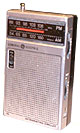
Transistor radio

Most of my in-car radio listening is XM these days. But at home I still tune in to a couple of the local stations. And it dawned on me this week that the little transistor radio I listen to is more than 20 years old. We brought it with us when we moved to Jefferson City in 1984. And it could have easily been 10 years old then. I love this little radio (made in Hong Kong for General Electric). On the front it proudly announces “Integrated Circuit” and, on the back, there’s a little plasic clip for attaching to your belt. I’m trying to think of other things in my life that have worked as well or as long as this little transistor (when did we drop that adjective?) radio. I so clearly remember when a small, portable radio like this was the ONLY way to listen to music or news away from your home, car or office.

If/when this one breaks or dies, with what sort of device will I replace it? I’m sure they still make them but for how much longer. Will they become integrated with some kind of mobile device (cell phone)? That doesn’t seem practical. I’m not going anywhere with this. Just a small ode to a long-time companion.

42 million sat radio subs by 2009?

XM Satellite Radio and Sirius Satellite Radio could have more than 42 million subscribers by the end of 2009, according to a report by SkyWaves Research. Two week ago, XM announced that it had surpassed 2 million subscribers. On May 11, Sirius said it had reached the 400,000 mark.