
Smoker’s Oasis

The death of Peter Jennings (from lung cancer) last week has lots of folks thinking about smoking. I remember when smoking was allowed on airplanes and ash trays were common desk accessories in the office. Ash tray. A tray for your ashes. Do they still manufacture ash trays? I’m sure they do.
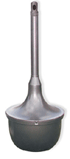
My favorite “ash tray” is The Smoker’s Oasis. The grand daddy of ash trays, The Smoker’s Oasis has sprung up like big, stinking mushrooms outside offices and buildings across America. When we drove our smoking employees outdoors, we had to come up with someplace for them to put their butts.

We had one outside our offices for a while. It was originally located 30 or 40 yards from the back door of our building. The next time I saw it, it was right next to the building, so smokers could get a little shelter from the rain.

I went searching for it to take a picture for this post but it’s gone. When I asked one of my smoker co-workers where it was located, she would only mutter, “It’s gone. I don’t know where it is.”

My current theory is our Smoker’s Oasis has become like Dracula’s coffin. Only smokers know where to find it and you can never spot them going to or from the secret location.

Do our closeted smokers take turns emptying our Smoker’s Oasis? Is there a secret duty roster somewhere, showing who has butt chores this week? And where do they dump the butts? Do they bury them in the woods behind our office, taking care to spread leaves over the shallow grave?

Do they dream of a day when they are once again in the majority and can come in from the cold? Will we have nice, cut glass ash trays on every desk, with the company logo proudly imprinted on the side? Will we see a day when there is no longer a need for the Smoker’s Oasis? We can only hope.

New Convergence program at MU J-School

Mike McKean heads up the new Convergence program at the University of Missouri School of Journalism. This fall he begins his 20th year teaching at the J-School. Once upon a time, he was a reporter for The Missourinet, one of the state news networks owned by the company I work for. Mike and I get together every few months to talk about radio and journalism and the Internet and stuff like that.

Today I took my recorder along and asked him about: Teaching journalism in 2005; podcasting; blogs; radio; advertising; newspapers; “citizen journalism” and some other stuff.

AUDIO: Interview with Mike McKean 20 min MP3

Caged bird sings

Jefferson City prison inmate Irving Berry has written a song for Missouri, entitled “Missouri, Home Sweet Home to Me,” which he calls a gift of honest reconciliation from all of Missouri’s incarcerated sons and daughters. Berry says 90 percent of the inmates he has come into contact with are remorseful. Berry, who has been in prison for nearly 30 years, wrote the song while incarcerated at the Cameron prison. When he was transferred to Jefferson City, he met with fellow inmate Mark Immekus, who wrote the music. They recorded the song with fellow inmates at the Jefferson City Prison. [Missourinet.com]

Nikol Lohr on pregnancy

“I don’t want kids. Sometimes I like kids okay, sometimes they’re funny or smart, but I don’t want one growing inside me like a tape worm. They grow in there and press down all your organs and give you incessant heartburn and make you have to pee all the time and make your ankles swell so the only shoes you can wear are flip-flops. And then when they’re finished leeching off you, they slide out like greasy little piglets all mucousy and pink.”

“Then afterwards, you have twenty years of no life of your own. If you do it right, anyway. And then a whole lifetime of worry. Like having a dog that outlives you and runs away all the time and chews up all your furniture and pees everywhere and hates you at least for a while no matter what. A dog that no matter how good you try to be is slightly embarrassed of you and will definitely lie and deceive you. A dog that won’t let you pet it and that talks back.”

Steve Jobs on podcasting

“One thing Steve Jobs said to me that didn’t make it into my [June 28] story was that he’s getting interest from corporations about creating podcasts to reach customers and others directly  without going through [traditional media], offers Markoff. An example might include something like Adobe wanting a podcast for Photoshop users.

His point: All of this breaks down old traditions  everybody is getting dis-aggregated by new technologies, Markoff says. The lesson for PR practitioners, according to Markoff, is to recognize that things are changing in the media. More people are trying to reach [audiences directly].”

— From a story by NY Times’ John Markoff who recently interviewed Steve Jobs when Apple added podcasts to iTunes

“Podcasting Is Not the Next Mass Medium”

In an article titled “Podcasting Is Not the Next Mass Medium,” David Coursey (Publish.com) poo-poo’s the idea of podcasting (and blogging, for that matter):

“Personal Podcasting, like personal blogs, is a fad and will fade. Just like personal sites were a fad in the early days of the Web. People experiment because content creation can be fun, sort of like finger-painting was back in preschool, but people also run out of creative energy, and the maintenance of a site, blog or Podcast becomes a chore. And the content gets boring, and the audience goes away.

I’ve been in the media all my professional life and have spent years trying to understand audience behavior. I can’t always tell what the masses will like, but I am pretty good at calling losers. And as a mass medium, Podcasting will be one of them. “

Three comments: First, that Mr. Coursey has “been in the media all my professional life,” might be more liability than asset in understanding what’s happening in the world of new media. Second, I’m not sure there will be such a thing as a “mass medium” in the future. We’ve been part of the masses. Now we want to be individuals. Third, the photo posted with his column makes me want to bitch-slap him real hard.

Jeff Jarvis on “Freedom Center”

Mr. Jarvis is so right when he calls for “the truest expression of American freedom: commerce.” Instead of a “Freedom Center” (at the site of the World Trade Center), he wants to see life:

I want to see stores that sell scanty clothes, no burkas allowed.
I want to see restaurants that serve liquor.
I want to see movies that show anything, even sex.
I want to see bookstores that celebrate free speech.
I want to see stores selling products from all over the world: the fruits of globalization.
I want to see life there. Defiant, unapologetic life.