Does radio still “own” breaking news?

We radio guys (back when I was a radio guy) used to pooh-pooh the daily newspaper as “yesterday’s news,” for their inability to cover breaking stories. The folks at The Providence Journal are changing that and they’re using a blog (among other tools, I’m sure) to do it.

They call their news blog “7to7” and it is “…is projo.com’s first reporting channel for breaking news. The news gets to the blog staff in a variety of ways: posting, e-mail, or dictation — whatever works well in a given circumstance. We’ve even set up a dedicated blog phone line and an e-mail address.” Publisher Howard G. Sutton takes this view:

“Decades ago, the newspaper business abdicated the franchise for breaking news to broadcast media. With the strength of projo.com, and a newsroom at least 10 times the size of any local competitor, we are poised to take back the leadership position for breaking news. When people in our market need to find out what it is happening right now, they will turn to projo.com and The Providence Journal. We are taking back the franchise.”

Editor Joel P. Rawson recently reinforced the initiative in his memo to the staff: “It is our goal to be the source for breaking news in Rhode Island, to dominate it, to own it.”

More on how “7to7” works at Poynteronline.

Case in point: I was cruising Digg yesterday and came across a story about a shooting at a mall in Kansas City. Full story with pix, only 18 minutes old. Of course, the local radio guys might have been all over this. But the point is, the radio guys have to work hard to be first with breaking news. It’s no longer theirs by default.

“How did the mainstream press get it so wrong?”

Bill Moyers'That’s the question Bill Moyers attempts to answer in “Buying the War” (Bill Moyer’s Journal on PBS). A damning indictment of the coverage of the events leading up to the invasion of Iraq. Tim Russert looked silly and Dan Rather was pathetic. I kept flashing on the old pre-WWII Nazi propaganda footage.

I always thought a good, strong, free press would be our last line of defense against the crooks and thieves we keep electing. (“Gooks in the wire!”)

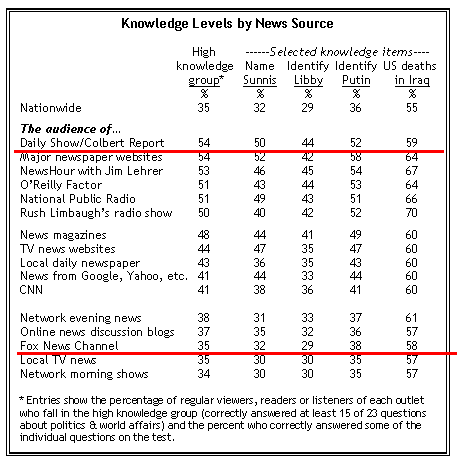
After watching Buying the War on Tivo, we watched Moyer’s Conversation with Jon Stewart. An insightful look at The Daily Show. What it is and what it is not.

Following that, Moyers did a great segment with Josh Marshall, the political blogger from talkingpointsmemo.com. Blogging for Truth looked at Marshall’s perspective on the role of politics in the recent firings of federal prosecutors.

Watching these back-to-back was interesting. And somewhat reassuring (if you watch them in the right order). You’ll find video and transcripts on the PBS website. Good stuff.

Future of TV? Live video from your cell phone to the world

“At the 2007 National Association of Broadcasters show, ComVu Media demonstrated live video transmitting at 30 fps at 640 x 480 resolution from a mobile phone over a wireless data network.

ComVu used its PocketCaster software to broadcast full screen video from a Nokia N95 multimedia device, transmitting over HSDPA data connection. Anyone using a Nokia N95 device — including field reporters — can now capture and broadcast video directly to air and concurrently stream live video to Web-portals, blogs and 3G-enabled phones. ComVu CEO William Mutual called the end-to-end solution “the future of news gathering worldwide.” — Podcasting News

If I was running a news operation, I think I might invest in one of these and see if it’s as cool as it sounds.

Five Common Headline Mistakes and How to Avoid Them

The headline of a blog post is arguably as important as the post itself. Digg points us to this handy list at copyblogger:

1. No Reader Benefit – Ask yourself “what’s in it for them?” If the headline doesn’t tell you, it’s missing a benefit.

2. Lack of Curiosity – Does your headline make you have to know what the promised answer is? Use questions, numbers, challenges and statements that compel the prospective reader to explore the beneficial content you’re offering.

3. Lack of Specificity – Use variations of the “list” headline, use words like “this,” “these,” “here is” and “here are” to refer specifically to your content, and also use hard numbers and exact percentages when appropriate.

4. Lack of Simplicity – Stick to one concept, eliminate unnecessary words, and use familiar language.

5. No Sense of Urgency – Check to see that items 1-4 above are truly present. If so, try reworking the headline to make it more compelling without stepping too far into hyperbole. If all else fails, examine the premise of the content itself. Is it really “need to know” information?