
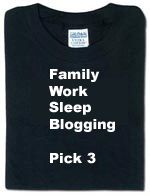
Key to efficient blogging

Pick3This post at E-Meida Tidbits is aimed at journalists who worry about the additional time it takes to blog. But I think this is good advice for any blogger.

“…the key to blogging efficiently is this: DO NOT treat it like writing an article. That is, make blogging part of your ongoing processes for research, notetaking, and communication.

A blog post is not (or at least, it shouldn’t be) a writing assignment you must prep for and deliver as a finished package. Let go of the idea that you must have everything nailed down, organized, and edited before you publish.”

I’ve been stressing (just a little) about my light posting of late and had this idea for a T-shirt.

Time to rethink the AP model?

Cory Bergman at Lost Remote raises some interesting questions about the AP model in light of Google’s deal to host AP stories (rather than link back to newspaper websites).

He also points to a blog post on the "prickly issue of local broadcasters pulling local newspaper stories via the wire and posting them online (and occasionally vice-versa). Now that both mediums have expanded to the web, they’re direct competitors. And the local wire goes a long way to beef up the depth of content on a local TV site."

I’m pretty sure he’s talking about TV broadcasters. I’m afraid nobody is much concerned about radio stations getting their news from Google.

AP news on Google

“After a couple years of spirited negotiations, Google has signed agreements with the Associated Press and AFP that will reduce the amount of traffic Google News refers to news sites. First, Google News will start hosting full versions of AP stories instead of linking off to them. And second, Google will begin to filter out duplicates of the same AP story. So you won’t see multiple versions of an AP story from various newspapers, listed with the most recent at the top. Google said the end result is less duplication and a better variety of stories.” — Lost Remote

Do radio stations still subscribe to the AP? It’s been years since I was in radio stations, talking with managers about news and where/how they get it. But even back then, a lot of stations really only relied on AP for state news and high school football scores. Our company offers a “poor man’s wire service” that still has an amazing number of subscribers. [Yo, David. Can you give us an update on this?]

Perhaps the bigger question is… how much do listeners rely on their local radio station for news. I would think a lot. But what’s the order of importance? Local…state…national…world? What can/do I get from my local radio station (on air or online)… and what do I get from a Google search (perhaps on my mobile phone)?

These are interesting times.

Kay reviews debate with Ron Livingston (and some other guys)

ABC NewsKay Henderson was back in the digital Green Room following ABC News’ debate this morning in Des Moines. The “other guys” in the headline were: Actor Ron Livingston; the LA Times’ Mark Barabak; ABC News Political Director David Chalian and ABC News senior political reporter and author of “The Note” Rick Klein.”

Livingston is an Iowa native who gained international stardom with his leading role in the movie “Office Space.”  He was also one of Carrie’s boyfriends in “Sex & the City” plus he did a fine job in “Band of Brothers.”

At no time during the 9 minute video was Kay and Ron in the same frame.

Transparent journalism

Sausage
If you’re in the news business, you should read this blog post by Radio Iowa (a Learfield network) News Director O. Kay Henderson. It’s a good example of a reporter allowing her readers/listeners to see how the sausage is made.

The post (and the story to which it refers) is about the network’s coverage of remarks made by Democratic presidential candidate Joe Biden at the Iowa State Fair on Wednesday. Kay appropriately headlines her post "Splitting hairs with the Biden camp." (Read the post)

In the old (pre-blog) days, if the subject of a news story thought it inaccurate or unfair, the reporter could respond, "I stand by my story" and that would be the end of it.

In this instance, Kay has used her blog to add context to the story and I think everyone is better off for it. Here’s what we reported. Here’s what people thought about our report. And here’s some background we didn’t include in the story.

This is why I think every news organization should be blogging. We rely on journalists to cover important news. It’s important that we trust them to do it fairly and accurately. Letting us see how they do the job makes it easier.