
As a nation of people, the United States is just too stupid to survive.
Category Archives: TV Clips
Captain Midnight and the Secret Squadron
Yes, I was there. And I had a decoder ring.
What does the yellow light mean?
Wallets, billfolds and money-clips
When the nurse handed me my vaccination card she said, “Keep this in your wallet.” Hmm, where did I put my wallet? For the past year we’ve been paying for stuff online with a credit card.
I found my wallet and decided to do a little house cleaning. How much of this stuff do I really need to have with me every time I leave the house? I can pay for gas and groceries using my phone and ApplePay. And I’ve always kept some cash in a money clip. I see that some get by with their driver’s license and a credit/debit card in a phone case. Which got me wondering… do young folks still carry wallets?
“The difference between billfold and wallet is that a billfold is a small, folding sleeve or case designed to hold paper currency, as well as credit cards, pictures, etc while wallet is a small case, often flat and often made of leather, for keeping money (especially paper money), credit cards, etc.” (WikiDiff)
Forty years ago, when I started wearing suits to work, I carried a wallet in the inside pocket of my suit coat. (The one on the left in the photo below). When I hung up the suits for last time, I switched to a “billfold” (middle) and kept it in a pocket of my laptop case.
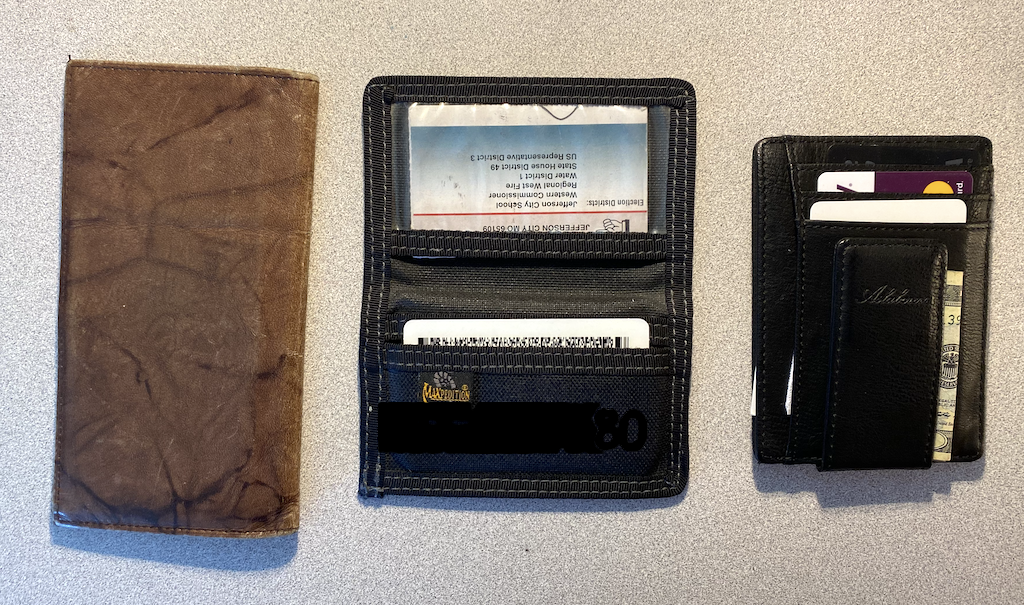
Along the way I kept looking for ways to lighten the load and tried some that didn’t fold at all. Just some pocket for credit cards and a magnetic money-clip. I’m giving that a try as I get back in the world.
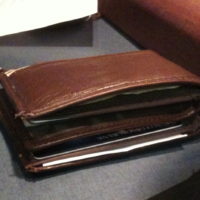
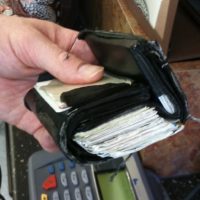
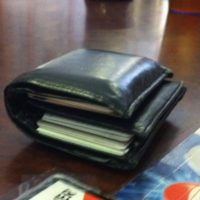
I’ve long been fascinated by “fat wallets” and collected a few photos over the years. Each of the wallets pictured below were carried in the hip pocket. I would have dearly loved to got through the contents of each of these. What a story they could tell.
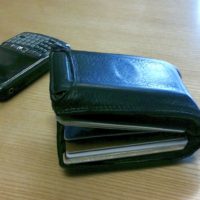
And no discussion of wallets would be complete without George Costanza’s exploding wallet. Another scene from the Wallet episode.
Trackdown (Trump con man episode)
“Trackdown is an American Western television series starring Robert Culp that aired more than 70 episodes on CBS between 1957 and 1959. Trackdown was a spin-off of Dick Powell’s Zane Grey Theater. Trackdown stars Robert Culp as Texas Ranger Hoby Gilman. It is set in the 1870s after the American Civil War. In early episodes, stories focused on Gilman going to different Texas towns in pursuit of wanted fugitives.” (Wikipedia)
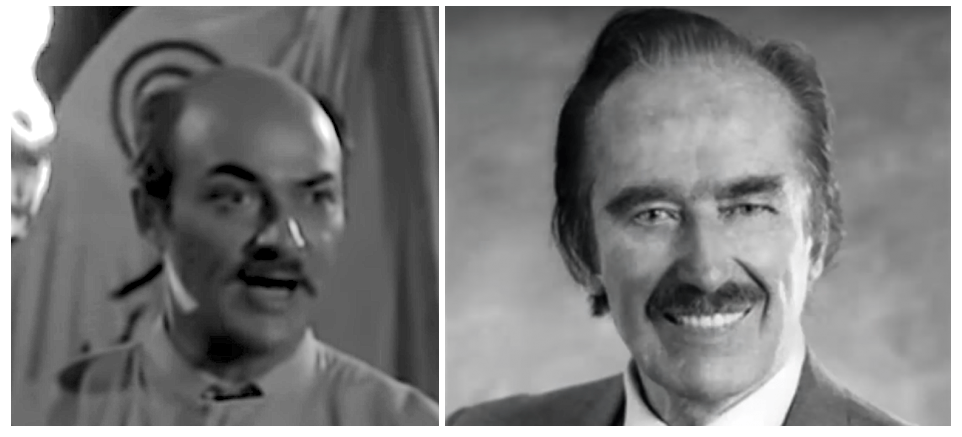
I was nine years old in 1957 and remember watching Trackdown every week (no binge-watching back then). In those days we watched everything but westerns were must-see TV. In a 1958 episode a con mand named Trump comes to down and warns people the world will be destroyed and only he can save them… by building a wall.
And the actor playing Trump in the episode… looks a little like Fred Trump (right).
Is this good government?
Probably not but let’s remember the whole point of being the government.
Chris Stevens KBHR 570 AM (Northern Exposure)
Northern Exposure is an American comedy-drama television series that ran on CBS from 1990 to 1995. My favorite character was Chris Stevens (played by John Corbett). “A philosophical ex-convict who works as the disc jockey at KBHR 570 AM. Between songs, Chris offers comments on events in Cicely and on more intellectual and controversial subjects.”
The Chris character was the DJ we all wanted to be. Okay, “I” wanted to be. Fortunately, I was smart enough to know I couldn’t pull off those long, zen monologues without John Corbett’s wonderful voice and delivery, and a room full of writers. There are a few “Chris Stevens tribute videos” on YouTube that painfully illustrate the folly of those who tried.
My buddy Bob Hague (also a radio guy) told me of an acquaintance that “went bonkers” because Chris never wore headphones in the series.
My father was a Radio Operator (?) in the Navy during WWII. Based on the little he told me of that experience, it was Morse Code rather than than voice transmission. After the war he went to watchmaker school until he figured out he could get paid (GI Bill) to go to the Pathfinder School of Broadcasting (Kansas City).
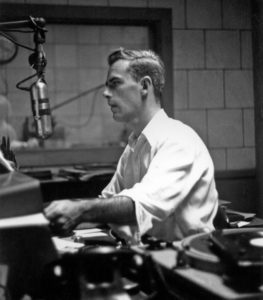 I recall him saying the the “announcers” didn’t wear headphones because they were in one studio and the engineers (who did wear ‘phones, suppose) were in another. I believe this was common and the reason you’d see announcers from that era cupping a hand behind one hear (holding copy in the other) in order to better hear the golden sound of their voice.
When pop got hired at the little station in Kennett, MO, he was shocked to learned he’d have to “run his own board” and that necessitated wear phones. But I remember (as a child) seeing him or one of the other announcers being on the air without headphones.
Trump clothing made overseas
Seinfeld: Here’s to feeling good all the time
Tech Support (Reno 911)
One of my favorite scenes from Reno 911.