
Category Archives: Film & TV
Chris Stevens KBHR 570 AM (Northern Exposure)
Northern Exposure is an American comedy-drama television series that ran on CBS from 1990 to 1995. My favorite character was Chris Stevens (played by John Corbett). “A philosophical ex-convict who works as the disc jockey at KBHR 570 AM. Between songs, Chris offers comments on events in Cicely and on more intellectual and controversial subjects.”
The Chris character was the DJ we all wanted to be. Okay, “I” wanted to be. Fortunately, I was smart enough to know I couldn’t pull off those long, zen monologues without John Corbett’s wonderful voice and delivery, and a room full of writers. There are a few “Chris Stevens tribute videos” on YouTube that painfully illustrate the folly of those who tried.
My buddy Bob Hague (also a radio guy) told me of an acquaintance that “went bonkers” because Chris never wore headphones in the series.
My father was a Radio Operator (?) in the Navy during WWII. Based on the little he told me of that experience, it was Morse Code rather than than voice transmission. After the war he went to watchmaker school until he figured out he could get paid (GI Bill) to go to the Pathfinder School of Broadcasting (Kansas City).
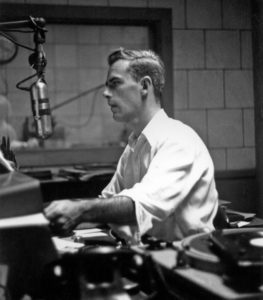 I recall him saying the the “announcers” didn’t wear headphones because they were in one studio and the engineers (who did wear ‘phones, suppose) were in another. I believe this was common and the reason you’d see announcers from that era cupping a hand behind one hear (holding copy in the other) in order to better hear the golden sound of their voice.
When pop got hired at the little station in Kennett, MO, he was shocked to learned he’d have to “run his own board” and that necessitated wear phones. But I remember (as a child) seeing him or one of the other announcers being on the air without headphones.
Paying for good TV
I grew up glued to the TV and could have never imagined a time when I watched almost nothing on the boob tube. But here we are. Almost no regular viewing since starting my news fast. The one exception is the ABC sitcom, Modern Family. I find the writing so fast and flawless that I have to watch each episode twice to get all the jokes.

This week it occurred to me that we didn’t start watching until the third or fourth season so I went searching for earlier shows and wound up buying the first season (24 episodes) for $30. This might be the first time I’ve done that. (I’m not counting Netflix) $1.25 per episode and no commercials. That’s a good deal in my book. Going forward I see myself (willingly) paying for more of what I watch and listen to. And I’ll be more discriminating. I already have the sense more and more of the good stuff requires a subscription. The crap will come loaded with commercials.
Inherit the Wind
The Expanse – Season Two
Fans of the SyFy series The Expanse might enjoy recent episodes of Decrypted, Ars Technica’s TV podcast. The February 1st episode included an interview with Daniel Abraham and Ty Franck, the authors of the books (under pen name James SA Corey).
I’ve watched the first three episodes of season two and suffered only mild dissonance between my mental images of characters and locations from having read the novels. They discuss this at some length in the podcast.
And it’s really niggling things like Bobbie Draper’s combat suit. It was… bigger and played a bigger role in the books. And the damned ceilings are too high. By that I mean the living spaces just seem unnecessarily large. The spaces on the Rocinante are just larger than they need to be (like I know how to design spaceships). Same for Tycho Station. It looks like a gigantic shopping mall. This seems “off” to me. Spacers wouldn’t be so wasteful.
It’s a mistake, in my opinion, to expect the TV series to hew to the details of the books. And, yes, I recommend reading the books first but other can make a case for the other way.
Anyhoo, if you like the books and/or series, you might enjoy the podcast.
Kowloon Walled City of Hong Kong
The fortress-like Kowloon Walled City of Hong Kong was demolished in the early 1990s, but a German documentary crew braved the sprawl in 1989 and captured amazing footage from inside this sunlight-less patchwork metropolis.
Drone speeding up a snowy mountain
Competitive FPV drone racer Gabriel Kocher filmed an incredible video of his drone speeding up a snowy mountain.
Can only humans act?
Digital effects will make Robert De Niro look decades younger in his new Scorsese movie.
For me this raises interesting questions about the essence of acting. We’ve long been able to create backgrounds and scenes with CGI that are nearly impossible to distinguish from ‘the real thing.’ So where does the acting happen? Facial expression? The body? The tone and inflection of the the actor’s voice? If an AI captures and then perfectly reproduces De Niro’s voice, is that acting? Will we notice or care? Are we close to someone (some thing) passing a cinematic Turing Test?
RKO Pictures
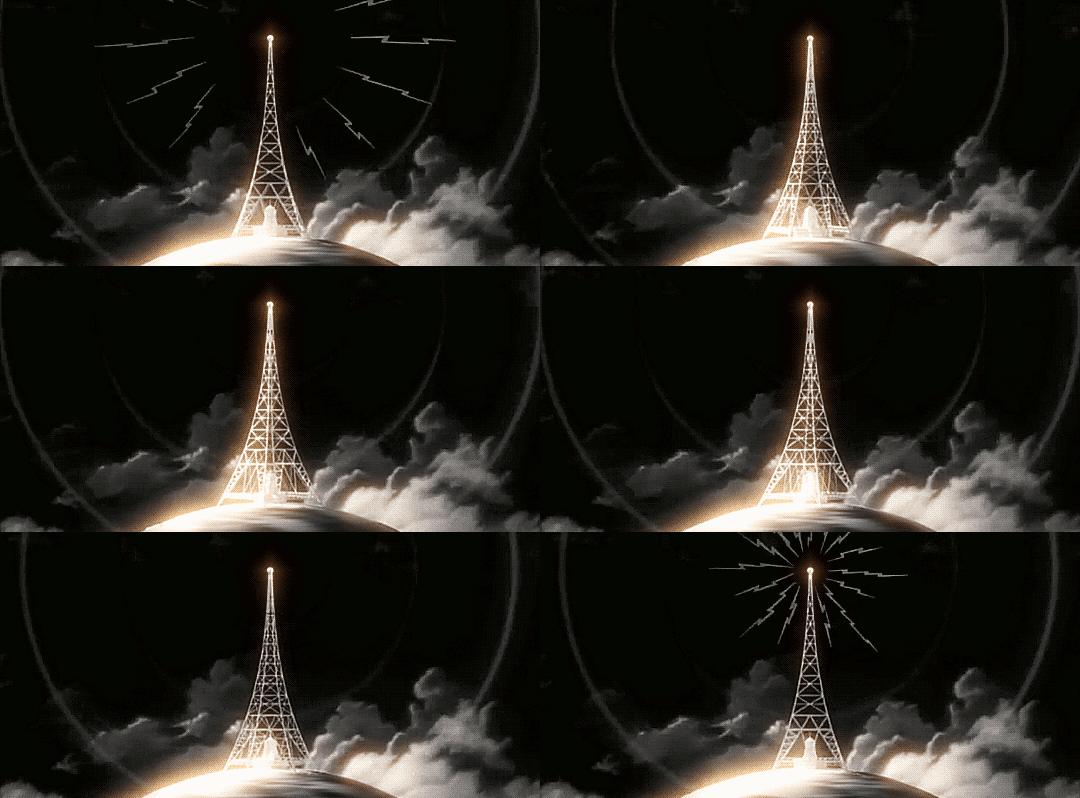
Wikipedia: “RKO has long been celebrated for its series of musicals starring Fred Astaire and Ginger Rogers in the mid-to-late 1930s. Actors Katharine Hepburn and, later, Robert Mitchum had their first major successes at the studio. Cary Grant was a mainstay for years. The work of producer Val Lewton’s low-budget horror unit and RKO’s many ventures into the field now known as film noir have been acclaimed, largely after the fact, by film critics and historians. The studio produced two of the most famous films in motion picture history: King Kong and Citizen Kane. RKO Pictures is also a member of Motion Picture Association of America.”
This image brings back lots of great memories from my childhood.
Sound City Studios
Wikipedia: “Sound City Studios was located in the San Fernando Valley, amidst rows of dilapidated warehouses. The little-known recording studio housed a unique analog Neve recording console and had a reputation for recording drums. Artists such as Nirvana, Kyuss, Red Hot Chili Peppers, Fleetwood Mac, Neil Young, Rick Springfield, Tom Petty, Rage Against The Machine, and Slipknot recorded groundbreaking music at the studio. The film tells the story of the studio from its early days in 1969 until its closing in 2011.”