
NAB Radio Show: Podcasting session

Scott’s notes and impressions from the podcasting session at the NAB Radio Show. I am assuming the focus was on how broadcasters can use podcasting.

  • Rather slow and uneventful (although the panel was loaded with the right kind of people)
  • Subscriptions should be for extra stuff only
  • Merchandise is huge rev source
  • Repurposing interviews and special segments GOOD. Normal programming BAD. But time shifting is GOOD. ????
  • Listeners don’t mind commercials if content is good and on-demand.
  • The guy next to me breathes very, very loudly.
  • Podcast listeners are more apt to be info junkies.
  • None on this panel seem excited or comfortable.
  • Use podcasting to distribute info/ent that you wouldn’t normally spend valuable air time for.
  • Perishable programming – content must always be fresh but must have a long shelf life too. People have to be able to come back and relive or discover (archives) and that info/content must be relevant.
  • Ads are the killer. Ads have to be current at all times. PodShow’s tech allows the show to be assembled with current ads whenever the consumer downloads.
  • Length – 22 min for audio, 5 for video.
  • Podcasts must promote interaction.
  • All of this (podcasting, mp3, internet) comes from telephones. It will all go back to telephones. No more “ipod only” products. Speculation.
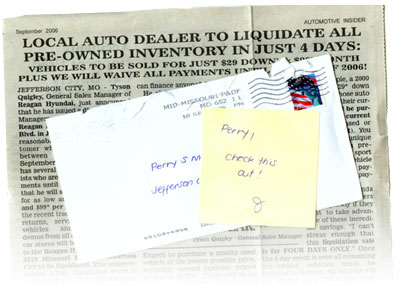
Stalking the prospect. Shhhhh.

Dear J:

Thanks for sending me the newspaper story about the big liquidation at Reagan Hyundai. It looks like a great opportunity to buy a pre-owned vehicle!

Wait a minute. I don’t think this is a real story at all! You know what this is? It’s a sales gimmick! But that can’t be right, it came with a hand written Post-It note. What the heck is going on here?

This is what direct mail marketing has come to. Can the marketing wizards at the car dealership really think I’m this stupid? Or, do they think this is insanely clever and assume I will, too. My guess is they weren’t shooting any higher than just getting some chump to open the envelope. (“He opened it! He opened it!”)

From the same bag of tricks:

At a recent sales training session for a national marketing group, one of the more popular tactics for getting appointments was a how-to on hiding your phone number from the prospect’s caller ID. That one has haunted me all week. If the prospect knows it’s me calling she won’t take my call. So I gotta sneak up on her. How about dressing up as the Culligan man and toting in a big bottle of water? Once in the office, drop the bottle and start your pitch.

Early in the game

31.4% of Americans don’t have internet access; 88% of all users have never heard of RSS; 59% of American households have zero iPods in them; 30% of internet users in the US use a modem; Detroit (one million people) has six Starbucks.

Seth is reminding us “all the growth and opportunity and the fun is at the leading edge, at the place where change happens” and we’re living on a never-ending adoption curve. For those of us in media, who depend on advertising… I’d rather be early to the this dance than late.

Bonus Quote: Doing it for free

“…pioneers are almost never in it for the money. The smart ones figure out how to take a remarkable innovation and turn it into a living (or a bigger than big payout) but not the other way around. I think the reason is pretty obvious: when you try to make a profit from your innovation, you stop innovating too soon. You take the short payout because it’s too hard to stick around for the later one. ”


Seth Godin: No more job interviews

I’ve long held that job interviews are a waste of time. They tell you nothing. And once someone is hired, you usually know within a week if you made the right decision. But then it’s too late. My man Seth Godin (I know, I know) suggests a better way:

“There are no one-on-one-sit-in-my-office-and-let’s-talk interviews. Boom, you just saved 7 hours per interview. Instead, spend those seven hours actually doing the work. Put the person on a team and have a brainstorming session, or design a widget or make some espressos together. If you want to hire a copywriter, do some copywriting. Send back some edits and see how they’re received.

If the person is really great, hire them. For a weekend. Pay them to spend another 20 hours pushing their way through something. Get them involved with the people they’ll actually be working with and find out how it goes. Not just the outcomes, but the process. Does their behavior and insight change the game for the better? If they want to be in sales, go on a sales call with them. Not a trial run, but a real one. If they want to be a rabbi, have them give a sermon or visit a hospital.”

I’ve been thinking about the various job openings we have at Learfield, wondering if this could work for us, and I can’t see why it wouldn’t. But more to the point, the traditional interview technique is worthless, so what have you got to lose?