“Threads of advertising-sponsored content”

“Advertising is becoming content, not message. Or, more specifically, the message is knit into the content.  Under that scenario there is no 30-second spot per se, there are simply threads of advertising-sponsored content.

Creating “content that people choose to watch (and share)” (and listen to) is the job of every company that calls itself “media.”  This goes to the heart of radio’s revenue model because it is clearly out of step with the direction of clients and their agencies.

This is why the structure of so much of radio is outdated.  We have sellers who move spots and programmers who mix music. What we need amongst these are content creators who match consumers with clients in the presence of our brands by bringing compelling ideas to life.”

— Mark Ramsey Media

Your business card a billboard for your brand

“In my universe a powerful brand should be able to explain their mission in a single paragraph–the fewer words, the better. But what most brands forget is that their business card is indeed their ‘napkin,’ a blank canvas enabling them to communicate the essence of their brand (or fail to do so).

We live in a super-cluttered world where no one has time for anything. We’re bombarded with text messages, TV commercials, billboards and online ads, and so companies need to know what they stand for. It’s a fact that you cannot remember more than three television commercials in a row, let alone recall the design of your average business card unless they manage to rise above the cacophony and stand out in a way that’s completely relevant.”

Fast Company

nd.

Are you living “a meaningful well-lived life?”

Eudaimonia is a term the Greeks used to describe “a meaningfully well-lived life.” In this essay, Umair Haque wonders if the economy we have is providing this:

“Instead of an “energy industry,” I see a resource addiction that saps money and preserves self-destructive expectations. I see, instead of food and education “industries,” an obesity epidemic and a debt-driven education crisis. Instead of a pharmaceutical industry, I see a new set of mental and physical discontents, like rates of suspiciously normally “abnormal” mental illnesses and drugs whose lists of “side effects” are longer than the Magna Carta. Instead of a “media industry,” I see news that actually misinforms instead of enlightening — rusting the beams of democracy — and entertainment that merely titillates.”

But Mr. Haque thinks things are changing (and I hope he’s right):

“I believe the quantum leap from opulence to eudaimonia is going to be the biggest, most significant economic shift of the next decade, and perhaps beyond: of our lifetimes. We’re not just on the cusp of, but smack in the middle of nothing less than a series of revolutions, aimed squarely at the trembling status quo (financial, political, social): new values, mindsets, and behaviors, fundamentally redesigned political, social, economic, and financial institutions; nothing less than reweaving the warp and weft of not just the way we live—but why we live, work, and play.”

We just don’t know which half

“Every advertising should be measurable. You should be able to adjust it, right? Then you should be able to tune it, track it, track the right users, and target to the right people.” – Susan Wojcicki, Google Ad Chief (from In the Plex by Steven Levy)

Mel Karmazin calls this “fucking with the magic.” And sixty years ago, it was magic.

The Two Bobs

The Missouri Department of Transportation recently announced the closure of a number of offices around the state and the elimination of a bunch of jobs. Difficult times call for difficult decisions.

A few days ago I got a whif of how this is coming down, at least for some employees.

In at least one section, managers at a certain level and above were notified they will have to “reapply” for their current jobs. They’ll log in to a website and justify why they should keep the job they have had for years.

They’ll also have to identify some other jobs within the department that they’d be qualified for, in the event they don’t keep their current job.

Anyone who has ever done a stint in management sees what’s going on here. Someone up the food chain doesn’t have the authority (or balls) to decide who stays and who goes, and to tell them that, eye-to-eye.

“Yes, I know you did your job for 15 years and got great evaluations every year, but someone more qualified got your job. Sorry.”

Now I ask you, after going through this demeaning process, even if you get to keep your job, how do you feel about the people you work for?

Direct Mail Spam

It bothers me –more than it should– that I can filter out most email spam but not the spam that hits my USPS mail box.

The envelope above contained a not-very-interesting offer from a local car dealer (Capitol Chrysler Jeep Dodge). I’m guessing the dealer knew it wasn’t very interesting because he designed the envelope to look like something official from the state DMV. He knew that if the recipient knew is was fr0m a car dealer, she would just toss it.

So, if the dealer is this dishonest in his marketing, why should I expect him to be any more trust-worthy in selling me a car?


“The new normal”

“What’s actually happening is this: we’re realizing that the industrial revolution is fading. The 80 year long run that brought ever-increasing productivity (and along with it, well-paying jobs for an ever-expanding middle class) is ending. The promise that you can get paid really well to do precisely what your boss instructs you to do is now a dream, no longer a reality.”

From a post by Seth Godin.

“The Cultural Imperative For A Social Business”


That’s the title of a blog post by Maria Ogneva that has been stuck in my head for a week or so. It’s about how businesses and organizations communicate and share information. A topic of discussion in our company recently. Here are a few of my take-away’s from Maria’s post:

“Transparency and openness require the braveness of “opening up the kimono”, not when convenient, but all the time. It involves letting people know what’s happening and why, with advance notice, providing a channel to share feedback, and closing the feedback loop – in the open.”

I give us a B- on that one. We’d like to be there but aren’t quite.

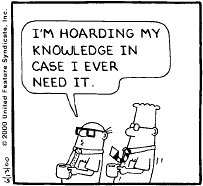
“Knowledge hoarding is replaced by sharing. Traditionally, our educational systems have emphasized becoming a specialist. We have hoarded our knowledge in fear that if we shared what we knew, we will become more replaceable.”

Ouch. Been guilty of that myself. I suspect we still have pockets but by the very nature of hoarding, it’s difficult to know.

“Command and control mindset: Traditionally, corporations have been structured with tightly managed controls at the top, which were passed down through levels of management, down to the people who actually performed the work. Tasks to be done, as well as the processes by which these tasks had to be done, were mandated from the top.”

The C&C manager often has an “I-know-best-that’s-why-I’m-the-manager” mindset. Takes a lot of self-confidence to break free of this approach. But the command and control style of management be less and less effective in any event:

“Rigid hierarchies: Scarcity of information pre-Internet, combined with specialization, has contributed to knowledge hoarding. At times, this asymmetry of information, and not the right leadership skills, allowed people to rise up the corporate ladder. Hierarchies were developed to preserve this status quo. However, things are changing rapidly, and democratization of information is definitely putting the emphasis back on leadership style, and not access to information, as a competitive advantage.”

This is why I’m all in on the Network and shared information. It’s breaking down these 20th century approaches to business, communication and everything else.

If you manage a company or work at a company, you should take a few minutes to read this insightful post. I’ll let you know how things come out at our company.


Techies and Taciturns

Olivar Marks blogs about collaboration for ZDNet. He brings up an issue that I’ve been dealing with as I push for an enterprise social networking platform (Yammer) at our company.

“There seems to be a personality type that has a huge appetite for learning and using ever more frequent waves of new technology developments that is independent of any particular demographic, and who are eager to participate in group activities online or off.”

“These folks are often called “early adopters” and “techies” in companies and are leveraged in pilot try outs of new technologies. Their opposite –I call them the Taciturns (habitually reserved and uncommunicative)– are those who have limited interest (or competence and confidence) in collaborating, preferring instead to work solo and communicate on their own terms.”

Okay, I’m squarely in the first group. To the point of being annoying.

“Obviously some of the people who have created the workflows and body of knowledge inside a company through years of service resent the trivialization of their old fashioned ways of working, and some have been led to believe that they need to buck up their ideas and get with it on Twitter, micro/macro blogging, Facebook-in-the-enterprise and other forms of social engagement with their cohorts.”

…and I helped create some of those workflows and bodies of knowledge during the last quarter century but it’s time for some of them to go!

“The Taciturns of all ages generally speaking are laughing inwardly at all the teenage leadership stuff they hear being bandied about, and have often already decided they won’t be participating in any of that.”

What most managers -in my experience- really want is for every employee to immediately open, read and act on every email “from the top.” The notion of a social networking platform is less appealing because they now have to compete for attention with stuff (they consider) less important than theirs (usually everything).