
Chris Anderson’s Free – The Future of a Radical Price

I’m almost finished with Chris Anderson’s Free – The Future of a Radical Price. It’s hard for us old dogs to wrap our minds around how free can be a real business model but Anderson makes his case with lots of compelling examples and insights. Here are a couple of my favorites:

“Venture capitalists have a term for this used of Free to shrink one industry while potentially opening up others: “creating a zero billion dollar business.” Fred Wilson, a partner at Union Square Ventures, explains it like this: “It describes a business that enters a market, like classified or news, and by virtue of the amazing efficiency of its operation can rely on a fraction of the revenue that the market leaders need to operate profitably.”

Gulp. And then there’s this little conundrum:

“The nature of the advertisement is different online. The old broadcast model was, in essence, this: Annoy the 90 percent of your audience that’s not interested in your product to reach the 10 percent who might be (think denture ads during football games).

The Google model is just the opposite: Use software to show the ad only to the people for whom it’s most relevant. Annoy just the 10 percent of the audience who isn’t interested to reach the 90 percent who might be.”

Watching or listening to stupid ads that had no relevance for me never bothered me when there were no alternatives. I just tuned them out. Now I find myself thinking “why am I watching Billy Mays scream at me about gluing my pants back together?
Seth: Free is the future

“When there are thousands of people writing about something, many will be willing to do it for free (like poets) and some of them might even be really good (like some poets). There is no poetry shortage.”

“In world where there is room for anyone to present their work, anyone will present their work.”

Read Seth Godin’s blog post.

Ignore Everybody (Hugh MacLeod)

Telling someone how to be creative is like explaining how to wiggle your ears. But Hugh MacLeod’s little blog-to-book (Ignore Everybody – And 39 Other Keys to Creativity) has some useful insights. Here are my favorites:

  • The more original your idea is, the less good advice other people will be able to give you.
  • Good ideas alter the power balance in relationships. That is why good ideas are always initially resisted.
  • The sovereignty you have over your work will inspire far more people than the actual content ever will.
  • It was so liberating to be doing something that didn’t have to have some sort of commercial angle, for a change.
  • Doing anything worthwhile takes forever.
  • Companies that squelch creativity can no longer compete with companies that champion creativity.
  • Like the best jobs in the world, it just kinda sorta happened.
  • Art suffers the moment other people start paying for it. The more you need the money, the more people will tell you what to do. The less control you will have. The more bullshit you will have to swallow. The less joy it will bring.
  • The only people who can change the world are the people who want to. And not everybody does.
  • Selling out is harder than it looks (It’s hard to sell out if nobody has bought in)
  • If you’re arranging your life in such a way that you need to make a lot of fuss between feeling the (creative) itch and getting to work, you’re putting the cart before the horse. You have to find a way of working that makes it dead easy to take full advantage of your inspired moments. They never hit at a convenient time, nor do they last long.
  • The best way to get approval is to not need it.
  • Part of being creative is learning how to protect your freedom.
  • The size of the endeavor doesn’t matter as much as how meaningful it becomes to you.
  • If you are successful, it’ll never come from the direction you predicted. Same is true if you fail.

Henry Domke: From blog to book

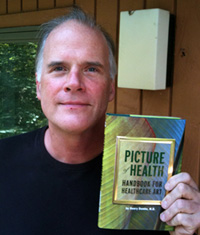
henry-book200My friend Henry has self-published a book (Picture of Health, Handbook for Healthcare Art). The term usually applied to self-published books is “vanity press,” but there’s nothing vain about my friend Henry and the story behind the book is interesting.

With a little help and encouragement from me (and others, I’m sure), Henry started blogging a couple of years ago. He wrote about health care art (his specialty). He was a natural but a little more serious than your typical blogger. His posts were more like essays than blog posts and took more time to write. He clearly saw the blog as a complement to his art business.

Somewhere along the way, I told Henry about services that convert blogs to books. He was immediately interested and began researching the idea. The result is Picture of Health.

The book is beautiful. Henry spared no expense. Heavy paper, embossed cover. It felt like it weighed five pounds. God (and Henry) knows what it cost to print.

Now here’s the part I like: The book is not for sale. At least not on Amazon or at Barnes & Noble (I see that you can purchase a copy from his blog). Henry published the book to give it away. Of the thousands of names in his client database, Henry selected just over 18-hundred to receive a copy of the book. (Do the math)

Henry is using the book to build on his relationship with important clients. By keeping the book (relatively) rare, he hopes to increase its value. It’s an expensive gamble and he has promised to share the results.

The part that I found most interesting about this blog-to-book story is that the book is the ONLY book about health care art. I couldn’t believe that when Henry told me but he insists it’s true. Not one book about a multi-million dollar business. Somebody else is writing one but Picture of Health is one of a kind for now. This blows me away. I mean, how many topics don’t have at least ONE book about them?

On the bedside table (2009)

The Increment, David Ignatius

“The CIA has zero assets in Iran until a message is sent to the agency’s Web site that indicates that the Iranians are making real progress toward a bomb. It falls to veteran spy Harry Pappas to identify the sender and weigh the validity of the information, while the bellicose White House gears up for war. Pappas is disheartened and disaffected; he knew the Iraq War would be a disaster, and he lost his marine son there. To carry out his assignment, he must go rogue and seek the aid of British intelligence.”

Life, Inc., Douglas Rushkoff

“In the twenty-first century, we continue to consider corporations as role models and saviors but engage other people as competitors to be beaten or resources to be exploited. Our lives are overextended, and there is no time, energy, or commitment to do anything but work and perhaps consider family.”