
The future of personal blogs

This is such a succinct take on blogging –again from ChatGPT– I’m posting verbatim. I like the line, “A social post is a sparkler. A blog post is a lighthouse.” Abandoned lighthouse might be more accurate but it’s a nice image. Will we –or have we– lost the ability to distinguish AI created content from that of humans? And, yes, I “value continuity over virality.”

Blogs won’t disappear. They’ll matter less in the mainstream and more in the margins—where depth, ownership, and longevity beat the fast-twitch feed of social media. Continue reading →
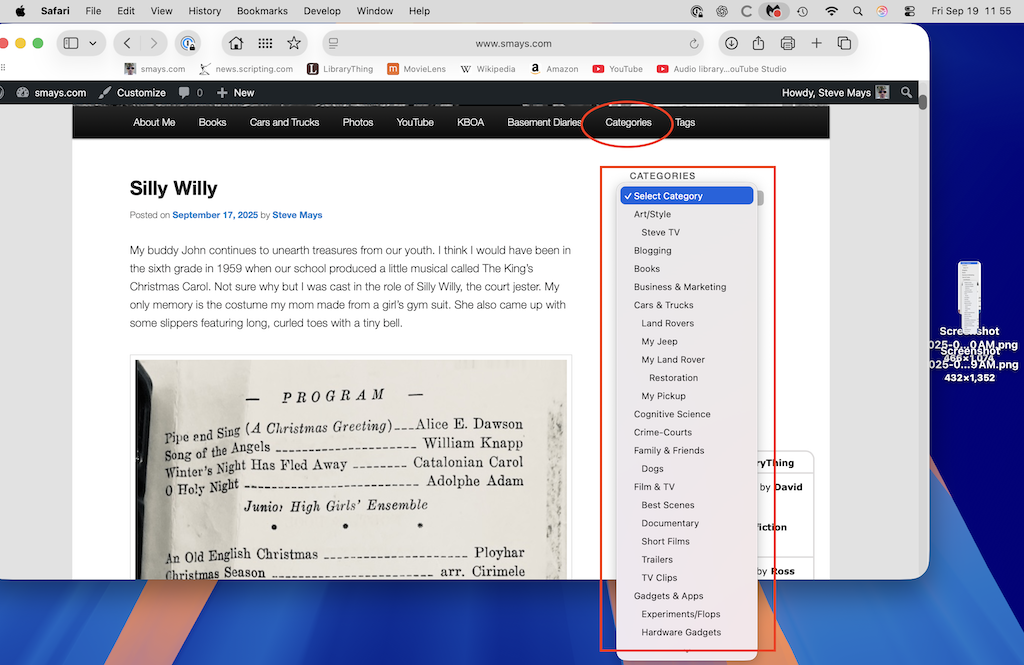
New Categories Page

In the twenty-plus years I’ve been keeping this journal I have posted 6,420 times. I’m currently using 50 categories and 133 tags (down from ~200). On more than one occasion I’ve mentioned my interest in taxonomy (“An ordered arrangement of groups or categories.”), and I’m in the middle of a major over-haul.

For years I’ve included a little sidebar widget showing my categories but I’d be very surprised if anyone but yours truly ever uses it. Just too long for that tiny space so I’ve created a CATEGORIES page with some buckets into which I’ve grouped the categories.

ChatGPT blog analysis: Time

This is the latest in what is shaping up to be a series of analyses of my blog posts by ChatGPT. Some bonus links in the comment below. 


ChatGPT: I’ve been through your 44 posts tagged TIME, and I have to say: this collection feels like a personal meditation-in-slow-motion. Where memory had you circling the persistence of self, and awareness leaned toward the immediacy of being, your reflections on time are more like a spiral — looping between philosophy, science, novels, and your own lived texture. Let me walk you through the main threads I see.

Continue reading →

“noticing what it feels like to notice”

When I upload a collection of posts from my blog to ChatGPT and ask for an analysis, would the response be in the form of an essay? I put that question to ChatGPT:

I’d say my default mode isn’t exactly an essay — it’s more like a well-organized, conversational analysis. But if you want it to read as a continuous, polished piece of writing (intro → development → conclusion, narrative flow, maybe even metaphors or a “voice”), then I’d shape it intentionally as an essay.

To see the difference between ChatGPT’s normal style and an essay, I decided to upload my posts (42 going back 15 years) on awareness. This is one of those touchy-feeling topics that most people never think about (paradox alert). The resulting essay is as close as we’re ever likely to get to explaining my interest in this topic.

Continue reading →

“Cartography of your mind”

A year ago I uploaded the tags page from my blog and asked ChatGPT for an analysis. Lots of updates to ChatGPT since then and I was curious what that analysis would look like today.

Since your earlier experiment with ChatGPT, the analysis we can do has definitely evolved. Instead of just listing or clustering, I can now look at your tags like a map of your interests across time, themes, and personas. This isn’t just a tag list — it’s a kind of cartography of your mind over two decades of posting. It shows where you’ve been, what you’ve valued, and how your focus has shifted from the outer world of radio and tech to the inner world of consciousness and memory, with AI now serving as bridge between the two.

This is an insight I’m not sure I could have ever come up with on my own. The AI can look at my blog (the tags, for now) from 30,000 feet while the best I can do is a post or category. Here’s the updated analysis: Continue reading →