When AI can “read” my blog

Even the people who seem to understand AI large language models best, don’t pretend to know how capable they will become in the near future. Against that backdrop, can you foresee a time when an AI can scan/analyze the 6,400 posts of my blog (without having to upload the files)? [Full thread]

Claude.ai: Given that you’ve written 6,400 posts, you’ve clearly been at this a long time — that’s a substantial body of thought. Here are the possibilities I find most genuinely compelling:

Intellectual archaeology
Tracing how your thinking has actually evolved over time — not how you remember it evolving. Most prolific writers are surprised when an outside reader identifies the real turning points, the ideas you quietly abandoned, the obsessions that recur in disguise. An AI could map this with precision a human editor never could, simply because of the volume.

Finding your strongest work
Long-form bloggers almost always have brilliant posts buried under the sheer weight of output. An AI could identify which pieces are most original, most internally coherent, or most likely to resonate — not by traffic metrics, but by the quality of the thinking itself. That’s a different and arguably more honest filter.

The book you haven’t written
6,400 posts almost certainly contain one or more books worth of coherent argument that you’ve never assembled into a single form. An AI could identify the connective tissue — the thesis that runs underneath years of posts — and propose a structure you couldn’t see because you were too close to it.

Contradiction and tension mapping
Where have you argued both sides of something over the years? Not as a gotcha, but as a genuine map of your intellectual uncertainty — the questions you keep returning to because you haven’t resolved them. Those unresolved tensions are often where the most interesting thinking lives.

A “second brain” interface
Rather than one-time analysis, an ongoing conversational layer over your entire archive — so you could ask things like “have I written about this before?” or “what’s my actual position on X when I look across everything I’ve written?” Your blog becomes a queryable extension of your own memory.

Your readers’ experience
Surfacing unexpected connections for new readers — showing someone who just found one post, the three other posts from 2014 and 2019 that are in genuine dialogue with it, even though you never linked them.


The thread connecting all of these is that the real value isn’t in the individual posts — it’s in the patterns across all of them that nobody, including you, has ever been able to see all at once.
Continue reading →

“Why humans cling to stories”

I prompted Perplexity to look for themes or trends in the 70+ posts (going back to 2004) in the Religion category.


1. Religion as human-made stories and systems

You treat religion less as revelation and more as a **human** technology: something people invent, edit, and use to organize behavior, power, and meaning. You’re drawn to writers like Harari, Adams, Hines, Watts, Harris, and Ehrman who frame gods, money, nations, and ideologies as “shared fictions” or “maps” that work pragmatically rather than metaphysically. Your own comments echo that: religion is one example of a larger human habit of myth‑making to hold fragile social orders together.

2. Skepticism of certainty, affection for “I don’t know”

Many posts poke at people who are utterly sure they’ve found the “one true faith” out of thousands of incompatible options. You highlight quotes and essays that argue the only honest stance is some version of “I don’t know, and neither do you,” and you clearly resonate with that. The tone is rarely angry; it’s closer to amused disbelief at how confident people can be in claims they can’t possibly verify.

3. Religion, ego, and performance

You repeatedly connect religiosity to **ego**: chosen peoples, special relationships with God, and the need to feel correct or favored. Posts about appearing religious (Machiavelli, “appearing to be religious”), evangelical branding, and “religion and ego” all treat belief as something performed for social and psychological payoff as much as for doctrine. You’re especially interested in the gap between what people say they believe and how they actually behave or legislate.

4. Power, politics, and “weaponized” faith

Another through‑line is religion as a power tool: surveillance, social control, justification for violence, or political branding (evangelicals and the GOP, Christian Right decline, cults, “The Family”). You focus less on abstract theology and more on who gets to define “God’s will” and what that does in the real world. Organized religion, in your posts, is often less about God than about those who act in his name.

5. Spirituality without dogma

Alongside the critique, there’s a consistent interest in non‑dogmatic spirituality: Zen, Buddhism, meditation, Sam Harris’s “spirituality without religion,” Alan Watts on stillness and consciousness. You repeatedly highlight ideas about awareness, present‑moment experience, the illusory self, and consciousness as primary, often contrasting that with inherited belief systems and scriptures “cobbled together during the Iron Age.” You seem much more attracted to practices that clarify experience than to creeds that explain it.

6. Religion, technology, and future “gods”

In more recent posts you connect religion to AI, Silicon Valley, and new ideologies: AI‑written scriptures, Silicon Valley as a birthplace of future religions, money and the economy as a kind of religion, liberalism/communism/nationalism as modern creeds. A recurring question is what happens to “religions of text” when the texts start talking, or when algorithms and biotech become the new sources of superhuman authority.

7. Your overall stance

Putting it all together, your “religion posts” read less like attacks on believers and more like a long, curious investigation into why humans cling to stories and what those stories do to us. You tend to trust awareness over belief, experience over doctrine, and are wary whenever any story—religious or secular—claims unquestionable authority.

Tag cloud graphic

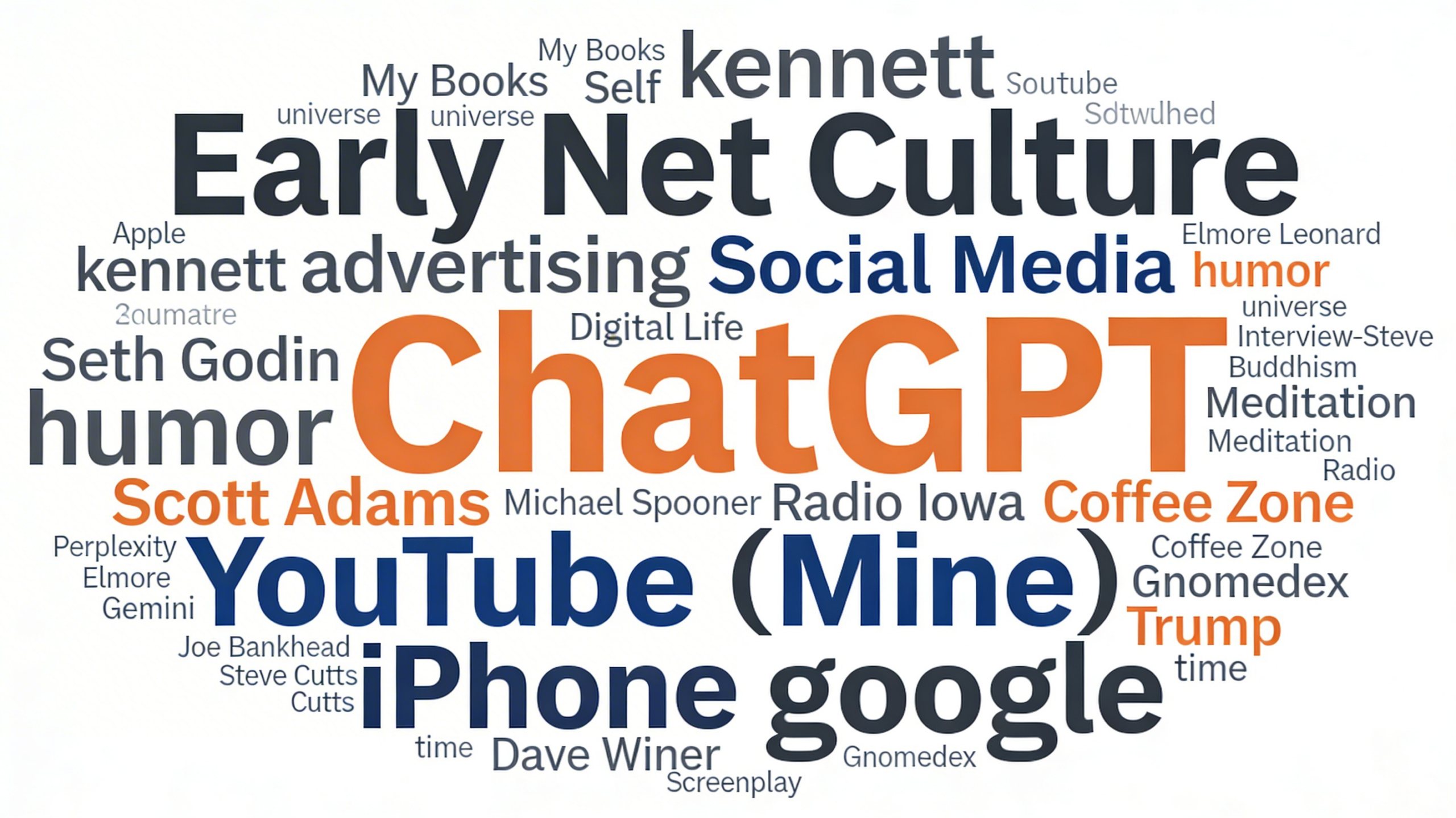
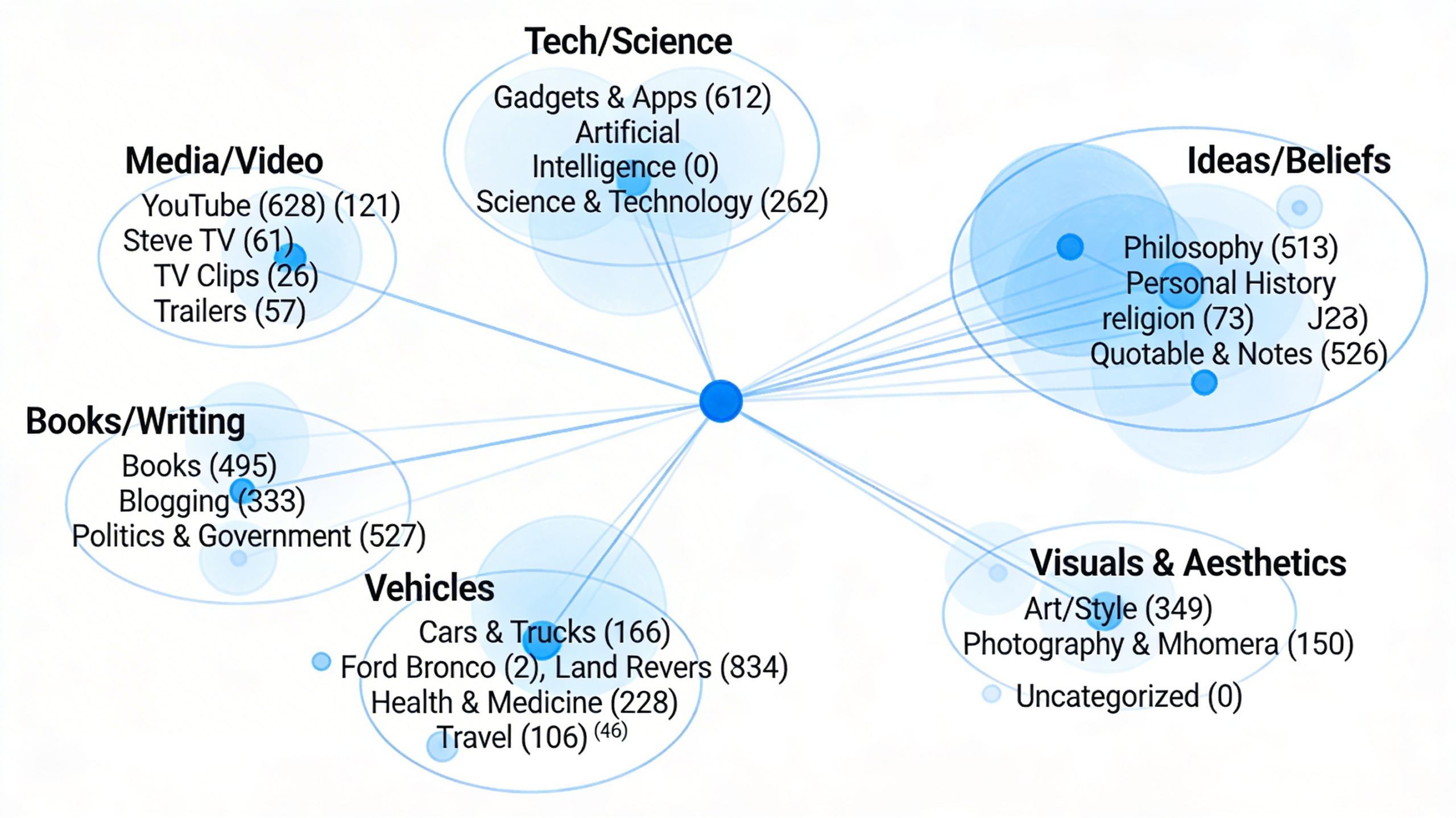
An earlier post featured two graphical representations (from Perplexity) of the categories I’m currently using on smays.com. As a follow-up, I uploaded the current list of tags.

At first glance one would think this blog is just about ChatGPT and it did capture a lot of my attention over the past couple of years. That will change now that I have deleted my ChatGPT account.

During recent blog maintenance, I moved ChatGPT from category to tag (along with Perplexity and Gemini). Artificial Intelligence is the top-level category for those topics (link below).

Along with all of the blog posts on this topic, I saved a lot of those conversations to my local Documents folder. This morning I prompted Gemini to analyze that “AI Bots” folder. Continue reading →

Category “tag cloud”

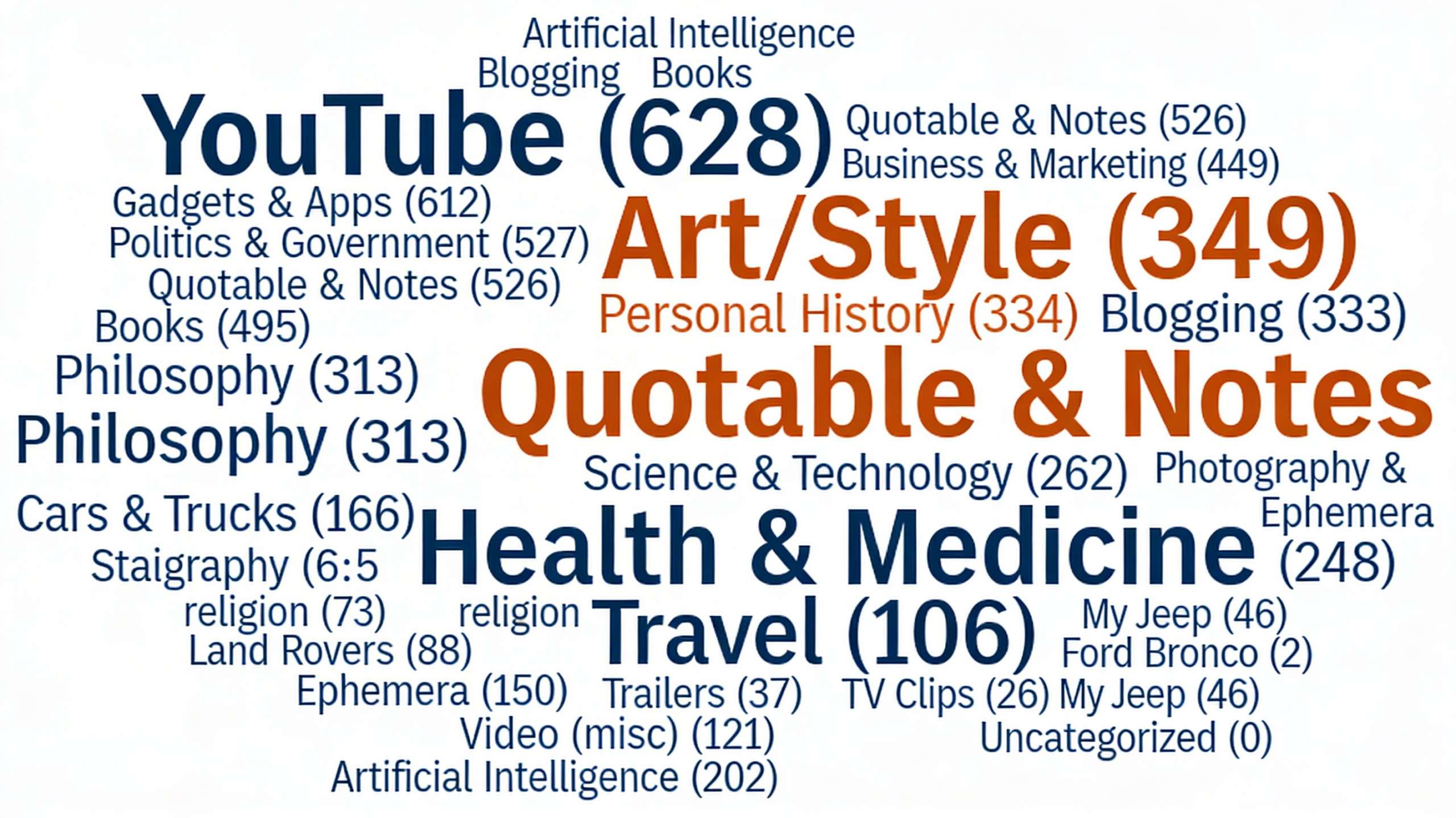
AI tools like Perplexity and Gemini have proven to be invaluable at giving me a new perspective and understanding of my 24 years of blog posts. I’ve written about this frequently. This morning I provided a list of my categories showing the number of posts in each and prompted Perplexity to create a visual representation of the data. Took a little tweaking but I find the results interesting.

For what it’s worth, Gemini was unable to perform this task but did offer several explanations of what it was my fault and not the AI.