
Journalists: How to feed the blog beast

Amy Gahran (The Right Conversation) offers some useful tips for reporters who are asked or required to blog. The first one is the best one: Don’t use your blog to post stories. Instead, use it to post complementary content around your stories.

Other nuggets from Ms. Gahran:

  • Blog as notepad. If you’re following an issue (maybe a local Superfund site) and you come across an interesting angle or tidbit that is relevant but doesn’t warrant its own story, instead of just jotting yourself a note about it, blog it. If possible, create a category or tag in your blog so interested community members can easily track that issue through your blog. That also makes it easy for you to find that note when you are ready to do a followup story.
  • Distributed reporting. So many meetings, so little time. Let’s say you can’t get to a public meeting about that Superfund site. So you post a blog item to let the community know the meeting’s happening and why you think it might matter. Toss out a couple of questions you’d ask if you were going. Invite your readers to attend the meeting, and maybe pose those questions. Ask them to post their notes — and the answers they received — in the comments. More fodder for you.
  • Community outreach. Pose open questions to your blog audience: What are their top concerns about that Superfund site? Agenda-setting works best when it works both ways.
  • Buzz builder. You’re working on a big investigative feature about that Superfund site. It’ll take you months to pull it together. You can drop hints about how that project is progressing — without giving away the farm or totally blowing it with your competition or sources.
  • Cutting room floor. Did your editor cut a particularly poignant anecdote or pithy observation from your latest story simply for space? Blog it! It’s already written, so why not make it work for you? Make sure you always link to the published story, of course.
Does radio still “own” breaking news?

We radio guys (back when I was a radio guy) used to pooh-pooh the daily newspaper as “yesterday’s news,” for their inability to cover breaking stories. The folks at The Providence Journal are changing that and they’re using a blog (among other tools, I’m sure) to do it.

They call their news blog “7to7” and it is “…is projo.com’s first reporting channel for breaking news. The news gets to the blog staff in a variety of ways: posting, e-mail, or dictation — whatever works well in a given circumstance. We’ve even set up a dedicated blog phone line and an e-mail address.” Publisher Howard G. Sutton takes this view:

“Decades ago, the newspaper business abdicated the franchise for breaking news to broadcast media. With the strength of projo.com, and a newsroom at least 10 times the size of any local competitor, we are poised to take back the leadership position for breaking news. When people in our market need to find out what it is happening right now, they will turn to projo.com and The Providence Journal. We are taking back the franchise.”

Editor Joel P. Rawson recently reinforced the initiative in his memo to the staff: “It is our goal to be the source for breaking news in Rhode Island, to dominate it, to own it.”

More on how “7to7” works at Poynteronline.

Case in point: I was cruising Digg yesterday and came across a story about a shooting at a mall in Kansas City. Full story with pix, only 18 minutes old. Of course, the local radio guys might have been all over this. But the point is, the radio guys have to work hard to be first with breaking news. It’s no longer theirs by default.

Blogger on front page of New York Times

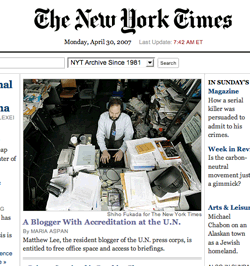
New York TimesIt’s stories like this one, on the front page of the New York Time, that put the “no shit?!” look on my face when someone tells me they’ve never heard of blogging.
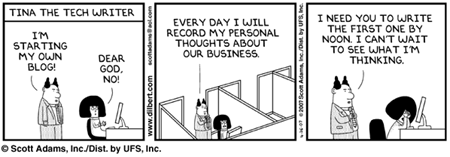

Stories like this must make it a little harder for institutions and governmental bodies to deny access to bloggers. Not that the U.N. or the New York Times get much respect outside of The Big City. [Thanks, Henry]

Best vet blog

A good blog is: personal, informative, timely, passionate, focused… and, yes, I do have an example in mind. Following excerpt is from yesterday post on Your Pet’s Best Friend:

“When we welcome a new client to our practice, part of the process is a questionnaire about their pet’s health history and environment. The last question is: “Do you consider your pet to be a member of the family?” and most people answer “Yes”. The human-animal bond is very strong. It’s very common for people to say that the pet is like a child to them. Cat-lovers often say that the cat owns them, rather than the other way around. Certainly many (most?) of us consider our pets as companions, as opposed to property. Thus it would seem that referring to ourselves as the “guardians” of our pets is just a nice way of saying how we really feel. [Trade Secret: the real key question is “Where does your pet sleep?”]”

If you come across what you believe is a better vet blog, send me the link.

Life before YouTube, Flickr and Mac Book Pro

I just wasn’t thinking ahead. When I started messing with websites and putting stills and video online, everything was just hard. Almost nobody had fast internet connections. YouTube, Google Video et al were somewhere over the digital rainbow. And hard drives had not become as cheap as they are today, so just “keeping” these big files was a problem.

And I was so intent in putting everything I did online, I didn’t bother to save high resolution still images. I rendered most of my video down to files sizes that could be downloaded.

I’m reminded of my lack of foresight every time I go back and upload a clip to (in this case) Google Video. Like this performance by Daniel “Slick” Ballinger, recorded in March of 2004.

And I should add that the iLife suite (iDVD, iMovie, iPhoto, etc) that ships with OSX just makes it so easy and fun to create. Who knew? Now we save everything. Uncompressed. Best quality. Word to the wise.

Voice-to-text-to-blog?

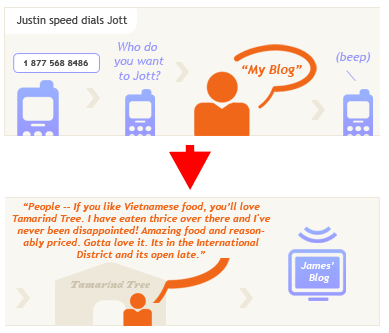
Planet Nelson points to Jott: “…is a free service (to the extent that your cell can call anywhere in North America for free) that allows you to dictate a 30-second message into your phone and then have it sent as a text email to a friend/colleague/self/offending politician/anyone whose email address is in your Jott address book.”

From Jott.com: “Using Jott, yoau can either Jott your blog directly or just jott yourself and post later. Better yet, your readers can listen to you too — a great way to connect?”

Blog with Jott

If I understand this correctly… a news reporter could be posting audio and text reports directly from their mobile phone to their blog. And given the evolving definition of “reporter,” this tool could be used by anyone, whether they went to J-School or not.

Update: Jamie at Planet Nelson Jott’ed back on this post. The voice-to-text was close. “Blogroll” became “blog rule” and “Gnomedex” showed up as “noon desk.” But pretty slick all the same.

Five Common Headline Mistakes and How to Avoid Them

The headline of a blog post is arguably as important as the post itself. Digg points us to this handy list at copyblogger:

1. No Reader Benefit – Ask yourself “what’s in it for them?” If the headline doesn’t tell you, it’s missing a benefit.

2. Lack of Curiosity – Does your headline make you have to know what the promised answer is? Use questions, numbers, challenges and statements that compel the prospective reader to explore the beneficial content you’re offering.

3. Lack of Specificity – Use variations of the “list” headline, use words like “this,” “these,” “here is” and “here are” to refer specifically to your content, and also use hard numbers and exact percentages when appropriate.

4. Lack of Simplicity – Stick to one concept, eliminate unnecessary words, and use familiar language.

5. No Sense of Urgency – Check to see that items 1-4 above are truly present. If so, try reworking the headline to make it more compelling without stepping too far into hyperbole. If all else fails, examine the premise of the content itself. Is it really “need to know” information?

By the time you need a blog, it’s too late

One of my blogging sermonettes is the importance of having an established blog (and readership) before you need it. Once the shit has hit the fan, you can’t run down the hall to the IT department and shout, “Quick! We need a blog!”

If you have a credible blog in place, you can respond to and comment on topics as they arise. A good example of this is “Your Pet’s Best Friend,” a blog written by my old Kennett buddy Dr. T. Everett Mobley.

Like vets all across the country, his clients are concerned about contaminated pet food. He’s been posting short updates with links to other websites and just generally letting his readers know what’s happening.

Everett is not our vet but I know him and trust him and I’ll be checking his blog to get his take on this situation. As far as I know, none of the Jeff City vets have blogs. Missed opportunity.

Blog lemonade

VirginaThe “West Virginia” printed on the shirts players wore after winning the NIT title with a 78-73 victory over Clemson on Thursday night is missing the last “i” in “Virginia.” WVU sports information director Shelly Poe said the NIT printed the shirts.

Embarrassing? Maybe a little for the NIT. But certainly not for West Virginia. Their accomplishment is in no way diminished. But it will get a little ink for a day or two.

If I were the Resident Blogger for West Virginia Athletics, I would be having some fun with this.

  • Invite fans to send in videos of themselves wearing the T-shirt and explaining the misspelling.
  • Post an explanation loaded with typos.
  • Have a fake professor (with British accent) explain how the spelling on the shirt is –in fact– the original, “correct” spelling of “Virgina”

Blogging lemonade.

Disclosure: The company I work for handles multi-media marketing for Clemson.