
The J-Walk Blog is very popular. For all the usual reasons. He writes well about interesting stuff and he posts every day. Usually several times a day. John Walkenbach (Mr. J-Walk) was called away to a meeting and didn’t post for a week. Upon his return, he checked his stats and did a little trending to determine he would lose all of his many readers in 17 days if he stopped posting altogether. One assumes it would take less time for blogs with fewer readers. I wonder how long –if at all- it would take for visitors to return. And why would they?
Category Archives: Blogging
Seth Godin: “Write like a blogger”
I quote Seth Godin so often I gave him his own tag. And sometimes he writes/thinks something so dead-on that I have to quote the entire post. Every word is gold:
"You can improve your writing (your business writing, your ad writing, your thank you notes and your essays) if you start thinking like a blogger:
- Use headlines. I use them all the time now. Not just boring ones that announce your purpose (like the one on this post) but interesting or puzzling or engaging headlines. Headlines are perfect for engaging busy readers.
- Realize that people have choices. With 80 million other blogs to choose from, I know you could leave at any moment (see, there goes someone now). So that makes blog writing shorter and faster and more exciting.
- Drip, drip, drip. Bloggers don’t have to say everything at once. We can add a new idea every day, piling on a thesis over time.
- It’s okay if you leave. Bloggers aren’t afraid to include links or distractions in their writing, because we know you’ll come back if what we had to say was interesting.
- Interactivity is a great shortcut. Your readers care about someone’s opinion even more than yours… their own. So reading your email or your comments or your trackbacks (your choice) makes it easy to stay relevant.
- Gimmicks aren’t as useful as insight. If you’re going to blog successfully for months or years, sooner or later you need to actually say something. Same goes for your writing.
- Don’t be afraid of lists. People like lists.
- Show up. Not writing is not a useful way of expressing your ideas. Waiting for perfect is a lousy strategy.
- Say it. Don’t hide, don’t embellish.
What would happen if every single high school student had to have a blog? Or every employee in your company? Or every one of your customers?"
Pseudonymous
I’ve been corresponding with a few political bloggers who I chided for being anonymous. Because, they explained, their ideas are so controversial, so inflammatory, so powerful… they risk their jobs or worse if they sign their names. But –they insist- they aren’t anonymous. They are “pseudonymous.” I had to look it up in the dictionary:
pseudonymous – writing or written under a false name
anonymous – not identified by name, of unknown name
So, if I write something and don’t sign any name to it, that’s anonymous. And if I sign a false name, that’s pseudonymous. Yes? Is this a distinction without a difference? Or, if I sign my letters “The Shadow,” readers won’t know who I am but they’ll know the letter was written by someone who calls himself “The Shadow.” And if I don’t sign the letter at all, the reader will have no way of knowing subsequent letters were written by the same person. Is that it?
I went to two of the smartest people I know for clarification. First, Bob Priddy, a long-time broadcast journalist and author:
“One hides behind a fake name. The other hides behind no name. Steve is a name. Anonymous is a word.
It’s the difference between hiding behind a red curtain or hiding behind a blue curtain. I suppose those who use pen names do so because they don’t want to be anonymous. It’s much more rewarding to hear people discussing who Howard Beale is than it is to hear people discussing who anonymous is because anonymous can be anybody and Howard Beale is somebody. Nobody discusses anonymous. Everybody discusses Howard Beale and therefore the sniper feels some kind of importance. Both are gutless but one is gutless with an ego.
My friend Kay Henderson (also a journalist) wrote this:
“I have never heard or seen the word “pseudonymous” before. Interesting. My first thought was of George Eliot who wrote under the male pseudonym because writing, at the time, was a “male profession.” My second thought was “Primary Colors” was written by “Anonymous” as you’ll recall.
I may be behind the times here, though. Is “Alice Cooper” or “Marilyn Manson” a pseudonym? How about “Madonna” or “Cher” or “Diddy” or “Snoop Dog” or any number of professional athletes who adopt a stage name? Our culture has grown so used to people who adopt another name/character/stage name in public that perhaps it’s not that much of a stretch to expect it to happen on-line.
Is political “speech” subject to different standards than are considered the norm for the rest of the culture? I will agree with my colleague that the cloak of a pseudonym is too often used by bloggers. But who will be the blogger police? Perhaps it will take something akin to pulling back the curtain and having Dorothy expose The Wizard to change the on-line culture. Perhaps more sites will forbid “anonymous” posting in the comments sections. I find the requirement of a name, however, laughable in most instances if you read the “names” which are used.”
I suspect we got such passionate response to this because the phantom bloggers would like to be out. No doubt all of their friends know of their secret identities (“That ‘Howard Beale’ guy? That’s me. Seriously.”). Questioning their ethics or courage stings. I’ll try to stop.
Can blogging kill you?
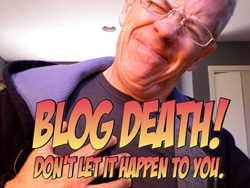 Jeez, I hope not. But according to this article at NYTimes.com, some bloggers are working in what amounts to a “digital-era sweatshop” and it’s affecting their health. A few well-known bloggers have recently died of heart attacks.
I’m pretty sure I wouldn’t want to blog for my supper. That would take a lot of the fun out of it.
I am (not) “Howard Beale”
There. It’s out in the open. I feel better already. I am the political blogger who posts under the pseudonym “Howard Beale.” Because I so passionately believe all the things I write, I can no longer hide behind a curtain of secrecy. I’m out, baby!
I’m still trying to figure out how to work my blogging software so I can start using my real name on my blog posts, so you’ll still see “Howard Beale” for a while. But it’s me, smays.com.
And I call on my fellow phantom bloggers to pull off their masks and take ownership of their words. Trust me, you’ll feel better.
UPDATE: Okay, joke’s over. Even my closest friends didn’t spot this as a hoax. That’s scary. This ridiculous post (and photo) should be obvious as a spoof. Looks like the real “Howard Beale” is safe for now.
When it’s too risky to sign your name
Technology in the Missouri Senate
 I got a few minutes with Missouri State Senator Charlie Shields this morning. Senator Shields –the Majority Floor Leader– was kind enough to let me ask a few questions at a very busy time for the legislature. I wanted his take on how the Senate uses –or doesn’t– use technologies like laptops, the web, smart phones, Blackberry’s, blogs and podcasting.
The House allows laptops in the chamber but the Senate doesn’t. The concern seems to be that senators would be surfing the web or checking email and not paying attention to debate and the business of the senate. Senator Shields does not agree with that position and feels it’s just a matter of time until laptops are allowed.
I asked about Blackberry’s and smart phones, which are allowed. He said you don’t have to look hard to find a Senator checking his email.
The media can have laptops in the press gallery at the press table. I didn’t ask but assume there is wifi access for the media because I could get it in the hallway waiting to talk with the senator.
I asked if any bloggers had requested permission to cover the senate. He said not to his knowledge. I wasn’t entirely clear on his answer to the question, would bloggers be allowed to cover the proceedings. I think both the House and Senate make a pretty clear distinction between the “real” media and bloggers.
Senator Shields was unaware of any of his senate colleagues blogging. It surprises me a bit that some of the more clued-in haven’t discovered the power of this tool.
As for personal tech gadgets, Senator Shields has a Blackberry and an iPod on which he sometimes listens to jazz podcasts and NPR’s Car Talk.
He concluded with the prediction that the role of technology in the Senate will increase dramatically in coming years. No doubt.
Update: Missourinet News Director Bob Priddy –who has been covering the Missouri legislature since the early 70’s– adds and clarifies:
“We actually don’t have a press gallery as the House does. We have a press table which is on the Senate floor. The senate, of course, has had its sessions on the internet, first on our site, then on others, and then on its own site for many years.
The irony of the idea that Senators will be at their desks checking email or playing games or bidding on ebay is that most senators don’t stay on the floor unless the legislation being considered is really big or unless they have a specific role with any bill. They can be in their offices checking their email or playing games or shopping on ebay.
The use of blackberries and smart phones on the Senate floor is a mixed blessing. It does enable the senators to get information from their office or their staff without leaving their desks. But it also enables lobbyists to send them messages from the hallways, giving lobbyists access to the Senate floor although the rules don’t allow them in the chamber in person. For some folks, that’s not a comfortable relationship but nobody has figured out a way to control that access, nor do they seem to want to.
The use of the computer has helped the amendment process. Senate staff sits at the other table at the front side of the chamber and can prepare amendments on the computer and run them into a printer pretty quickly. It’s been several years since I’ve seen a Senator write an amendment at the desk. In fact, debate is often slowed or stopped so a Senator can go to the staff table and have the staff write an amendment.
Of course the computer has made it a whole lot easier for the people in the clerk’s office to compile the journal, prepare copies of bills with amendments included in them before the bill goes up for final passage—-and just generally manage the flow of documents that go through the place.”
PS: If you’re wondering why I didn’t just post the audio of the interview… I hit the wrong button on my new fancy-pants digital recorder and erased the interview. Please don’t take my car keys.
“I’m mad as hell and… anonymous!”
 One of our reporters stepped on blogger toes earlier this week. Steve Walsh is a reporter for The Missourinet, a radio network headquartered in Jefferson City. He took over the network blog a few weeks back and has been doing a good job with it. The post in question attempted to make some “distinctions” between MSM bloggers and “political” bloggers.
“…while the MSM bloggers represent their media outlets and, therefore, must be truthful and accurate … the vast majority of the political bloggers are unaccountable … and sometimes fall short of telling “the truth, the whole truth, and nothing but the truth.”
Ouch. That’s a commonly held view by a lot of reporters. And a lot of folks –bloggers and the public alike– would question the “must be truthful and accurate” part but that’s not what this post is about.
One of the blogs Steve “called out” is Fired Up Missouri. The blog represents the Democratic view of things and the blogger goes by the pseudonym “Howard Beale.” Howard Beale was the fictional news anchor in the film Network.
“Howard Beale” fired back and called Steve to task for a story he did some months ago. Your normal blogosphere kerfuffle.
Steve responded and made what I consider the check-mate move. He pointed out one key difference between MSM blogs like his and Fired Up Missouri. Steve signs his posts and the blogger at Fired Up Missouri does not.
This point trumps all others in my opinion. And adds heavy irony to the choice of the pseudonym “Howard Beale.”
“I want you to get up out of your chairs… go over to your computers… and post an angry rant to your blog… anonymously.” See? Doesn’t work.
But as luck –and some good detective work– I have discovered the identity of “Howard Beale” and will reveal it here at 5:00 p.m. this Friday. I think you’ll be shocked.
Disclosure: The company I work for, Learfield, is the parent company of The Missourinet, the company Steve Walsh works for. I should also point out that I have come out here as supporting Barack Obama. I don’t think of myself as a Democrat because if he wasn’t running I wouldn’t be voting for the Democratic candidate. But if I have a leaning, it’s more toward the views expressed on Fired Up Missouri.
Coffee Zone Fan Boy
I am not a fun guy (by conventional standards). I usually don’t enjoy a lot of things (beach, skiing, ocean cruise, etc etc) others find enjoyable. But I do have a few things that give me great pleasure. Reading, for example. I can spend an 8 or 10 hours on a weekend reading a good book.
 And I love my quiet time at the Coffee Zone, a local coffee shop owned and operated by Taisir Yanis. I’ve posted from and about the Zone many times.
This morning I decided the Coffee Zone needed a blog so I whipped one up while slurping Rocket Fuel, the high octane java that makes all other coffee taste like lukewarm Yoo-Hoo.
I’ve got to post his menu and add some pix but this will do for a start. Taisir registered a good domain –YanisCoffeeZone.com– and we’ll get that in place in a day or so.
Taisir knows and likes his customers and they like him. It will be fun to see how we might use his blog to build and serve the community he has created.
NCAA Blogging Policy
With the NCAA Basketball Championship upon us, the association has released its policy on blogging [Download PDF]:
“The following is the NCAA’s policy for the number of blog posts allowed during a men’s and women’s basketball championship competition or session (i.e., where more than one contest takes place under the same admission ticket): Five times per half, once at halftime and two times per overtime period.”
13 posts in a game that goes one OT. They’re clearly trying to prevent someone “live blogging” every bucket. And the policy is easily enforceable if you are a credentialed reporter. Violate the policy, lose your credentials. A very big deal. But if I’m sitting in the stands with my iPhone, posting to my Twitter page… how do you stop that? And why is that less of a threat to the NCAA?
If anyone comes across examples of the this, let me know.
DISCLOSURE: The company I work for, Learfield Communications, has the marketing rights for a bunch of teams playing in the NCAA championship series.