Cairns

Updates to this project will be added to the bottom of this post.

The hiking trail is finished (whatever that means). Still lots of dead limbs to chip up but the trail is as complete as I’m inclined to make it. But what to do with all those rocks?

“A cairn is a man-made pile (or stack) of stones raised for a purpose, usually as a marker or as a burial mound. Cairns have been and are used for a broad variety of purposes. In prehistory, they were raised as markers, as memorials and as burial monuments (some of which contained chambers). In the modern era, cairns are often raised as landmarks, especially to mark the summits of mountains. Cairns are also used as trail markers. They vary in size from small stone markers to entire artificial hills, and in complexity from loose conical rock piles to elaborate megalithic structures. Cairns may be painted or otherwise decorated, whether for increased visibility or for religious reasons.” (Wikipedia)

The Wikipedia article will tell you everything you might want to know about cairns but it piqued my curiosity so I’m reading a tiny book titled Cairns: Messengers in Stone by David Williams.

I chose a small natural clearing for my first effort. I immediately figured out the larger circle below would require way too many stones. The small circle is about six feet in diameter. The next photo down provides a better view. Continue reading

Hiking Trail Update 7.4.23

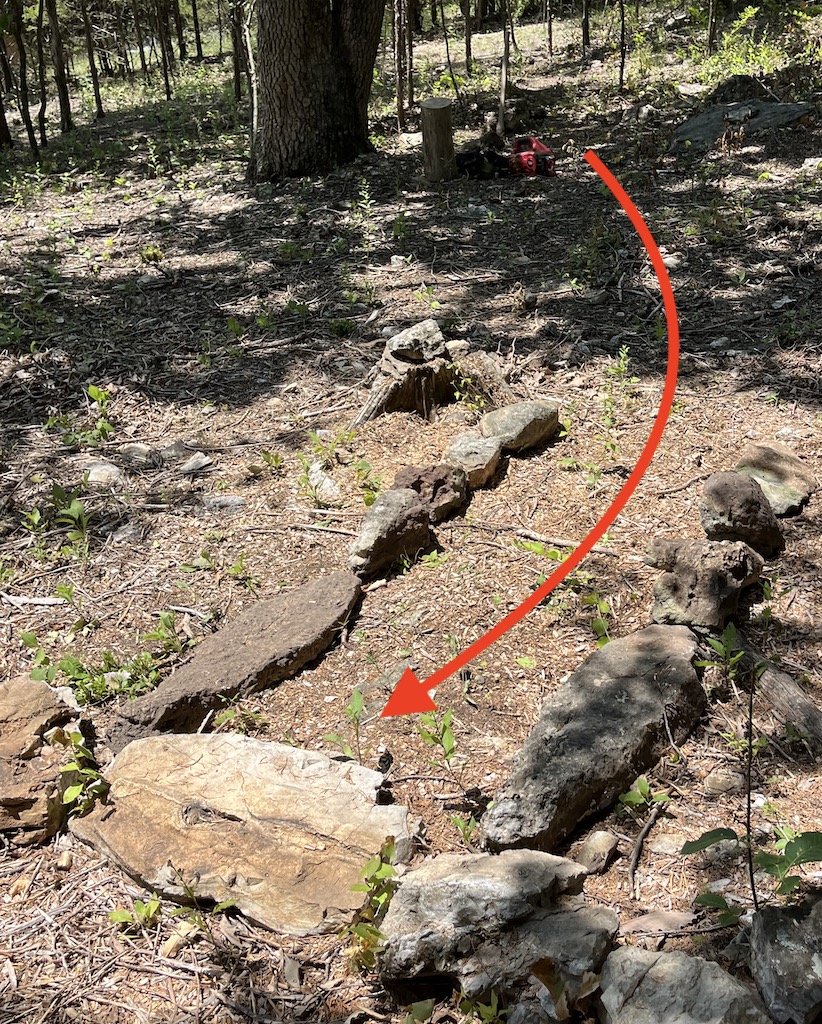
I think I might be on the last couple of legs of the trail. In the image below you can see where I moved the BFR and the arrow points to where the trail will connect with the first leg that I did so very long ago. This work might be done in the next couple of weeks, depending on the heat factor.
I’ve been thinking about about what comes next, after the trail is finished. Probably some clean-up. The trail forms a big loop with several switch-backs. Within this loop is a lot of dead cedar limbs that I can adios. As well as several rock shelfs that will look better cleaned up. And I might add a little color and whimsy in a few places.

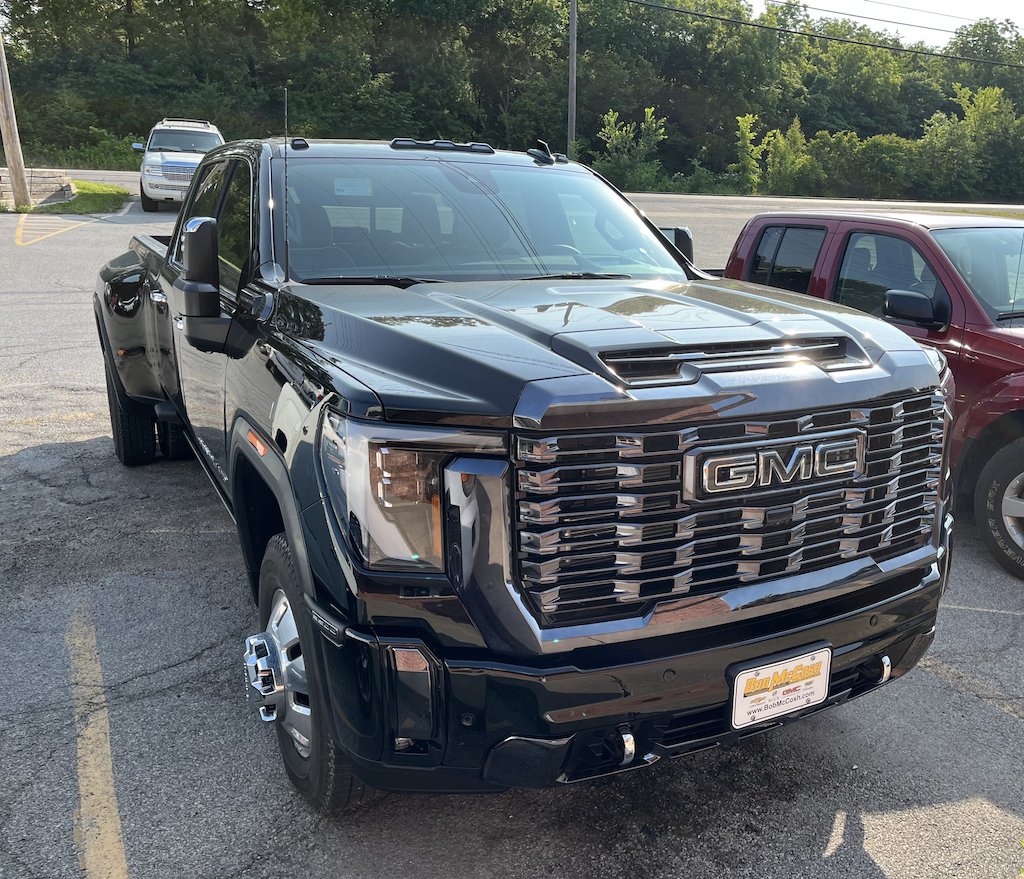
Pickup truck?

What makes a pickup truck… a pickup truck. What is its essence, if you will? A bed for “picking up” stuff? The Oxford Dictionary definition is: “a small truck with an enclosed cab and open back.” So, yeah, this is a pickup truck. But will it ever haul a load of cow manure or gravel or a greasy engine block? Will the owner ever climb into its luxurious cab in sweaty, dirty work clothes? Maybe.

But it just doesn’t say “pickup truck” to me. I’m not a farmer or rancher or anyone that needs a pickup truck. So I have no standing for this kind of snobbery. But a truck like the one above can cost $68,000 dollars. And it seems to be more about a comfortable ride for the driver (and passengers) than getting work done. Not that there’s anything wrong with that, as Jerry Seinfeld would say.

From my friend (and car aficionado) Phil: “nearly certain that’s a 2024 GMC 3500 Denali Ultimate. If so, $101-105,000 (with massaging seats!) if it’s just a regular Denali, it’s still a $95K+ truck… $68K might get you a used 2020, but not one of those.”

Another friend reports: “2015 GMC diesel/Denali still books at 50K!”

MAGA Dress Code

“An untucked, oversize t-shirt in red, white and blue, a fanny pack, billowing cargo shorts, tube socks, a ball cap and at least one ace bandage. It’s a look that says comfort, gun ownership and I-whine-about-the economy-while-driving-a-brand-new-truck.”

— Paul Rudnick

Dictator chic

Laura Clawson explains why Trump’s indictment bathroom photo says so much about him:

“…and a cheap-looking shower curtain on a tension rod, which appears to be hiding more stacks of boxes. That’s the shower curtain and tension rod you get when you’ve moved into a new rental apartment and, realizing there’s no shower curtain, run to Target so you can wash off the sweat and dust of having unloaded your own UHaul.”

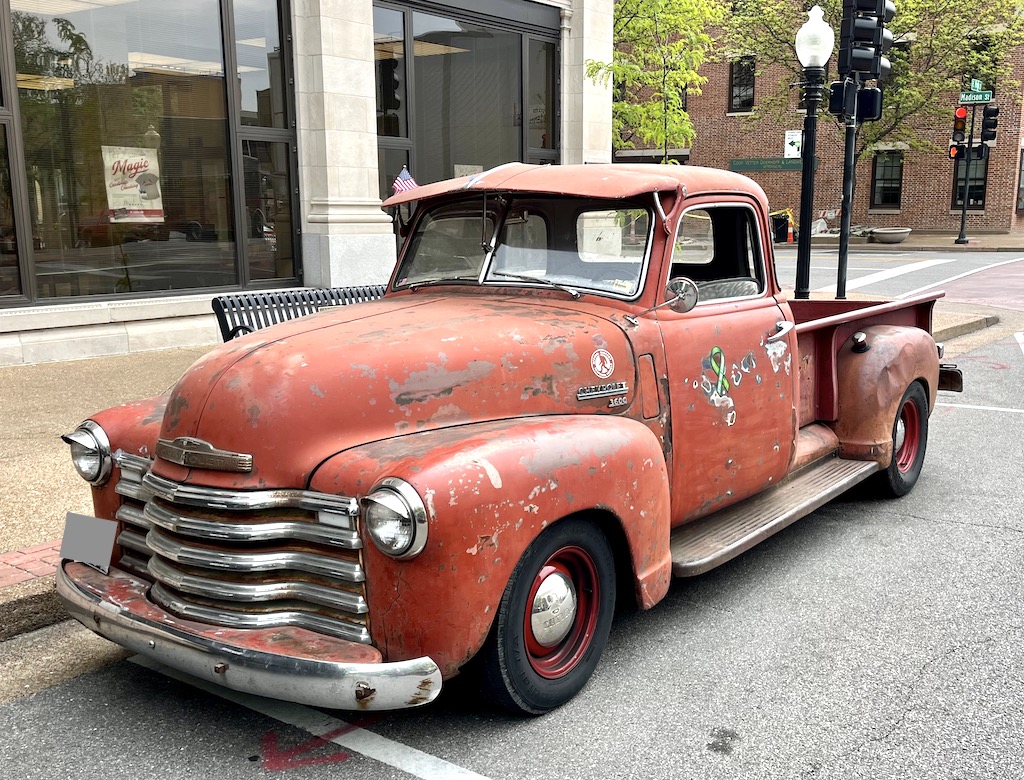
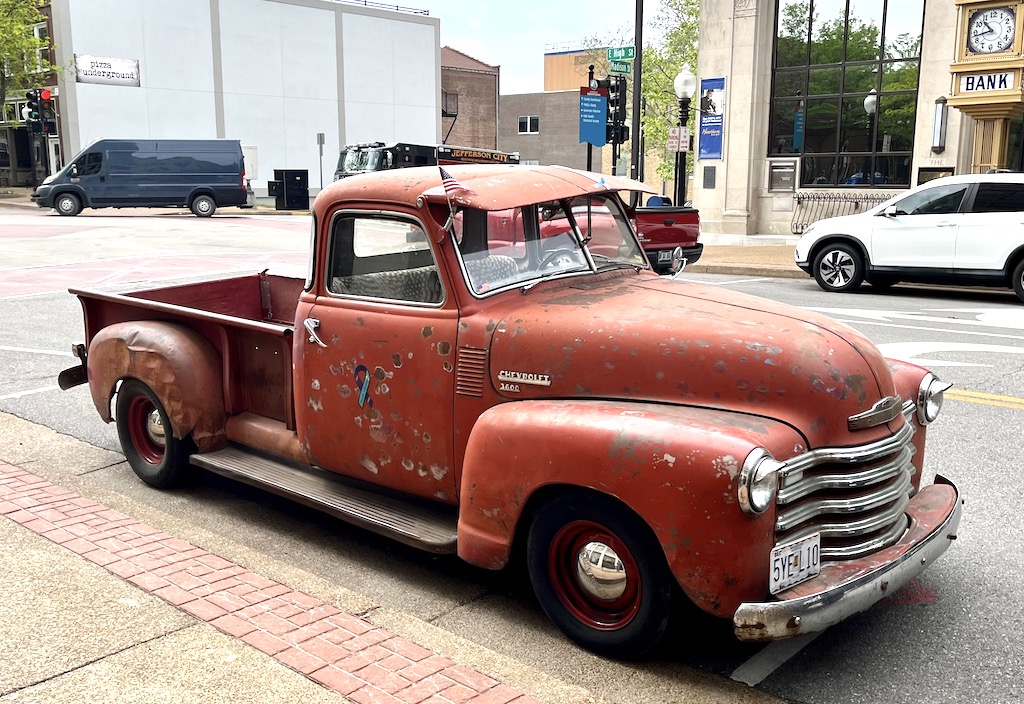
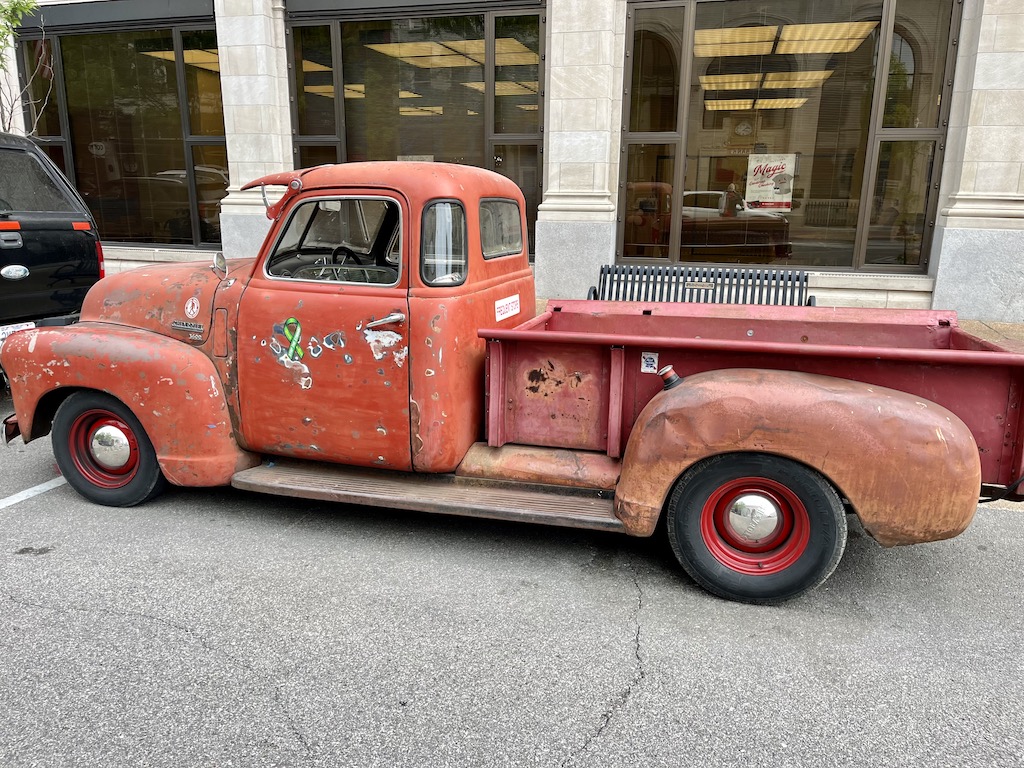
Chevrolet 3600 (Advanced Design)

“The Advance-Design is a light and medium duty truck series by Chevrolet, their first major redesign after WWII. Its GMC counterpart was the GMC New Design. It was billed as a larger, stronger, and sleeker design in comparison to the earlier AK Series. First available on Saturday, June 28, 1947, these trucks were sold with various minor changes over the years until March 25, 1955.” (Wikipedia)

The Art of Resurrection

“To know how a car works and how to repair it is to liberate oneself from an endless cycle of consumption.”

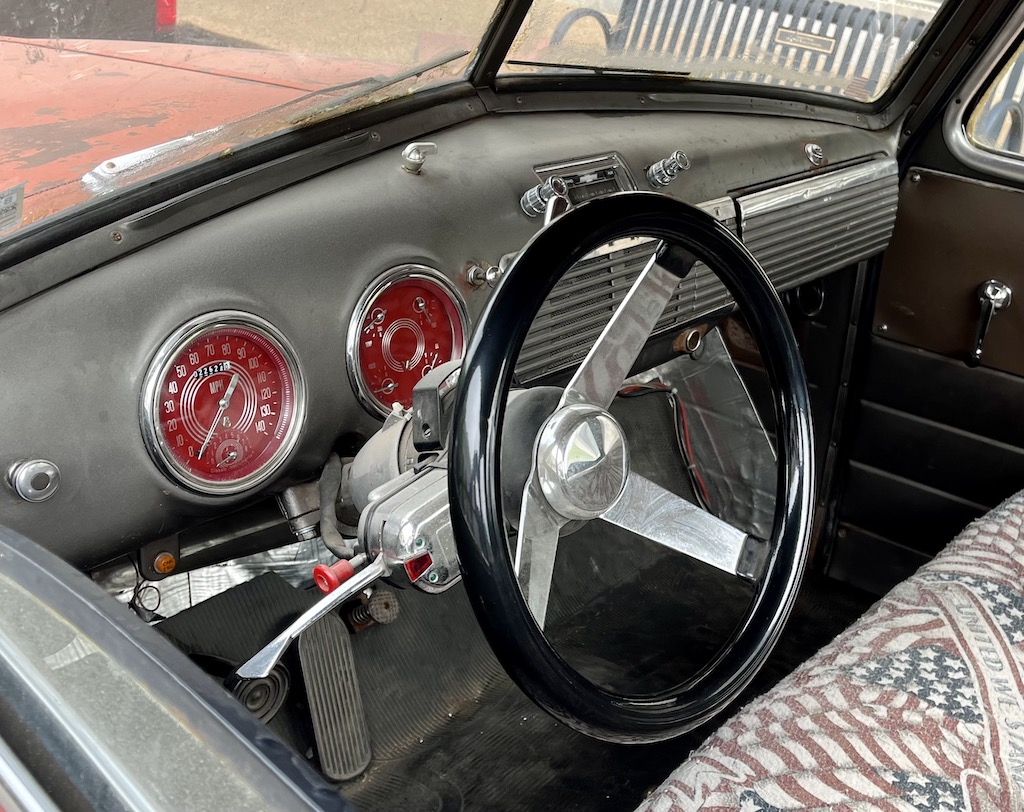
I know almost nothing about “how a car works and how to repair it” and it’s a little late in the game to hop off the “endless cycle of consumption,” but this article by Andrew Messick nicely sums up the appeal of my old vehicles. A few excerpts:

It was a good car, but it operated in a bland, even mundane, way. It performed every action I asked of it without complaint, without grumbling, without emotion, without any sort of personality. It was smart enough to tell me all of its ailments. A flashing exclamation point would show me a low tire. A phone notification would tell me my doors were unlocked. A gentle blue light would show it wasn’t quite warm enough to turn the heat on. But if I so much as put a wrench to the car, it would fall to pieces, and there would be nothing I could do to fix it due to its sheer complexity. 

This thing—this slow, lumbering piece of antiquity, this archaic hindrance to staying within the speed limit—has brought me more satisfaction than any flashy new car possibly could. There is an indescribable joy I experience when I pull the choke, press the starter button, and give a slight tap on the gas.

The new car, which was Disposable, was just a machine. Granted, it was a reliable, thoroughly trustworthy machine, but one lacking all soul, all sense of uniqueness. So mundane it blended into the parking lot, it had perfected the art of invisibility through being completely identical to everything around it.

But to own a car that requires only basic maintenance, something that one can do by themselves, to utilize that local corner mechanic, who may even be a staple of your community, to know your belongings beyond simply turning them on and using them, is to liberate oneself from the endless cycle of consumption.

It leaks when it rains. The “new car smell” passed from it decades ago. The factory optional heater—a drum of roughly coffee-can proportions with two small gates that either defogs your windshield or blows out a weak breath of lukewarm air onto your legs—achieves warmth that is only slightly better than freezing. Yet I would rather feel a waft of lukewarm air on my skin than pay a monthly subscription for seat heaters.