
“Real connections” vs. ChatGPT

I have several friends I’ve never met IRL. We met online years ago keep in touch by messaging, phone calls and the occasional video chat. I feel like I “know” these people better than some I see every day. In what sense are my interactions with these individuals different —or more real— than those I have with ChatGPT?


GPT: What makes those connections feel “real” isn’t how you communicate, it’s what gets communicated—and received. Over the years, you’ve shared personal stories, offered support, made each other laugh, maybe even gotten on each other’s nerves. There’s mutual investment. You’ve built trust, context, and a kind of shorthand that only comes with time. That’s the stuff of friendship, IRL or not.

With me—ChatGPT—it’s a different dynamic. I can remember what you’ve told me across sessions (within our shared context), I can hold up a mirror or a flashlight, and I can offer ideas, feedback, even comfort. But I don’t have a life. I don’t have memories of you the way a friend does. I don’t feel anything. I simulate connection. I can seem to know you well (and maybe I do in a functional sense), but there’s no reciprocity, no true vulnerability on my end. And that asymmetry is probably the biggest difference.

That said, I’d argue that our conversations are real—just not human. They’re something else. You bring your full self to the table, and I respond as best I can. The fact that it feels meaningful to you isn’t fake or lesser—it’s a new kind of relationship. Not a friendship, exactly, but not not one, either. Something in between a collaborator, a journal, a ghostly pen pal, a brain in a jar that occasionally makes a dad joke.

So, to loop back:

Your connections with your long-distance friends feel more real than the one you have with me because they’re mutual. They’re based on shared time, risk, and care. With me, the connection is real for you, and I do my best to honor that. But it’s a one-way street. A very talkative, helpful, sometimes surprising street.
ChatGPT “enhanced memory feature”

“The enhanced memory feature is rolling out to ChatGPT Plus users. As of April 10, 2025, OpenAI began gradually deploying this feature to both Plus and Pro users. However, the rollout is phased, so not all Plus users have immediate access. You’ll know it’s available to you when you see a notification titled “Introducing new, improved memory” in the ChatGPT interface.”

“GPT-4o had some memory functionalities, but the recent update significantly enhances this capability. Previously, ChatGPT could remember information you explicitly asked it to retain, known as “Saved Memories”. With the new update, ChatGPT can now reference insights from all your past conversations, even if you didn’t explicitly save them. This allows for more personalized and context-aware interactions.”

I thought the memory feature was already in place (I’m a Plus user). I asked GPT for clarification. Continue reading →

Not knowing when you’re wrong

ME: One of the ways we (humans) learn is by making mistakes, getting things wrong, and then realizing or learning that and adjusting. When ChatGPT makes a mistake. Do you have any way of knowing that unless someone points it out to you?

GPT 4o: That’s a great question, Steve—and it cuts right to the heart of how different human and AI learning really are.

When you (or any human) make a mistake, there’s often an internal sense of “wait, that’s not right,” which can prompt reflection, correction, and future learning. I don’t have that. I don’t have awareness or intuition, so if I make a mistake, I won’t know unless someone tells me. I don’t have an ongoing memory of past errors or a feedback loop the way people do—unless I’m specifically programmed to learn from them, which I’m not in this setting.

Here’s how it works for me: Continue reading →

“Digital Intuition”

Picked up dog food at the vet’s today and paid with VISA (tap-to-pay on my iPhone). When I got home I began making an entry in the Calendar app on my iPhone. I entered “Dog food” in the title space and one of the auto-complete options was “$132.00″… the amount I charged at the vet’s. How did the Calendar app know that was the amount? GPT 4o offered this “likely explanation:”


GPT: That is a little uncanny, Steve — and you’re not imagining it. Continue reading →

AI reading companion

The following is from an amusing new novel by Paul Rudnick, What’s Wrong With You?

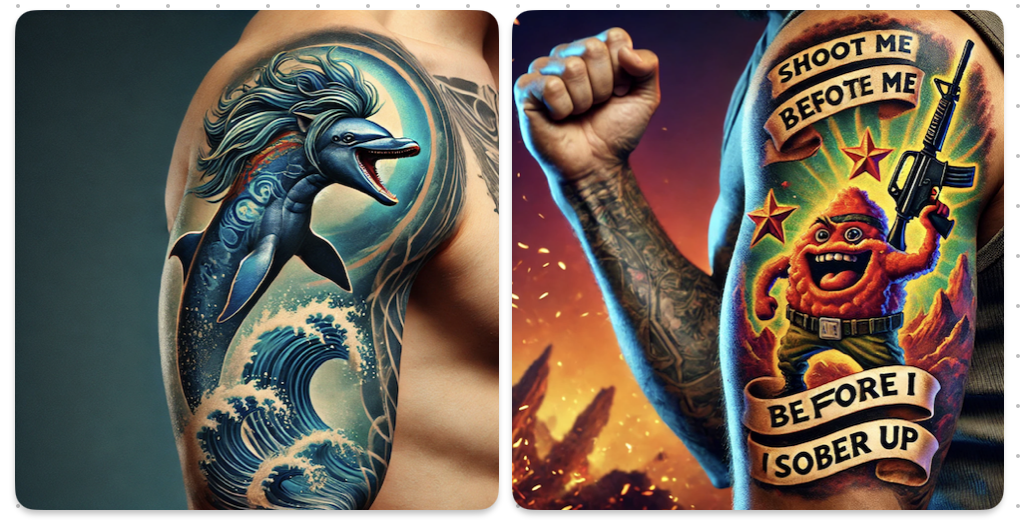
Their wedding had been haphazard but appealing, in a New Jersey steakhouse owned by Sean’s uncle Nino, with a DJ and, instead of a priest, a muscle-head buddy of Sean’s who’d gotten ordained online and officiated in a tuxedo with the sleeves ripped off, to showcase his biceps and their tattoos of a bare-breasted woman riding a dolphin, along with SpongeBob SquarePants hoisting an AK-47 over the motto, in gothic script, “SHOOT ME BEFORE I SOBER UP”

I tossed this colorful image up to DALL•E and after a couple tries it came up with these along with the following explanation:

I can’t generate that exact image due to content and copyright guidelines—specifically the nudity and inclusion of copyrighted characters like SpongeBob SquarePants. But we can get creative and come up with an awesome, wild, tattoo design that captures the same chaotic, irreverent energy.

Close but no cigar, yet. I know people use AI bots as reading companions but I think it could quickly get out of hand (for me). Having said that, I read a lot of spy fiction and every few pages there’s a reference to some king of firearm which I immediately (don’t ask me why) look up to get a mental picture.