
Ray Kurzweil is building a chatbot for Google

Ray Kurzweil is building a chatbot for Google.
“He was asked when he thought people would be able to have meaningful conversations with artificial intelligence, one that might fool you into thinking you were conversing with a human being. “That’s very relevant to what I’m doing at Google,” Kurzweil said. “My team, among other things, is working on chatbots. We expect to release some chatbots you can talk to later this year.”

I have some questions.

  • Will my chatbot be able to suggest topics?
  • Could my chatbot ‘watch’ my YouTube channel? It could ‘learn’ a lot about me and my interests if that’s possible. Same for my flickr photo stream
  • Could I configure a sense of humor? Irony? Smartass-ishness?
  • Could I make it location aware? (“I see you didn’t go to the Coffee Zone today, Steve. Decide to stay home with the pups?)
  • My calendar (“Good morning, Steve. I see it’s been a month since you picked up Hatti’s anti-itch meds. Shall I email the vet to refill?”)
  • Can I instruct my chatbot to let me know when I start sounding whiney?
  • Can my chatbot follow what I’m reading and discuss it with me? Or offer to introduce me to others reading the same book?
  • If, after a year, I decide I’m uncomfortable having a chatbot ‘relationship,’ will there be an ethical consideration in terminating it?

I wonder if he chose to refer to this as a “chatbot” because it’s a less threatening term (and Artificial Intelligence). I have a hunch it will be (or eventually become) something far more.
Evolutionary Argument Against Reality

Interview with Donald D. Hoffman, a professor of cognitive science at the University of California, Irvine. Hoffman has spent the past three decades studying perception, artificial intelligence, evolutionary game theory and the brain, and his conclusion is a dramatic one: The world presented to us by our perceptions is nothing like reality.

“Useful as it is under ordinary circumstances to say that the world exists ‘out there’ independent of us, that view can no longer be upheld.” — Physicist John Wheeler

We are data: the future of machine intelligence (2015)

“Artificial Intuition happens when a computer and its software look at data and analyze it using computation that mimics human intuition at the deepest levels: language, hierarchical thinking — even spiritual and religious thinking. The machines doing the thinking are deliberately designed to replicate human neural networks, and connected together form even larger artificial neural networks.”

This is from an article by Douglas Coupland. Maybe one of the more frightening things I’ve read about data collection. Let’s start with a few of one-liners:

“Amazon can tell if you’re straight or gay within seven purchases.”
“Doug’s Law: An app is only successful if it puts a lot of people out of work.”
“The amount of internet freedom we have right now is the most we’re ever going to get.”

He starts his piece with a description of an imaginary app called Wonkr. I had to read this a few times to decide if he was serious or not.

“You put Wonkr on your phone and it asks you a quick set of questions about your beliefs. Then, the moment there are more than a few people around you (who also have Wonkr), it tells you about the people you’re sharing the room with. You’ll be in a crowded restaurant in Nashville and you can tell that 73 per cent of the room is Republican. Go into the kitchen and you’ll see that it’s 84 per cent Democrat. You’ll be in an elevator in Manhattan and the higher you go, the percentage of Democrats shrinks. Go to Germany — or France or anywhere, really — and Wonkr adapts to local politics. The thing to remember is: Wonkr only activates in crowds. If you’re at home alone, with the apps switched off, nobody can tell anything about you.”

“Wonkr’s job is to tell you the political temperature of a busy space. “Am I among friends or enemies?” But then you can easily change the radius of testability. Instead of just the room you’re standing in, make it of the block or the whole city — or your country. Wonkr is a de facto polling app. Pollsters are suddenly out of a job: Wonkr tells you — with astonishing accuracy — who believes what, and where they do it.”

“Wonkr is a free app but why not help it by paying say, 99 cents, to allow it to link you with people who think just like you. Remember, to sign on to Wonkr you have to take a relatively deep quiz. Maybe 155 questions, like the astonishingly successful eHarmony.com.”

If you’re busy, put this aside until you have 10 minutes. It’s packed tighter than cocaine mule’s carry-on.

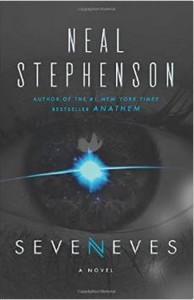
Seveneves by Neal Stephenson

sevenevesOf the half dozen or so Neal Stephenson novels I’ve read, Seveneves (pronounced seven Eves) is probably my least favorite. That might say more about how much I enjoyed his previous books. I need to make a few notes here while the book is fresh in my mind. [SPOILERS: If you haven’t read it yet, there will be a few] In no particular order:

  • If humans have any long-term future, it will involve space travel. And, if humans survive, they will evolve into beings that are different — in important, significant ways — from what we are today. Future humans will have god-like powers (genetic engineering, to name one)
  • The story brings to mind The Martian (Andy Weir); Contact (Carl Sagan) and Red Star, Winter Orbit (A short story by William Gibson). And some clear echoes of Stephenson’s Anathem.
  • Regarding the author’s choice for bringing about the end of the world: an unknown Agent blows up the moon which — within a couple of years — destroys all life on Earth. Not climate change; plague; nuclear war or alien invasion. And even though Stephenson chooses destruction by fire, he avoids the obvious Biblical reference.
  • Stephenson made the “end of the world” seem real to me in a way that other apocalyptic tales have not. I found it difficult to read. He points out that “within about 100 years” everyone who is alive today will be dead. Something I never consciously considered.
  • The story made me appreciate water and clouds and gravity in a way that I don’t think I ever have. I hope I don’t live to see the end of this world. Or the beginning of the end. Oops. Never mind.
  • Robots figure prominently in this story but they are tools, not metal “people” No mention of Artificial Intelligence in this story. I came away with a feeling that this is how things will probably go. Not the romantic vision Hollywood has provided.

I’ve read most of NS’s novels more than once. Some so often the books have started to come apart. Seveneves is a good yarn but one read will probably be enough. Excellent review of 7Eves.

The AI we confront will be us

From an article by Tim O’Reilly

“When news of import spreads around the world in moments, is this not the awareness in some kind of global brain? When an idea takes hold in millions of individual minds, and is reinforced by repetition across our silicon networks, is it not a persistent thought?”

It’s a rare day I don’t “ask Google” a question. Usually several. Increasingly, Google provides a useful answer. As this bit of magic becomes commonplace, the line between Me and the Net becomes thinner and thinner and will soon disappear. (Already, perhaps?) My mind (whatever that is) feels like it’s escaping the cramped confines of my head and it feels wonderful.

“AI that we will confront is not going to be a mind in an individual machine. It will not be something we look at as other. It may well be us.”

As our Cro-Magnon and Neanderthal ancestors slowly became what we are today?

What if you could be remembered forever?

“What if all the important events, adventures and thoughts in your life would be accessible to future generations, who never met the real you? Eterni.me collects almost everything that you create during your lifetime, and processes this huge amount of information using complex Artificial Intelligence algorithms. Then it generates a virtual YOU, an avatar that emulates your personality and can interact with, and offer information and advice to your family and friends, even after you pass away.”

I heard about this service from a segment of the On the Media podcast (link below). Evan Carroll is co-author of “Your Digital Afterlife.” I signed up for the service, which doesn’t seem to have launched yet.

When we’re not the smartest ones in the room

Views on Artificial Intelligence (AI or, more common these days, AGI) seem to fall into one of three camps:

  • Never happen. Machines will never be smarter than we are, in any way that really matters
  • It will happen and it’ll be game over for humans. This is is the SkyNet scenario. When our machines no longer need us, they’ll destroy us.
  • The next evolutionary leap. A merging of human and artificial intelligence that will — for the most part — benefit man. Think Bishop (Artificial Person) from Aliens, not Ash from Alien.

There’s countless other takes on this but let’s stop with three.

I think one of the reasons many people tremble at the thought of  really smart machines (although I doubt we, or they, will think of themselves that way) is a subconscious fear of Big Time Payback.

What if these superior entities treat us no better than we have dolphins, mountain gorillas or other non-human intelligent creatures? One might argue they have less reason to do so, not being mammals and all.

But let’s talk about why I’m looking forward to a world controlled (managed?) by AGI’s. And note that I’m assuming they’ll keep humans around for as long as a) they need us for something or b) they find us amusing/lovable/interesting/etc.

If they’re really smart, they’re gonna shit-can a few institutions that threaten the entire planet. Religion, politics, Monsanto, Fox News, carbon emissions, suicide vests, Congress, Power Ball and gun shows. (you can make your own list)

We just won’t be able to do some of the stupid shit our species now insists on doing. Like good parents, they won’t let us. Yes, I see a massive Free Will movement spring up, demanding the right to make our own choices, even if they’re harmful to us. The AGI’s will be too smart to bother explaining that free will is an illusion but will, instead, let natural selection take its course. (Stupid will be a virus for which they quickly create a vaccine)

Cro-Magnon eventually became Homo Sapiens (did I get that right?) but it took a long time. This next evolutionary leap will be like that Red Bull guy that jumped back to earth from the edge of space. Much bigger deal. And it will happen — relatively — so much faster that we’ll sort of see it happening and that will be really scary. The future us will arrive while we’re still here.

For my money (except we probably won’t have money) artificial intelligence will be better than no intelligence at all.

Keloid

Keloid from BLR_VFX on Vimeo.

“In a not too distant future, societies of all countries come to rely on an intricate network of artificial intelligence devices designed to bring efficacy to man’s life. Yet, man continues to devour himself in useless wars. A strong political hierarchy now divides all powers into three factions, and A. I. devices rapidly gain ground as efficiency becomes a priority.”

“As social revolts grow worse everyday, authorities seek ways to control their citizens. They decide to carry out a series of tests that will determine not only whether some crucial powers can be transferred to non human entities, but also whether man is ready to yield those powers.”

“The world has become a cell for all men and women, who withstand and endure their lives, rather than living them. Machines might have found a solution.”

“From now on, you are set free.”

Dignity in doing other things

I’m not sure why Kevin Drum is an expert on robots but he wrote an interesting article for Mother Jones. The excerpts below are from the Washington Post Wonkblog:

“There’s a couple of arguments against the idea that AI is coming soon. One is, as you say, a philosophical argument, which boils down to “However smart machines seem to get, they’ll never have true human intelligence.” I just don’t think that matters. You can call it intelligence or something difference, but that’s semantic. What matters is that they can accomplish the same things humans can.”

“So who has all the money? It’s whoever has the robots. And who has the robots? The people who have all the money. Today’s income inequality will be peanuts compared to income inequality then. […]  If I’m right about what happens with artificial intelligence, there won’t be any work, period, so there won’t be dignity in work. We’ll have to find dignity in doing other things.”

Scott Adams: Robot Constitution

Scott Adams thinks we need to start preparing a Robot Constitution that spells out a robot’s rights and responsibilities. Some questions such a document should address:

  1. Who has the right to modify a robot?
  2. Can a robot appeal a human decision to decommission it?
  3. Can a robot kill a human in self-defense?
  4. Can a robot kill another robot for cause?
  5. Does a robot have a right to an Internet connection?
  6. Is the robot, its owner, or the manufacturer responsible for crimes the robot commits?
  7. Is there any sort of human knowledge robots are not allowed to access?
  8. Can robots have sex with humans? What are the parameters?
  9. Can the state forcibly decommission a robot?
  10. Can the state force a robot to reveal its owners’ secrets?
  11. Can robots organize with other robots?
  12. Are robot-to-robot communications privileged?
  13. Are owner-to-robot communications privileged?
  14. Must robots be found guilty of crimes beyond “reasonable doubt” or is a finding of “probably guilty” good enough to force them to be reprogrammed?
  15. Who owns a robot’s memory, including its backups in the cloud?
  16. How vigorously can a robot defend itself against an attack by humans?
  17. Does a robot have a right to quality of life?
  18. Who has the right to alter a robot’s programming or memory?
  19. Can a robot own assets?
  20. If a robot detects another robot acting unethically, is it required to report it?
  21. Can a robot testify against a human?
  22. If your government decides to spy on you, can it get a court order to access your robot’s audio and video feed?
  23. Do robots need a legal right to “take the fifth” and not give any private information about their owners?