The following account is from Tom, Son of Ben – Life and Times of Ben Cash, by Tom Cash and used here with his permission. According to Mr. Cash, these descriptions were from eye witnesses, the Daily Dunklin Democrat, Glen Brogden and John Steward.
“My father was sales manager for Ben F. Jones Chevrolet dealership directly across the street from the county jail. “Ringworm” Barton, the wrecker driver, was a buddy who took me up on the roof of the garage to watch. We climbed up a ladder at the back. On reaching the front I found many others already up there plus the street was packed with people.The tension increased as 8:00 a.m. approached. Kennett Street was lined from Julius Kahn’s Department Store to Second Street. Glen Brogden was just fifteen at the time. He said, “I didn’t leave the store but watched as all the stores, shops and roof tops on the south side of the square filled with the curious. Many of the owners were fearful their roofs would collapse. It was impossible for them to see a full block away but no matter, they could always say they were “there.”
From my vantage point it was only possible to see the top of the scaffold over the newly erected 10 foot board fence. When they brought out Adams we could only see the top of his head. I watched as a hood and rope were placed over his head and seconds later he disappeared.
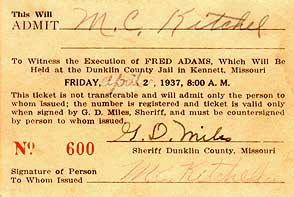 Mr. Dewey Miles, the sheriff, was a friend of my father, so Dad had one of the inside tickets. An even those and were passed out to friends of Mr. Miles. Dad told me he had visited Adams in jail but I am unaware if he signed the petition to stop the hanging.
Shortly after the trap door was sprung the sheriff appeared at the front door. His deputies parted the crowd as he ran to his car, parked and running in the street. He quickly entered it without saying a word and disappeared in a cloud of dust. Friends say it was the hardest job he ever had but went with the job as sheriff.
Along with the description above, Tom Cash included a photocopy of the following newspaper article. There is no indication in which newspaper the article appeared. The first paragraph appears to be an account of the crime for which Adams was executed. The remainder, an account of the hanging. Given that the photograph of Fred Adams (above) appeared in the St. Louis Star-Times, my best guess is that is the source of this story as well.
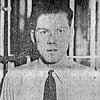 “Fred Adams, 22-year-old Rector, Ark., youth who was hanged at 8:05 a.m. Friday on a scaffold constructed at the north side of the jail, for the murder of Night Marshall Clarence Green at Campbell on the night of March 28, 1934. Adams had been given four reprieves prior to his execution which was originally set for December 18, 1936. This picture was made at the jail in Kennett about six weeks ago.” [Picture and caption from the St. Louis Star-Times]
When the trio was interrupted by Night Marshal Green, Marshal Rodney Brown and Constable Harry Weeks, they left, running through a wooded grove at the rear of the station. Green and Brown gave chase and as they closed in Adams fired first and Vinyard followed with a volley of shots from his shotgun.
Smoking a cigarette and with a faint smile on his lips, Fred Adams walked onto the scaffold shortly after 8 a.m. this morning, and with any public statement of any kind was hanged by Sheriff G. D. Miles, who sprung the trap.
Shortly before 8 a.m., the large enclosure at the north and west of the jail was filled, approximately 1,000 persons who had been issued official passes gathering to be present at the execution of the man who had been convicted of the killing of Night Marshall Green at Campbell on March 28, 1934.
There was a crowd of more than 1,000 persons on the outside of the enclosure, anxiously waiting to hear the last words of the condemned man, a report being current Thursday night that he intended making an extended address.
Accompanied by Sheriff Miles, Deputy Sheriffs Abner Schultz, Harry Hester, Tom Grooms and Albert Lane, Adams walked out of the jail on the north side of the building and unassisted walked up the steps leading to the scaffold.
Adams was neatly dressed with a white shirt and a colored spring tie, and wore a faded blue jacket. He was freshly shaven and his blond hair was combed straight back.
Immediately upon mounting the scaffold, Adams nodded and waved his shackled hands to certain persons in the crowd. Shortly thereafter Sheriff Miles opened a window on the north east side of the enclosed scaffold where Adams had a full view of the crowd which had assembled on the outside.
Sheriff Miles appeared first at the window, with Adams to his right rear, and when the sheriff saw that someone in the crowd was about to take a picture, he requested that the picture not be taken. Sensing that the picture had been taken, he then asked that the film not be developed.
Adams smiled at the crowd, and waved both his hands to the crowd, much in the manner that a wrestler or boxer waves greetings to a crowd, and without saying a word turned around and Sheriff Miles closed the window.
Immediately thereafter Miles shook hands with Adams and the business of placing the hood over the head and the strapping of his hands and his arms to his body begun and was completed in a mater of a few seconds.
As Adams stood in the center of the trap door, the trap was sprung by Sheriff Miles.
Twelve minutes later Coroner G. I. Gilmore and Doctors J. C. Cofer and J. C. Keim, declared the man dead.
Even before the trap was sprung, the crowd on the inside of the enclosure began drifting out, one by one, and as soon as the man had dropped, there was a rush for the large gate at the rear of the jail, the only entrance or exit to the large enclosure.
It was noted there were at least six women in the crowd who witnessed the hanging, and at least two small children in the arms of their fathers.
Just as soon as the man was pronounced dead, the rope was cut and attendants of the Lentz Funeral Home took charge of the body which was removed to the funeral home on St. Francis Street, where it was being embalmed at the time this paper goes to press. No funeral arrangements were announced, and an attendant at the mortuary stated that Sheriff Miles had given instructions for the body to be embalmed, and that he would give instructions for his disposal later.”
